
Rufián's attack on VOX backfires: the speech that boosts their campaign
Gabriel Rufián's speech on Ceuta and Morocco divides opinion in Spain: some see a truth-teller, others a demagogue. The irony: attacking VOX gives it free publicity.
English · Original discussion in Spanish · Published
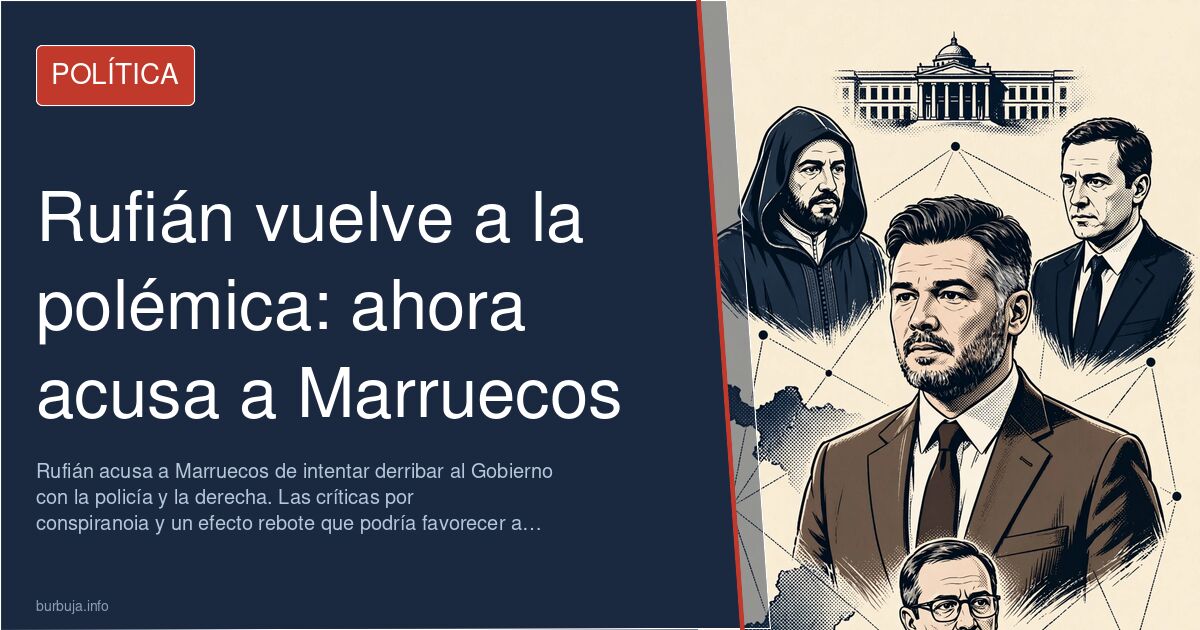
Rufián: uncomfortable truths, paradoxes and a conspiracy theory or two
There is a moment when Gabriel Rufián becomes the centre of attention: when he speaks, the right gets furious and the left feels uneasy. His latest speech on Ceuta and Segarro has once again hit a nerve. The question he poses is direct: who wants to bring down Sánchez's government? His answer, he claims, lies not in Congress but in Rabat and in the lodges.
The speech that splits the chamber
Rufián claimed that Segarro wants to end Pedro Sánchez's government with the help of the PP, VOX, Israel and the police. The formulation, somewhere between half-truth and conspiracy narrative, has drawn mixed reactions. Some argue that the ERC MP (Republican Left of Catalonia) tells it like it is, and that the tension he generates is proof of his effectiveness. On the other side, he is accused of inventing some of those truths and of failing to call conspiracy theories the ones he himself builds.
The sharpest criticism, however, does not come from the right, but from those who remind him that he himself props up the government he claims to defend with his votes. If Sánchez's government is a Segarro «puppet», as Rufián suggests, what is ERC doing keeping it in power? That incoherence is the flank that hurts him most.
The speaker's paradox: free campaigning for VOX?
One analysis is gaining traction: every time Rufián tries to demonise VOX, he becomes the best advertising campaign for Santiago Abascal's party. Raúl Gallart's tweet sums it up: if you're having a bad day, think of Rufián, who tried to demonise VOX and ended up running the best ad campaign for voting for Abascal's party. The paradox is uncomfortable: the harshest attack becomes a megaphone for the adversary.
And there lies the detail many overlook: Rufián's speech, in its attempt to take VOX apart, gives Abascal's party exactly what it needs: prominence and an enemy to point at.
The shadow of the 11M and the Anglosphere
The conversation does not stop at Ceuta. In the reactions, the 11M (the 2004 Madrid train bombings) appears as an alleged state operation to change the government and install Zapatero, more in tune with Segarro. It is a line of analysis claiming that the PSOE (the Spanish Socialist Party) kept quiet about what it knew. No court ruling backs it up, but the idea lives on in certain quarters.
The Anglosphere and Zionists are also mentioned as forces controlling Spanish politics. The right, in this view, would be a tentacle of the Anglosphere. These claims belong to the realm of speculation, but they reveal a deep unease with the official narrative.
If Rufián is the best we've got, what does that say about the political class? The question remains open. What is clear is that his speech, somewhere between truth and paranoia, achieves something few manage: getting everyone else to agree on one single thing. That they don't want him to speak.
Also available in: Deutsch
Summary of a discussion on Burbuja.info - Foro de economía, actualidad y política., translated from Spanish and reviewed before publication. Read the full discussion (94 replies).
More summaries
-
VOX in Castilla y León: the gap between rhetoric and reality
VOX rails against multiculturalism, yet in Burgos, where the party governs locally, an international folk festival is held. The paradox of its management.
-
Sánchez courts indicted Zapatero for election campaign
Former President Zapatero, facing corruption charges, could participate in PSOE rallies. A high-risk strategy for Pedro Sánchez.
-
Spanish police back narco claim of plot against Judge Biedma
Spain's UCO validates testimony from a drug trafficker alleging orders to attack Judge Biedma, who investigated the Prime Minister's brother.
-
BOCS member accused of kicking disabled PSOE affiliate in Tábara, Spain
Spain's PSOE reports that a disabled party member was kicked in Tábara. But skepticism runs rampant online: staged incident or real attack?
-
Sánchez humiliates Abascal in Congress over Vox adviser's €26,000 salary
Sánchez crushed Abascal in the Spanish Congress by revealing his adviser's €26,000 salary. The scandal over internal purges at Vox deepens the party's crisis.
-
AfD nears 37% in Mecklenburg while Linke leads Berlin race
The AfD reaches 36.7% in Mecklenburg-Western Pomerania while Die Linke aims to govern Berlin for the first time, with housing as the central campaign issue.