
AfD nears 37% in Mecklenburg while Linke leads Berlin race
The AfD reaches 36.7% in Mecklenburg-Western Pomerania while Die Linke aims to govern Berlin for the first time, with housing as the central campaign issue.
English · Original discussion in Spanish · Published
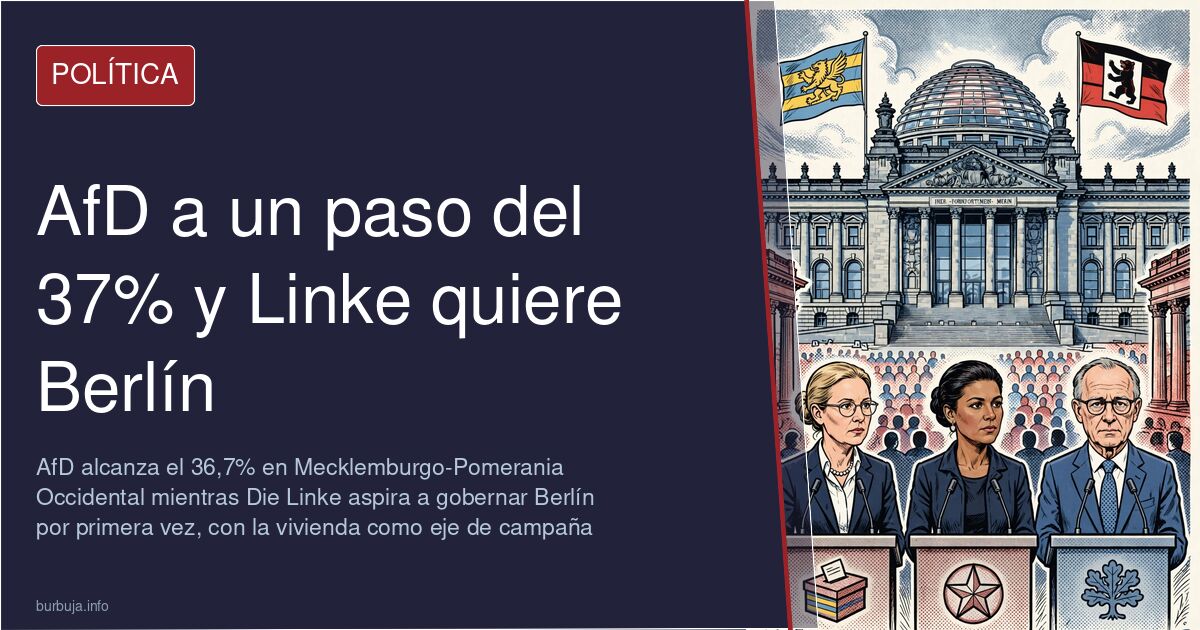
AfD nears 37% in Mecklenburg and Linke dreams of Berlin
Mecklenburg-Western Pomerania votes this Sunday with a forecast that breaks the script: the AfD leads with 36.7%, almost three points ahead of Manuela Schwesig's SPD (34.1%). And yet the Social Democrats have pulled off the comeback of the year, cutting a 19-point deficit in twelve months. In Berlin the picture is even stranger: Die Linke is aiming to win for the first time with 21.3%, trinc by the CDU (20.0%), the AfD (18.0%), the Greens (15.5%) and an SPD sunk at 12.0%.
Mecklenburg: Merz's CDU fights to avoid disappearing
The figure that gets the fewest headlines is the CDU's: 6.5%, leaving it on the brink of parliamentary representation. The reading is uncomfortable for Friedrich Merz, because the party that aspires to shape federal politics risks being shut out of a state parliament right at the start of the cycle. The Greens, at 5.2%, are fighting a similar battle, while Die Linke sits at 9.9%, confirming its low floor in the east.
The result paints a two-way duel decided by the narrowest of margins. The SPD's comeback is real, but not enough to offset the AfD's momentum. Little more than two points separate the top two, and in that range any mobilization failure can decide the election.
Why housing will decide the Berlin election
In the capital the campaign revolves around renting. Housing dominates the debate and only three-party coalitions seem able to add up to a majority. We are facing the most open contest in Berlin's electoral history: Die Linke is touching victory with its fingertips, the CDU holds on one point behind, and the AfD consolidates itself as the third force with 18.0%.
The paradox is that the left is soaring electorally in the same year the Social Democrats are bleeding out in their own stronghold. If the forecast holds, Berlin would have a government led by Die Linke for the first time. On paper, the pieces fit. In practice, the question is who pays the bill for such a coalition.
And one doubt remains that the result itself will leave open: if the CDU falls below the threshold in Mecklenburg, what is left of Merz's story for the rest of Germany?
Also available in: Deutsch
Summary of a discussion on Burbuja.info - Foro de economía, actualidad y política., translated from Spanish and reviewed before publication. Read the full discussion (44 replies).
More summaries
-
Spain’s November 29 election: ballots ready, budgets frozen
The Spanish government has issued tenders for election materials despite no scheduled vote, while Puigdemont challenges Sánchez to call early elections amid frozen budgets.
-
Satire Claims Ayuso Hears 7,291 Ghost Voices, Seeks Iker Jiménez
A satirical story attributes 7,291 paranormal voices and six years of insomnia to Madrid's Isabel Díaz Ayuso, leading her to consult TV presenter Iker Jiménez.
-
Spain's PSOE cornered by the 'plumber' corruption scandal
The case file of Spain's 'plumber' scandal has been declassified: attempts to discredit the investigating officer, meetings with the plumber, and a €250,000 offer to change testimony.
-
France: protests, police violence and calls for Macron to be held accountable
Young people, teachers and workers are protesting across France for their rights, amid reports of police violence and growing demands for Macron to be held accountable.
-
VOX spreads tax pledge of 0% income tax up to €22,000 in Spain
VOX has released a calculator promising 0% income tax up to €22,000, 15% up to €70,000 and 25% above that, plus a VAT cut to 18%. The PSOE has not offered a similar tool.
-
What if all of Spain voted like voters aged 65 to 74?
Spain's CIS polling institute simulates that if only over-65s voted, the PSOE would win 220 seats. The debate erupts on Burbuja.info: reality or propaganda?