
Rubiales' Cousins Demand Truth from Jenni Hermoso
Rubiales' mother continues hunger strike in Motril as two cousins urge Jenni Hermoso to 'tell the truth'
English · Original discussion in Spanish · Published
Rubiales' Cousins Demand Truth from Jenni Hermoso
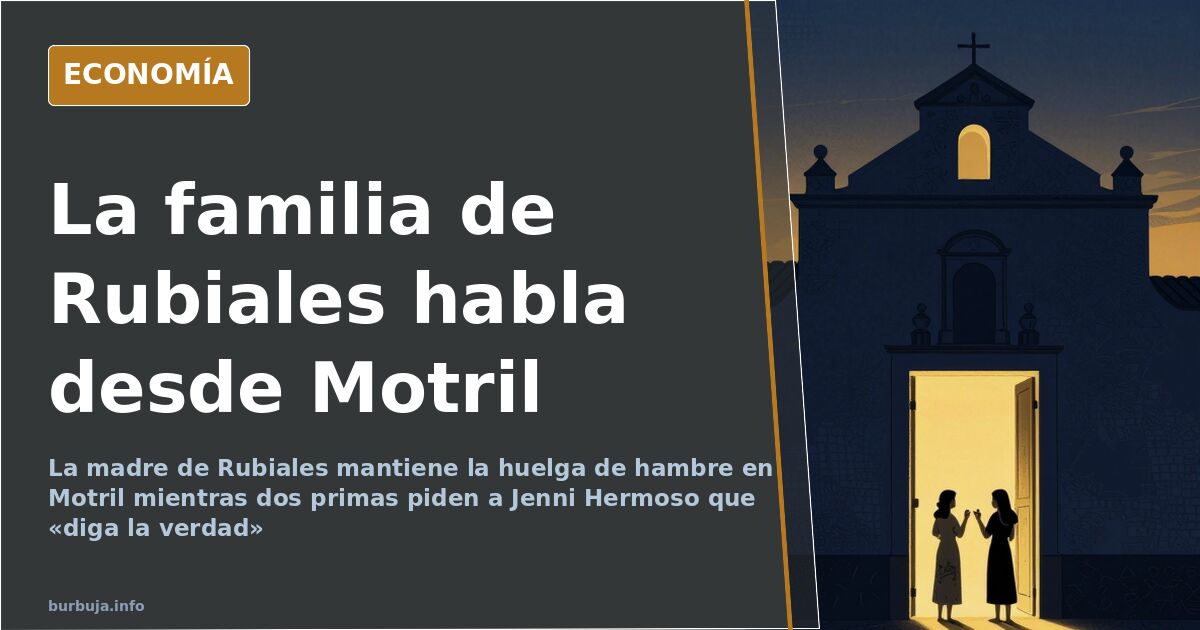
The door of the Divina Pastora church in Motril is no longer a quiet corner. Inside, Ángeles Béjar, Luis Rubiales' mother, maintains a hunger strike. Outside, two of his nieces repeat a slogan to any camera: "Jenni, we want you to tell the truth." The trigger remains the kiss given by the president of the Royal Spanish Football Federation (RFEF) to player Jennifer Hermoso during the Women's World Cup trophy presentation, a gesture she describes as non-consensual and after which she claims to have felt vulnerable. Rubiales is temporarily suspended.
What Rubiales' Family Demands and Why They Spoke Out
Vanesa Ruiz Béjar and Demelza Meijas Sánchez have broken the family's silence. The former insists that the executive's mother, "a very religious person," has taken refuge in God and will not leave the temple: the hunger strike will continue, they say, until the footballer gives her definitive version. The specific request is one: that the player explain, according to their account, "why she has changed her statement three times."
The underlying argument is not legal, but emotional. The family assures they are "suffering immensely" and that Rubiales was judged prematurely. Vanesa Ruiz Béjar summarizes it with a phrase that portraits the whole affair: "Anyone who spends five minutes with Luis knows he is a beautiful person, with a very good heart and noble." The other cousin adds that everyone is human and that "in a moment of joy and euphoria, this can happen to you."
The 'Media Lynching' Denounced by the Circle
The most repeated word in these statements is lynching. The circle speaks of a hunt, saying the suspended president "wants to be destroyed in every way," and argues there are accumulated years of attacks. One of the cousins places responsibility on what she describes as feminism, television, press, and politicians, calling the treatment of the episode as an assault shameful.
There is also explicit defense of staying in office: stepping down, they argue, would give the other side reason. Rubiales, they add, is isolated with his daughters because he needs "mental rest." A precision raised by a debate participant: the cousins defend the mother, not the executive. As the conversation pogre, this nuance gains weight against the initial reading that the whole family spoke for him.
Is There a Crime in the Kiss the Player Did Not Consent To?
Here the ground becomes slippery. One line of analysis holds that bad manners and improper behavior are not defined in the penal code, that humiliation is not a crime per se, and that so-called workplace abuse of authority is a colloquial expression: the incivil type of abuse of authority is reserved for public officials. If there is consent, they conclude, there can be no harassment.
The objection comes from the other flank: consent is not a starting point, it is exactly what must be determined. No repertoire of third-party comments, nor those of teammates, substitutes for that investigation. The exchange closes without agreement and with a phrase summarizing the distance between positions: knowing how to behave is not a legal criterion, but neither does the penal code exhaust what an institution can demand of its president.
Women Defending Rubiales: The Paradox of Whom to Believe
The case was presented as a matter of credibility and ended in a clash between incompatible female versions. The player speaks of assault. Her mother and cousins speak of a kiss of euphoria. If the criterion is to believe women, the immediate question is which one. Some translate the scene with irony, while others point out something less funny: women in the executive's circle cease to have their own opinion just when their testimony hinders, turning from subject to instrument.
Hovering over everything, a suspicion raised by a participant: it is not about defending Rubiales because he is liked, but looking at what comes next. Those celebrating retribution today may be the next targets.
Professionalism, Nearly €700,000, and 'Knowing How to Behave'
A position attributed nearly €700,000 a year—the figure assigned to the role in the analysis—does it have to demonstrate anything more than results? The salary as an argument appears and is countered: if remuneration is linked to professionalism, it should also be linked to knowing how to behave. The rebuttal is categorical: what some or others comment matters little; what matters are the facts.
The facts, as of this discussion, are these: a hunger strike, a temporary suspension, and a player maintaining her version. Nothing else. And a figure that disorients by its absence in the family narrative: statements from the church door do not mention the nearly €700,000 annual salary attributed to the position even once. There is only a mother who does not eat, a niece repeating three words, and a door that does not close.
The door of the Divina Pastora church in Motril is no longer a quiet corner. Inside, Ángeles Béjar, Luis Rubiales' mother, maintains a hunger strike. Outside, two of his nieces repeat a slogan to any camera: "Jenni, we want you to tell the truth." The trigger remains the kiss given by the president of the Royal Spanish Football Federation (RFEF) to player Jennifer Hermoso during the Women's World Cup trophy presentation, a gesture she describes as non-consensual and after which she claims to have felt vulnerable. Rubiales is temporarily suspended.
What Rubiales' Family Demands and Why They Spoke Out
Vanesa Ruiz Béjar and Demelza Meijas Sánchez have broken the family's silence. The former insists that the executive's mother, "a very religious person," has taken refuge in God and will not leave the temple: the hunger strike will continue, they say, until the footballer gives her definitive version. The specific request is one: that the player explain, according to their account, "why she has changed her statement three times."
The underlying argument is not legal, but emotional. The family assures they are "suffering immensely" and that Rubiales was judged prematurely. Vanesa Ruiz Béjar summarizes it with a phrase that portraits the whole affair: "Anyone who spends five minutes with Luis knows he is a beautiful person, with a very good heart and noble." The other cousin adds that everyone is human and that "in a moment of joy and euphoria, this can happen to you."
The 'Media Lynching' Denounced by the Circle
The most repeated word in these statements is lynching. The circle speaks of a hunt, saying the suspended president "wants to be destroyed in every way," and argues there are accumulated years of attacks. One of the cousins places responsibility on what she describes as feminism, television, press, and politicians, calling the treatment of the episode as an assault shameful.
There is also explicit defense of staying in office: stepping down, they argue, would give the other side reason. Rubiales, they add, is isolated with his daughters because he needs "mental rest." A precision raised by a debate participant: the cousins defend the mother, not the executive. As the conversation pogre, this nuance gains weight against the initial reading that the whole family spoke for him.
Is There a Crime in the Kiss the Player Did Not Consent To?
Here the ground becomes slippery. One line of analysis holds that bad manners and improper behavior are not defined in the penal code, that humiliation is not a crime per se, and that so-called workplace abuse of authority is a colloquial expression: the incivil type of abuse of authority is reserved for public officials. If there is consent, they conclude, there can be no harassment.
The objection comes from the other flank: consent is not a starting point, it is exactly what must be determined. No repertoire of third-party comments, nor those of teammates, substitutes for that investigation. The exchange closes without agreement and with a phrase summarizing the distance between positions: knowing how to behave is not a legal criterion, but neither does the penal code exhaust what an institution can demand of its president.
Women Defending Rubiales: The Paradox of Whom to Believe
The case was presented as a matter of credibility and ended in a clash between incompatible female versions. The player speaks of assault. Her mother and cousins speak of a kiss of euphoria. If the criterion is to believe women, the immediate question is which one. Some translate the scene with irony, while others point out something less funny: women in the executive's circle cease to have their own opinion just when their testimony hinders, turning from subject to instrument.
Hovering over everything, a suspicion raised by a participant: it is not about defending Rubiales because he is liked, but looking at what comes next. Those celebrating retribution today may be the next targets.
Professionalism, Nearly €700,000, and 'Knowing How to Behave'
A position attributed nearly €700,000 a year—the figure assigned to the role in the analysis—does it have to demonstrate anything more than results? The salary as an argument appears and is countered: if remuneration is linked to professionalism, it should also be linked to knowing how to behave. The rebuttal is categorical: what some or others comment matters little; what matters are the facts.
The facts, as of this discussion, are these: a hunger strike, a temporary suspension, and a player maintaining her version. Nothing else. And a figure that disorients by its absence in the family narrative: statements from the church door do not mention the nearly €700,000 annual salary attributed to the position even once. There is only a mother who does not eat, a niece repeating three words, and a door that does not close.
Also available in: Deutsch
Summary of a discussion on Burbuja.info - Foro de economía, actualidad y política., translated from Spanish and reviewed before publication. Read the full discussion (126 replies).
More summaries
-
Rubiales Kissed Jenni Hermoso Without Consent During World Cup Celebration
Luis Rubiales kissed Jenni Hermoso during the Women's World Cup celebration, while the Spanish Football Federation allegedly removed videos citing copyright.
-
Futpro, Jenni Hermoso’s agency, received 625.000€, according to an estimate
Futpro reportedly received some 625.000€ in public funds; 120.000 with only 61 founding members: nearly 2.000€ each
-
Debate over Spain women's team and their physiques
Analysis of the controversy surrounding Spain's women's football team, its budget growth and the debate over players' physical levels.
-
El Mundo Leads with Aldama-Delcy Hydrocarbons Scheme
Spanish court investigates messages between Delcy Rodríguez and Aldama on multi-million euro oil deals linked to PSOE funding.
-
EU to send inspectors to Spain over 2,389 million diverted to pensions
Spain's Court of Auditors has uncovered 2,389 million in EU funds diverted to pensions. Europe will send a mission in October, but many see it as mere theatre.
-
Diphtheria in Italy: another unvaccinated girl dies among four siblings
An unvaccinated girl has died of diphtheria in Palermo, Italy, and prosecutors are investigating her parents. All four children in the family were unvaccinated. It echoes the 2015 Olot case in Spain.