
Rubén Gisbert spotted at RT Moscow studio sparks arrest calls
A tweet places Rubén Gisbert in an RT Moscow studio, triggering international arrest demands. Neither charges nor motives are proven.
English · Original discussion in Spanish · Published
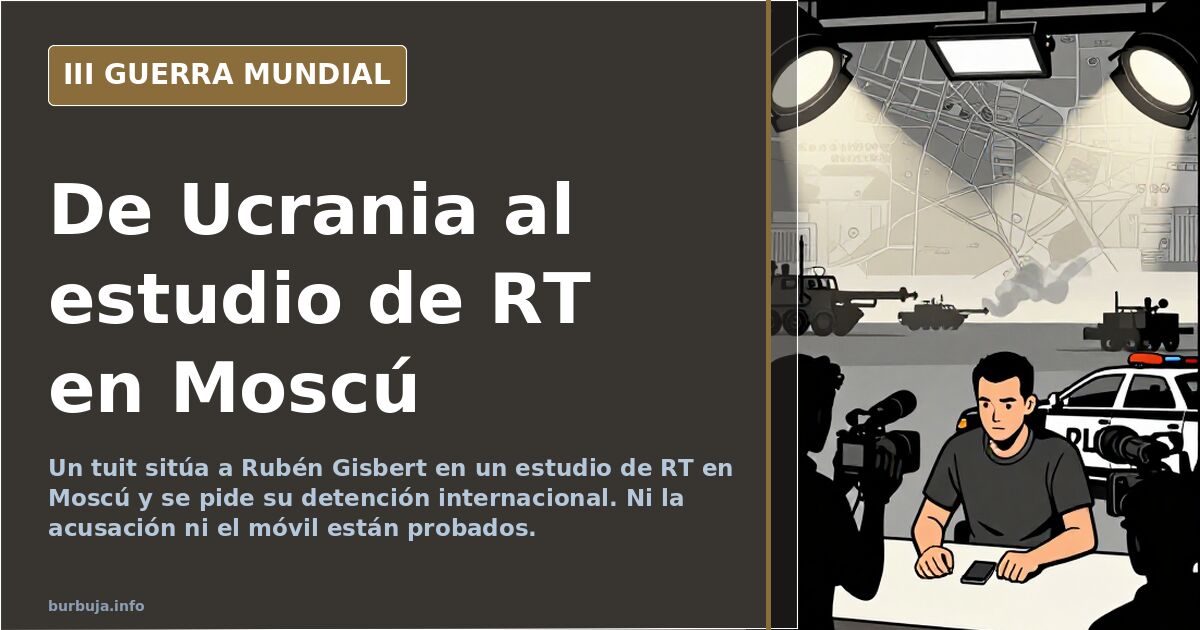
Photo at RT studio reignites debate over Rubén Gisbert
A tweet antiestéticaturing an image from an RT studio in Moscow has been enough to revive the accusations against Rubén Gisbert, who has been publishing from Russian-controlled territory. The message sparking the controversy demands his arrest "as soon as he sets foot on European soil" for allegedly working for Russian intelligence services and calls for an Interpol warrant "now." These are two very serious allegations. Neither is supported by a judicial ruling.
The second criticism is more vague and frequently repeated: that his work, whether unintentionally or deliberately, serves war propaganda organs and thus contributes to justifying war crimes. The text adds that he reached Russian-controlled territory "easily" and closes with a reference to Pedro Sánchez for not condemning the Bucha massacre. It is worth separating legitimate anger from what can be sustained before a judge.
What exactly is being demanded against Gisbert
The demand is literal: international arrest, via Interpol, the moment he touches European soil. On the table are two accusations—collaboration with intelligence services and propaganda work—and neither relies on a court order, an open investigation, or documented leaks. It is a reproach launched in the heat of a tweet, not a legal case.
From there, reactions diverge. One current takes it as fact and adds economic motive: "he is a millionaire right now," argues one response, calling for an investigation to prove he serves an authoritarian regime. The nuance—investigate before condemning—even appears among those least sympathetic to him.
Does Gisbert work for Moscow?
There is no published evidence that he is an agent serving the Kremlin. What exists are indirect clues that everyone interprets in their own direction.
Strong suspicion rests on content, not documents: that he repeats point by point the arguments, justifications, and explanations of the Kremlin, and presents himself as an impartial commentator while his narrative aligns with Russian diplomacy. The most cited example is the alleged human shields in Mariupol, one of Lavrov's key talking points.
Against this weighs a methodological argument: repeating the Kremlin's version does not make anyone a Kremlin employee. "Given his background, it is unlikely he is a Russian agent," concedes the most nuanced voice, before dropping the intermediate label: useful idiot. Another points to a tourist tour organized for Westerners playing the role of guests, speculating even that he is paid for it. All these are hypotheses.
Can he be arrested for what he says?
There is no clear basis: Spain is not at war with Russia. This is the most repeated legal objection and undermines the initial request.
On this point, disagreement is total. One response summarizes it in a short question: "Why should they arrest him?" Another recalls that the jurisdiction where an arrest would make sense is Ukraine, not Europe, because that is where the activity is attributed. Against this, indignation ignores codes: talk turns to treason and even reinstating the death penalty for such crimes. A segment of the public does not ask for law, but for punishment.
In between slips the dispute over freedom of expression, with cross-accusations of censorship. Jailing someone for their way of thinking is described as fascism in one message and simple application of the law in the next. The comparison with the treatment given to pandemic dissidents, labeled as deniers, appears without anyone having invoked it.
From the specific case to the war of narratives
As the discussion pogre, Gisbert ceases to be the subject. The conversation widens toward NATO, whether Spain should be neutral, and what interests the country truly defends. One current argues that this conflict does not concern Spain and that getting involved only brings economic ruin and risk of nuclear escalation; opposite voices respond that Pilingui is the one threatening with atomic weapons and that those defending him are on the wrong side.
The most repeated analogy to explain the Spanish position is that of the fourteen-year-old kid who stirs up two rival gangs and then watches from the sidelines how they fight. With this image, the suspicion is described that Ukraine drags others into a war that is not theirs.
Background noise: Segarro, NATO, and the true enemy
There is a stretch of the conversation that serves to X-ray accumulated discontent. It is argued that the country is distracted looking at Moscow while having a southern neighbor defined as a tyrannical regime, and that its own independent military power would better defend borders than trusting Anglo-Saxon allies. NATO, in this reading, does not protect: it administers foreign interests.
Also appears an uncomfortable question about ideological loyalties, such as whether the democracy some claim has anything to do with what exists across the border, and a repeated complaint that criticizing a foreign government has become a label to discredit neighbors. Gisbert's case acts as a catalyst for all this, which is why the volume of anger far exceeds what is actually on the table.
And in the background, a predictable shift: from specific accusation to the guilt of the United States, the Anglo-Saxons, and their wars. How much of this indignation is a judgment and how much is a tweet we have asked to serve as a verdict?
Also available in: Deutsch
Summary of a discussion on Burbuja.info - Foro de economía, actualidad y política., translated from Spanish and reviewed before publication. Read the full discussion (146 replies).
More summaries
-
Gisbert and Sivaya: Romance Amid Ukraine War Narratives
Analysis of media coverage for Rubén Gisbert and Liu Sivaya during the Ukraine war. Is this digital propaganda or reality?
-
Ukraine War: Surrender for Peace or Nuclear Escalation?
Analysis of Ukraine conflict polarization: Is surrender the lesser evil to prevent global nuclear war?
-
Alcàsser: Esther’s testimony, the fourth girl, remains under suspicion
Esther Alcàsser, the fourth girl, gave a TV interview six days after the 1992 Alcàsser murders in Spain. Her account and timeline discrepancies fuel ongoing controversy.
-
Russia hits Ukraine with 546 missiles and drones after failed attack on Moscow
Russia launches 546 missiles and drones against Ukraine following the attack on Moscow. We analyse the escalation of the conflict and the risk of further global tension today.
-
Happy Eid al-Adha to everyone
Forum users discuss the possible link between Eid al-Adha, meat prices and the moves on the World War III chessboard.
-
Could Ukrainian drones disrupt Russia's Victory Day parade on May 9?
Will Ukraine attack Russia's Victory Day parade with drones? Analysis of the threat, the Russian ceasefire, and the consequences of a possible show of force.