
Happy Eid al-Adha to everyone
Forum users discuss the possible link between Eid al-Adha, meat prices and the moves on the World War III chessboard.
English · Original discussion in Spanish · Published
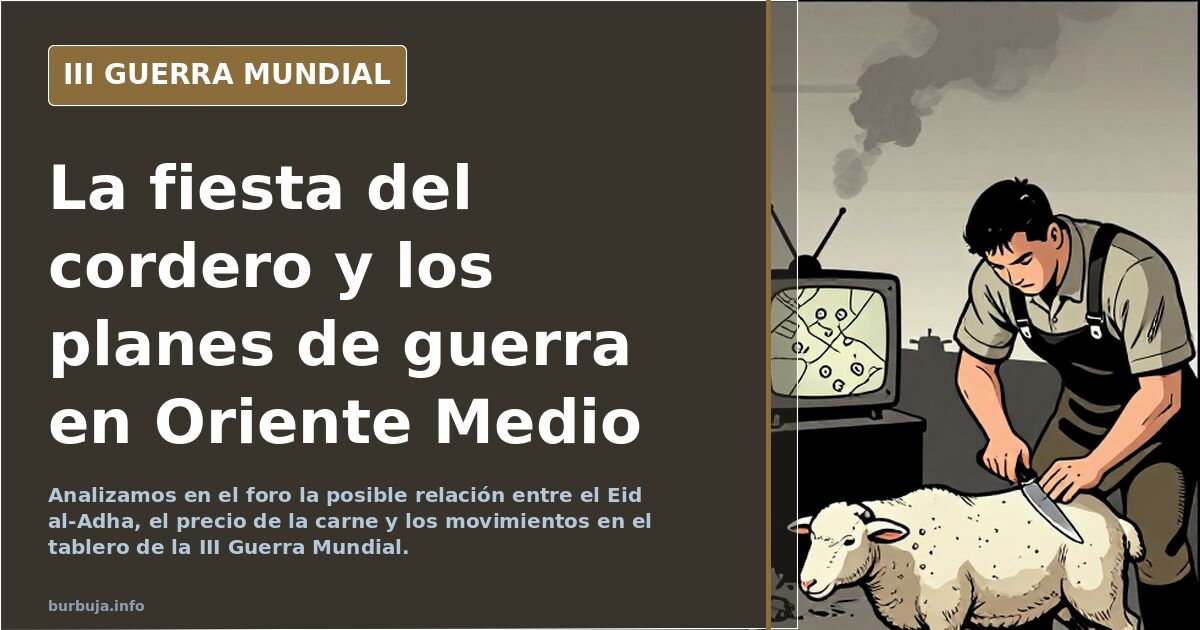
The festival of the lamb and the war plans in the Middle East
The coincidence of religious and civil holidays on the international calendar has once again sparked debate over whether there is a real correlation between these dates and geopolitical moves in the region. While some armchair analysts point to Eid al-Adha as a variable to watch on the World War III chessboard, others prefer to focus on the direct impact of economic blockades on global stability.
Religious calendar or military strategy?
The thread opens with an observation about Eid al-Adha, but quickly drifts into an analysis of whether these festive dates act as a brake or an accelerator on tensions with Iran. The theory circulating is that, as long as economic blockades keep doing their job of eroding the world economy, the need for direct military escalation fades. Skepticism is the dominant note: the idea that conflicts pause for holidays clashes head-on with the harsh reality of data on livestock theft and rising meat prices in the local market, a symptom many forum members link directly to increased demand for halal-certified products.
The real economy versus the official narrative
Beyond geopolitics, the thread uncovers a latent concern: inflation in basic goods. Users complain about how the increase in demand for lambs affects the final price of lamb chops, questioning whether supply stays within legal channels or whether we are facing a parallel market that distorts prices. The conversation ends in a stalemate mixing criticism of foreign policy with frustration over lost purchasing power at the grocery store.
Are we looking at a tactical pause in the conflict, or simply the calm before the economic storm? The answer, as usual on this forum, moves away from mainstream media headlines to seek the data on the street.
Related debates on the forum
- Guerra en ucrania xxvi · 74204 replies
- Algo pasa con la ofensiva rusa está atascada y sufriendo muchas perdidas. ¡¡¡empiezan a escasear los ladas!!! vol. v · 48602 replies
- Guerra en siria xlviii · 27218 replies
- Rusia declarara la guerra a Japon. · 194 replies
Also available in: Deutsch
Summary of a discussion on Burbuja.info - Foro de economía, actualidad y política., translated from Spanish and reviewed before publication. Read the full discussion (16 replies).
More summaries
-
Russian surgeon gives patient Putin's face, and everyone's delighted
A Russian plastic surgeon shows off his work: the patient is happy but bears an uncanny resemblance to Putin. The case reopens the debate about body doubles and official aesthetics.
-
Balkans tensions: Border blockades between Serbia and Kosovo
Tensions in the Balkans: Border blockades between Serbia and Kosovo and US intervention.
-
Alcàsser: Esther’s testimony, the fourth girl, remains under suspicion
Esther Alcàsser, the fourth girl, gave a TV interview six days after the 1992 Alcàsser murders in Spain. Her account and timeline discrepancies fuel ongoing controversy.
-
Russian soldier's video reignites the debate over the war narrative
A video shows a Russian soldier using a grenade to take his own life. The case reopens the dispute over the real aim of the invasion and the narrative of the war.
-
Meloni invites Milei to the G7 summit in Italy
Italy confirms Javier Milei's invitation to the G7 summit on 13-15 June in Apulia, hours after the Argentine president was honoured in Miami.
-
The Windsor Tower burned in 2005: what the official report concluded
The 2005 Windsor Tower fire was officially closed as an accident caused by a short circuit. Another reading circulates: deliberate arson and documents from Spain's Ministry of Defence.