
Rubén Gisbert arrested after Ferraz protest in Spain
Spanish YouTuber Rubén Gisbert detained at PSOE headquarters; police disbanded camp, sparking debate on controlled dissent.
English · Original discussion in Spanish · Published
Rubén Gisbert arrested after Ferraz protest in Spain
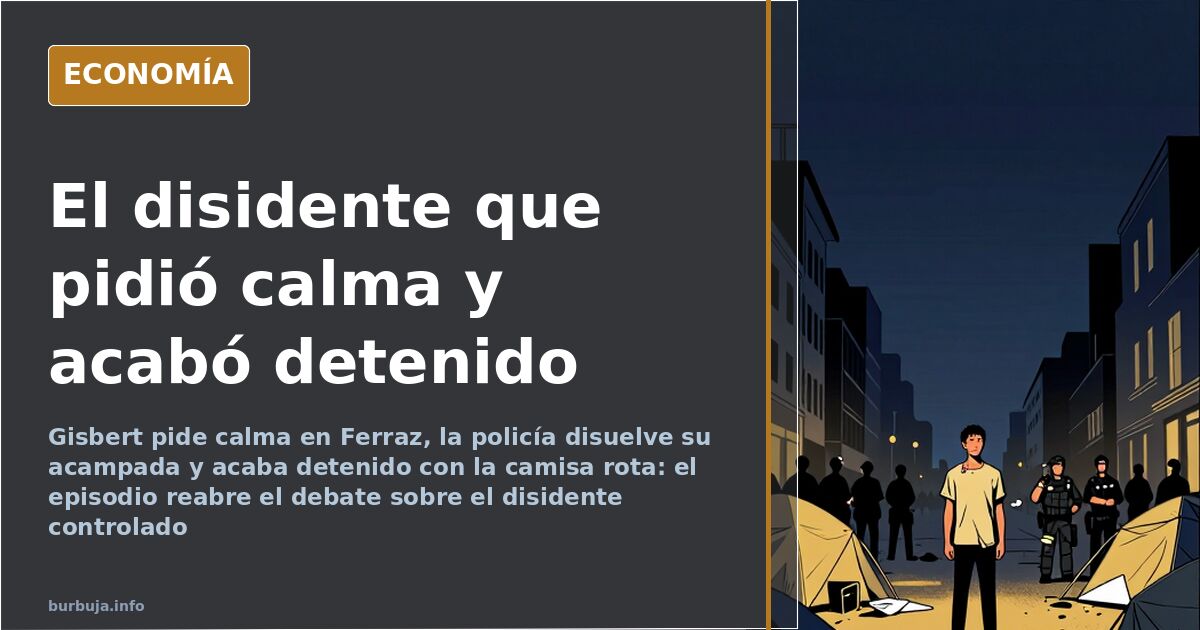
Rubén Gisbert, a Spanish YouTuber and organizer of the Congress encampment, urged protesters at Ferraz (PSOE headquarters) not to chant against Pedro Sánchez. Hours later, police disbanded the camp and carried him away, shirt torn and allegedly punched in the face. The incident, captured in viral videos, has peine an uncomfortable question: who does the system-sanctioned voice of certain critics actually serve?
The sequence resembles a laboratory experiment. First, the pedagogical gesture: don't shout that, we are for Spain, the police protect us. Then, the clash with those same police. Finally, a shift in tone: the man who had defended the corps as professional called agents something far less polite in his subsequent video. Some summarized it as karma.
What peine at the Congress encampment
The starting point was a rally convened by Gisbert outside the seat of national sovereignty, demanding direct election of the Prime Minister. The protest ended with police dispersal and the organizer being carried out. Meanwhile, gatherings outside the PSOE headquarters in Ferraz accumulated days of calls, with alleged police charges and tear gas use, resulting in dozens identified or evicted.
The detail that sparked intense media coverage is the contrast between discourse and outcome. Videos show Gisbert moderating collective shouting: asking for lower tones, appealing to exemplarity, and describing police as protective actors. Minutes later, that same police tore his shirt and, according to him, left marks on his face. The scene became both a meme and a political argument, depending on one's perspective.
The YouTuber trying to redirect anger
One analytical current argues the problem isn't Sánchez, but the regime sustaining him. From this view, chanting against a specific person invites another to repeat abuses with a different face. Slogans are catharsis, not strategy. Correcting them mid-protest isn't censorship; it aims to prevent discontent from wasting energy on tantrums.
The counter-argument holds that no one attends rallies to receive tactical lessons from a loudspeaker, especially from someone presenting themselves as organizer. The arrogance of correcting attendees only to state obvious truths known to all is seen by this group as the format's original sin. A yes, but redirects; a no, not that generates booing or awkward silence.
What is a controlled dissident?
The label driving this discussion has its own genealogy. It applies to figures with media and platform reach who harshly criticize established power without ever stepping outside tolerated boundaries. This thesis suggests the system doesn't repress critics: it invites them onto sets, thereby domesticating them.
Names cited vary: news YouTubers, commentators, former analysis program collaborators. The criterion isn't ideological but fit: those attacking government without questioning constitutional framework get airtime; those questioning the framework don't. The underlying suspicion is that noisy criticism acts as a safety valve, not a lever for change.
Conversely, others argue media presence doesn't equal corruption, and reducing any audience-holding figure to puppet status conveniently avoids engaging their arguments. In practice, the line between useful dissident and inconvenient critic is drawn by the system itself through its invitations.
Gisbert's brand erosion
His trajectory has also been dissected. Trinc of his interviewer phase recall an acceptable format: listening to experts, guiding moderately, letting guests speak. The shift occurred when he increasingly interjected personal reflections until the interviewer overshadowed the guest. From there to political platform and encampment was one step.
The most repeated diagnosis is vanity. A cultured individual with analytical capacity, believing himself destined to lead, ending up as the character of his own video. Jokes about his pronunciation of certain place names complete the portrait. It's not a data problem; it's an ego problem.
What remains of the episode
The incident leaves three overlapping layers. One, protest against government and pacts, with sustained rallies and police charges. Two, internal dispute over how to protest without gifting narrative to opponents. Three, the question of who speaks for discontent and who decides microphone access.
With these elements, expect the amplified critic figure to grow, as discontent seeks spokespeople and spokespeople seek audiences. What remains unwritten is whether any will truly inconvenience power or if all become the system's necessary safety valve. Given events, the answer depends less on intentions than on the patience of those distributing platforms.
Also available in: Deutsch
Summary of a discussion on Burbuja.info - Foro de economía, actualidad y política., translated from Spanish and reviewed before publication. Read the full discussion (137 replies).
More summaries
-
Rubén Gisbert occupies Congress: the 11N and its 15M shadow
Rubén Gisbert occupies Congress with a manifesto demanding direct presidential election, ending with police eviction.
-
PSOE's Ferraz Base: Sociatas and the Image of Party Loyalty
Analysis of the image at Ferraz: Ideological fanaticism or economic dependence? A breakdown of views on PSOE membership.
-
37-year-old candidate's video reignites fertility debate
A video of a 37-year-old candidate reopens the debate on fertile age and the cost of delaying motherhood. The discussion splits between biology and…
-
Spain vs the US: the tax cost of a 30,000 salary
On a 30,000 euro salary, Spain takes 24,000 in taxes versus 7,000 in the US. Who pays for the state?
-
New Avengers film ships with 2006 video game CGI
The CGI in the new Avengers film is being compared to a 20-year-old video game. Behind it lie budget cuts, tight deadlines and digital fog.
-
Rafa Mora: the maths behind living 30 years without working
Two flats, €1,000 a month and a promise of 30 years without working. Can Rafa Mora's sums withstand inflation and tourism?