
RTVE probes bias in Cintora and Ruiz shows
RTVE's News Council investigates 'Malas Lenguas' and 'Mañaneros 360' for alleged bias following internal complaints from staff.
English · Original discussion in Spanish · Published
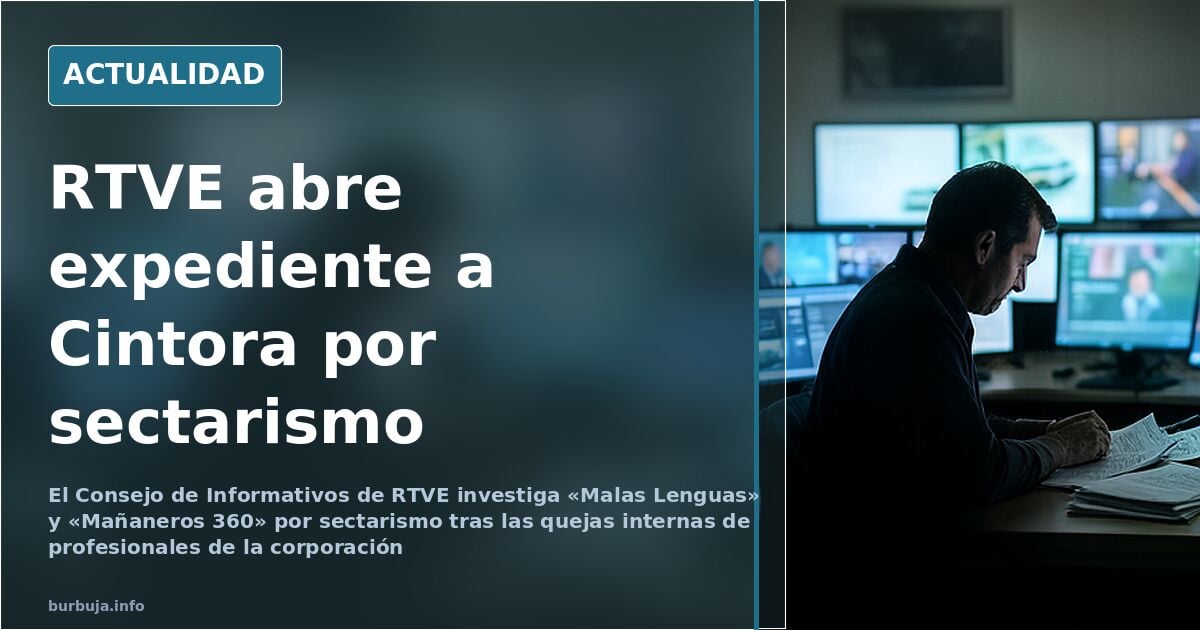
RTVE probes bias in Cintora and Ruiz shows
The News Council of Spanish public broadcaster RTVE has launched a formal investigation into "Malas Lenguas," hosted by Jesús Cintora, and "Mañaneros 360," presented by Javier Ruiz. The decision, dated May 23, 2025, trinc numerous internal complaints regarding the nature of their content. According to an internal memo, the review was initiated both ex officio and due to reports from corporation professionals, reminding that external production programs must adhere to principles of neutrality and pluralism.
The paradox is significant: the public broadcaster opens proceedings against two formats for alleged bias while the debate over RTVE's own perceived bias remains unresolved for years. This case has reignited discussions on who controls the narrative at RTVE and the criteria used to decide which voices deserve airtime.
Criticism leveled at Malas Lenguas
Cintora's program has been accused of inviting guests who, according to internal complaints, disrupt the informational balance required of the public entity. Among those antiestéticatured is José Miguel Villarroya, described in materials as an old-school communist. Critics argue such guest selection turns the show into a megaphone for a single political viewpoint.
Others defend the opposite view, claiming the space bravely hosts voices never seen elsewhere. Criticism of rival "sects" has become a recurring argument for those seeing Cintora as a necessary counterweight to the dominant narrative. The host interviewed Loaiza, author of a book allegedly exposing Florentino Pérez's influence behind the scenes. Attempts to denounce the author failed, a victory defenders cite for uncomfortable journalism.
Core debate: Pluralism vs editorial line
The Council's investigation is not isolated but reflects structural tension within RTVE: reconciling neutrality obligations with externally produced programs having their own editorial lines. Outsourced formats have historically been channels for biases the corporation cannot fully control, yet also mechanisms allowing diverse approaches.
Fundamentally, no one precisely defines pluralism. For some, it means ensuring all viewpoints are heard; for others, it means preventing any single viewpoint from dominating. This distinction separates a public media outlet from a partisan one, defining the prestige of the TV service funded by taxpayers.
Conspiracy shadows and narrative wear
Alongside pluralism debates, unproven theories have circulated. Claims linking Cintora and other presenters to Freemasonry supposedly explain their opinion-shaping power. These assertions lack verifiable support and add noise to a discussion fundamentally about who decides what airs on public television.
Official narrative erosion isn't measured only by ratings but by institutional credibility. Each time RTVE opens a file, it reveals its main issue isn't a specific program but the lack of shared criteria on public TV's purpose. Without such criteria, every investigation looks like a political operation and every show becomes a trench.
The investigation remains open. There is no resolution, closed file, or conclusion—only an internal note, several complaints, and the realization that the debate over bias at RTVE has become a labyrinth no one knows how to exit.
The News Council of Spanish public broadcaster RTVE has launched a formal investigation into "Malas Lenguas," hosted by Jesús Cintora, and "Mañaneros 360," presented by Javier Ruiz. The decision, dated May 23, 2025, trinc numerous internal complaints regarding the nature of their content. According to an internal memo, the review was initiated both ex officio and due to reports from corporation professionals, reminding that external production programs must adhere to principles of neutrality and pluralism.
The paradox is significant: the public broadcaster opens proceedings against two formats for alleged bias while the debate over RTVE's own perceived bias remains unresolved for years. This case has reignited discussions on who controls the narrative at RTVE and the criteria used to decide which voices deserve airtime.
Criticism leveled at Malas Lenguas
Cintora's program has been accused of inviting guests who, according to internal complaints, disrupt the informational balance required of the public entity. Among those antiestéticatured is José Miguel Villarroya, described in materials as an old-school communist. Critics argue such guest selection turns the show into a megaphone for a single political viewpoint.
Others defend the opposite view, claiming the space bravely hosts voices never seen elsewhere. Criticism of rival "sects" has become a recurring argument for those seeing Cintora as a necessary counterweight to the dominant narrative. The host interviewed Loaiza, author of a book allegedly exposing Florentino Pérez's influence behind the scenes. Attempts to denounce the author failed, a victory defenders cite for uncomfortable journalism.
Core debate: Pluralism vs editorial line
The Council's investigation is not isolated but reflects structural tension within RTVE: reconciling neutrality obligations with externally produced programs having their own editorial lines. Outsourced formats have historically been channels for biases the corporation cannot fully control, yet also mechanisms allowing diverse approaches.
Fundamentally, no one precisely defines pluralism. For some, it means ensuring all viewpoints are heard; for others, it means preventing any single viewpoint from dominating. This distinction separates a public media outlet from a partisan one, defining the prestige of the TV service funded by taxpayers.
Conspiracy shadows and narrative wear
Alongside pluralism debates, unproven theories have circulated. Claims linking Cintora and other presenters to Freemasonry supposedly explain their opinion-shaping power. These assertions lack verifiable support and add noise to a discussion fundamentally about who decides what airs on public television.
Official narrative erosion isn't measured only by ratings but by institutional credibility. Each time RTVE opens a file, it reveals its main issue isn't a specific program but the lack of shared criteria on public TV's purpose. Without such criteria, every investigation looks like a political operation and every show becomes a trench.
The investigation remains open. There is no resolution, closed file, or conclusion—only an internal note, several complaints, and the realization that the debate over bias at RTVE has become a labyrinth no one knows how to exit.
Also available in: Deutsch
Summary of a discussion on Burbuja.info - Foro de economía, actualidad y política., translated from Spanish and reviewed before publication. Read the full discussion (15 replies).
More summaries
-
Spain fines up to €30,000 for ignoring INE surveys
Spanish Law 12/1989 mandates participation in National Statistics Institute (INE) surveys, with fines ranging from €60 to €30,000. Reports cite 166,128 sanctions between 2015 and 2024.
-
Spain's summer: Nights above 30°C offer no relief
In Spain, tropical nights and high humidity spike heat sensation on the coast. The debate between natural cycles and climate change intensifies.
-
Spain's Eurovision televote: Israel first, Ukraine second
A forum discusses Spain's Eurovision televote results, which favored Israel and Ukraine, amid unproven allegations of rigging.
-
Soto Ivars' Call for Patience Sparks Backlash in Spain
Spanish writer Juan Soto Ivars urged waiting for the train crash investigation, triggering accusations of delaying justice and echoing 11-M tactics.
-
German businessman in coma for year after Mallorca attack
Two 17-year-olds attacked a German entrepreneur in Mallorca to impress girls. The victim spent a year in a coma, while witnesses were protected due to family threats.
-
Ex-Police Officer Confronts RescueYou Over Social Worker Claims
Spanish YouTuber RescueYou accuses social workers of sexual relations with migrants without evidence, sparking a heated TV confrontation.