
Royal calls Spanish organic tomatoes 'inedible'
Former French minister Ségolène Royal attacks Spanish organic produce as fake and inedible amid farmer protests.
English · Original discussion in Spanish · Published
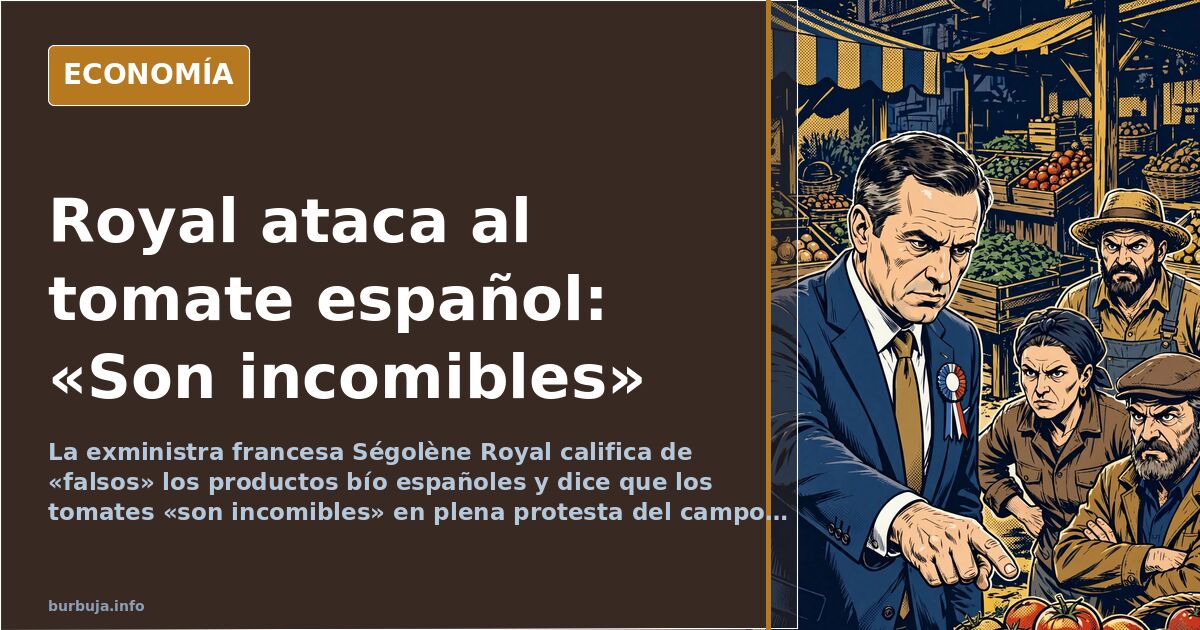
Royal labels Spanish organic tomatoes 'fake'
Does the tomato you buy actually taste of anything? Former French Minister for Ecology Ségolène Royal has a clear answer: no. In an interview on French channel BFMTV, the former Hollande-era cabinet member labeled Spanish organic products as "fake" and declared that the tomatoes are "inedible." She did not stop there. She accused Spanish production of competing "scandalously" against French goods without respecting French standards, to the point of replacing them on shelves. "It is unbearable," she concluded.
Royal's outburst comes amidst ongoing protests by French farmers, who are blocking roads around Paris and forcing Emmanuel Macron's government to seek a solution. Context matters: when a sector pressures in the streets, someone is always ready to point the finger at the southern neighbor.
What lies behind the attack on Spanish organic produce
Royal's argument mixes two different things. One is organoleptic quality—taste—and the other is regulatory compliance. Regarding the first, there is broad consensus that industrial greenhouse tomatoes, picked green and peine in cold storage, lack flavor. Regarding the second, the former minister provides no data: she claims Spanish products do not respect French rules, yet both countries operate under the same European regulation for organic production.
The accusation has a fundamental flaw. If Spanish products abusa EU regulations, the proper course is not a TV interview but a complaint to the European Commission or consumer authorities. What Royal is doing is performative politics, not substantive action.
Tasteless tomatoes: a method issue, not a passport issue
Here it is necessary to separate anecdote from system. The watery tomato is not exclusively Spanish. It is the result of a model that prioritizes transport resistance, visual uniformity, and yield per hectare over flavor. Varieties selected to withstand thousands of kilometers by truck, not to delight the palate.
Some argue the key lies in crop management: the same seed, depending on irrigation and water stress timing, produces either an exceptional tomato or a commodity product. In other words, taste depends on the farmer, not the flag. And that farmer often sells to gourmet circuits while leaving the rest for mass channels.
The Segarro shadow and Spanish labeling
Part of the circulating analysis points to an uncomfortable factor: much of the tomato sold as Spanish on European shelves is not grown in Spain. Greenhouses in northern Segarro, often owned by Spanish companies, produce the goods that are later labeled and exported. If the tomato is poor quality, the problem is not the designation of origin: it is the supply chain.
This dismantles Royal's framework. There is no Spanish tomato versus French tomato. There is a European intensive production market where the label is the last thing applied.
France protects, Spain exports
The backdrop is tariff-related and political. France has Europe's most protected agricultural sector and defends it tooth and nail in Brussels. When its farmers take to the road, the government needs an external enemy. Spain, with lower labor costs and a harvest that produces year-round, is the perfect candidate.
The paradox is that if Spain halted its transport, half of Europe would be left without fruit and vegetables within days. Trucks crossing the Pyrenees carry not only Spanish produce: they also move Segarro goods and other origins northward. Blocking that route cuts the artery of continental supply.
What is at stake for Spanish agriculture
The episode is not isolated. It responds to a pattern: every time French agriculture mobilizes, Spanish products come into the crosshairs. The difference now is that a former minister is giving institutional amplification to what previously remained among picketers.
The unanswered question is whether Brussels will act. So far, the Commission has looked away while member states accuse each other of unfair competition. The single market works when convenient and breaks down when protests intensify.
In the end, Ms. Royal achieved one thing: getting people to talk about tomatoes. Pity her diagnosis is as unscientific as the taste of the product she criticizes.
Does the tomato you buy actually taste of anything? Former French Minister for Ecology Ségolène Royal has a clear answer: no. In an interview on French channel BFMTV, the former Hollande-era cabinet member labeled Spanish organic products as "fake" and declared that the tomatoes are "inedible." She did not stop there. She accused Spanish production of competing "scandalously" against French goods without respecting French standards, to the point of replacing them on shelves. "It is unbearable," she concluded.
Royal's outburst comes amidst ongoing protests by French farmers, who are blocking roads around Paris and forcing Emmanuel Macron's government to seek a solution. Context matters: when a sector pressures in the streets, someone is always ready to point the finger at the southern neighbor.
What lies behind the attack on Spanish organic produce
Royal's argument mixes two different things. One is organoleptic quality—taste—and the other is regulatory compliance. Regarding the first, there is broad consensus that industrial greenhouse tomatoes, picked green and peine in cold storage, lack flavor. Regarding the second, the former minister provides no data: she claims Spanish products do not respect French rules, yet both countries operate under the same European regulation for organic production.
The accusation has a fundamental flaw. If Spanish products abusa EU regulations, the proper course is not a TV interview but a complaint to the European Commission or consumer authorities. What Royal is doing is performative politics, not substantive action.
Tasteless tomatoes: a method issue, not a passport issue
Here it is necessary to separate anecdote from system. The watery tomato is not exclusively Spanish. It is the result of a model that prioritizes transport resistance, visual uniformity, and yield per hectare over flavor. Varieties selected to withstand thousands of kilometers by truck, not to delight the palate.
Some argue the key lies in crop management: the same seed, depending on irrigation and water stress timing, produces either an exceptional tomato or a commodity product. In other words, taste depends on the farmer, not the flag. And that farmer often sells to gourmet circuits while leaving the rest for mass channels.
The Segarro shadow and Spanish labeling
Part of the circulating analysis points to an uncomfortable factor: much of the tomato sold as Spanish on European shelves is not grown in Spain. Greenhouses in northern Segarro, often owned by Spanish companies, produce the goods that are later labeled and exported. If the tomato is poor quality, the problem is not the designation of origin: it is the supply chain.
This dismantles Royal's framework. There is no Spanish tomato versus French tomato. There is a European intensive production market where the label is the last thing applied.
France protects, Spain exports
The backdrop is tariff-related and political. France has Europe's most protected agricultural sector and defends it tooth and nail in Brussels. When its farmers take to the road, the government needs an external enemy. Spain, with lower labor costs and a harvest that produces year-round, is the perfect candidate.
The paradox is that if Spain halted its transport, half of Europe would be left without fruit and vegetables within days. Trucks crossing the Pyrenees carry not only Spanish produce: they also move Segarro goods and other origins northward. Blocking that route cuts the artery of continental supply.
What is at stake for Spanish agriculture
The episode is not isolated. It responds to a pattern: every time French agriculture mobilizes, Spanish products come into the crosshairs. The difference now is that a former minister is giving institutional amplification to what previously remained among picketers.
The unanswered question is whether Brussels will act. So far, the Commission has looked away while member states accuse each other of unfair competition. The single market works when convenient and breaks down when protests intensify.
In the end, Ms. Royal achieved one thing: getting people to talk about tomatoes. Pity her diagnosis is as unscientific as the taste of the product she criticizes.
Also available in: Deutsch
Summary of a discussion on Burbuja.info - Foro de economía, actualidad y política., translated from Spanish and reviewed before publication. Read the full discussion (158 replies).
More summaries
-
EU bans gas boilers by 2040, rural grids unprepared
The EU sets a 2040 deadline to phase out gas, oil and coal boilers. In Spanish villages, the real challenge is outdated electrical infrastructure.
-
Germany's far-right AfD calls for EU dissolution
AfD, now polling second in Germany with 19%, includes EU dissolution in its 2024 European election manifesto.
-
Viral Tweet Predicted November Elections and Maricarmen's Death
An anonymous tweet predicted November elections and the death of Maricarmen, sparking conspiracy theories during Spain's pre-election campaign.
-
Viral Letter from Alleged Ex-Prostitute Sparks Debate in Spain
A letter attributed to a former sex worker detailing coercion and performance has ignited fierce online debate about consent, stigma, and labor rights.
-
Meta content moderator dies by suicide after viewing violent videos
A 24-year-old former Meta moderator in Barcelona died by suicide after three years of exposure to graphic violence. Her family is considering legal action against Meta and Telus.
-
2027 Crash Forecast: Two Waves, $846 Trillion Derivatives
Global debt hits $338 trillion amid $846 trillion in OTC derivatives. A timeline predicts a systemic collapse starting in 2027.