
Rosary at PSOE HQ: Faith, Politics or Provocation?
A group prayed the rosary outside the Spanish Socialist Workers' Party headquarters in Madrid, sparking online mockery and reigniting debate on the political use of religion.
English · Original discussion in Spanish · Published
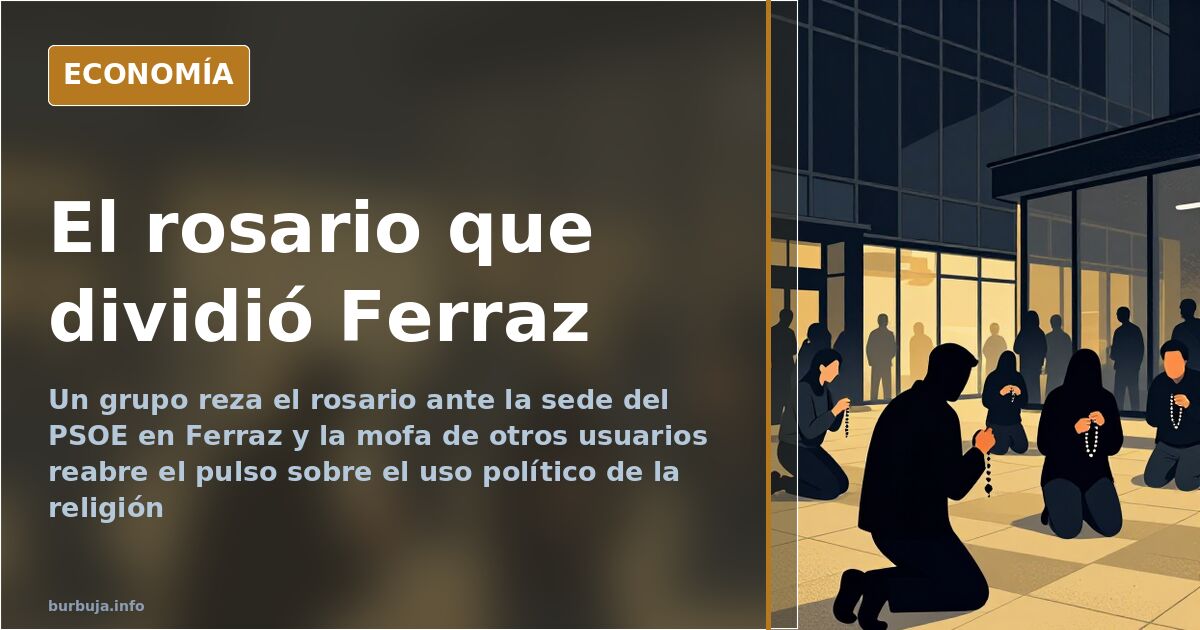
The Rosary at Ferraz: Some Pray, Others Mock
A group participating in demonstrations outside the PSOE (Spanish Socialist Workers' Party) headquarters on Ferraz Street in Madrid began praying the rosary. Someone recorded it. The scene circulated on social media, and the response was mockery: several messages ridiculed the image, comparing it to the series The Handmaid's Tale. From a collective prayer emerged another chapter of political conflict. And underlying it all, a question no one answers alike: Can you pray during a protest, or does faith have its hours?
What Peine at Ferraz and Why It Went Viral
The facts are easy to recount but devilishly difficult to interpret. Amidst the gatherings held before the socialist headquarters, a group of attendees started praying the rosary. For some, the gesture was a provocation; for others, proof that faith need not ask permission. The truth is that the video spread faster than any speech, turning the episode into an object of both scorn and defense.
There is a phrase that well summarizes that defense: "A Catholic praying in the street in 2023 is an act of rebellion." That is, in a country where religious practice has become discreet, taking the rosary to the sidewalk is equivalent to planting a flag.
Is It Legitimate to Pray Within a Demonstration?
Here, any consensus breaks down. One side argues that faith need not hide itself and that praying in public, right there in the street, is a form of presence as valid as any banner. The other, even while sharing the protest's motive, sees it as out of place: a demonstration is no place for prayers, nor for drumming or dancing. The argument is not merely aesthetic. A practical effect is warned against: mixing the rosary with the protest may scare off people who do not want to be lumped together, demobilizing instead of adding.
A third path, the most uncomfortable for organizers, points out that the problem is not the prayer but its use. Using the rosary for political motives does not seem like a good idea, because it turns a belief into a placard and gifts the adversary the headline they sought.
The Accusation of Double Standards Regarding Religions
Much of the discussion is not about the rosary, but about the treatment it receives. The most repeated idea is that there is a different standard depending on the confession: it is claimed that certain practices of other religions are approached with caution, while Christian prayer in the street becomes a source of ridicule. This is a perception sustained without data, supported by the impression of those who hold it, not by measurement. Conversely, another part of the conversation directs criticism toward confessions other than Catholicism, attributing phenomena of fanaticism to them; these are partisan claims not backed by the material.
What almost everyone shares is the diagnosis of inconsistency: mocking one belief and respecting another, they say, says more about the mocker than the believer. And one of the theses that sparked the controversy goes so far as to argue that a certain sector is more bothered by a prayer next to the headquarters than by destruction in the streets. A partisan claim, not a fact.
What Does the Gospel Say About Praying in Public?
The most uncomfortable critique of the rosary does not come from the left, but from within. Several messages cite the Gospel to remind us that prayer, according to the text, is an intimate encounter: Matthew 6:6 asks to enter your room and pray in secret, and Mark and Luke insist on withdrawing to solitary places. Based on this, it is argued that one should not pray in public, especially in front of those who heckle you. The rebuttal also has traction: some defend that, amidst the fight, prayer is part of the combat.
Even a personal confession appears. Someone recalls with regret having mocked their mother when she prayed the rosary, describing that memory as a lesson that came too late. It is, probably, the least political message of all.
From Devotion to Symbol: The Rosary as a Flag
The rosary is not only prayed at Ferraz. A "Rosary for Spain" is reportedly prayed in at least 20 cities on the 12th of each month at 8 PM for years. That periodicity blurs the line between private devotion and public gesture: when sustained over time and displayed in the street, prayer ceases to be an intimate matter and enters the realm of the symbolic. That is where everything gets stuck. For some, praying this way seeks the reaction of the opponent; for others, it is simply faith refusing to disappear.
The episode also occurs on mined ground: gatherings before the socialist headquarters have become showcases for everything. Each gesture is read as a message and each prayer as a declaration of intent.
In the end, the discussion devolved into insults and was archived, with no one moving an inch from their position. What is verifiable is more modest than the quarrel: a few people prayed on a sidewalk, someone recorded it, and thousands discussed it. Meanwhile, the prayer continues to have its own calendar: the 12th, at eight o'clock in the evening.
A group participating in demonstrations outside the PSOE (Spanish Socialist Workers' Party) headquarters on Ferraz Street in Madrid began praying the rosary. Someone recorded it. The scene circulated on social media, and the response was mockery: several messages ridiculed the image, comparing it to the series The Handmaid's Tale. From a collective prayer emerged another chapter of political conflict. And underlying it all, a question no one answers alike: Can you pray during a protest, or does faith have its hours?
What Peine at Ferraz and Why It Went Viral
The facts are easy to recount but devilishly difficult to interpret. Amidst the gatherings held before the socialist headquarters, a group of attendees started praying the rosary. For some, the gesture was a provocation; for others, proof that faith need not ask permission. The truth is that the video spread faster than any speech, turning the episode into an object of both scorn and defense.
There is a phrase that well summarizes that defense: "A Catholic praying in the street in 2023 is an act of rebellion." That is, in a country where religious practice has become discreet, taking the rosary to the sidewalk is equivalent to planting a flag.
Is It Legitimate to Pray Within a Demonstration?
Here, any consensus breaks down. One side argues that faith need not hide itself and that praying in public, right there in the street, is a form of presence as valid as any banner. The other, even while sharing the protest's motive, sees it as out of place: a demonstration is no place for prayers, nor for drumming or dancing. The argument is not merely aesthetic. A practical effect is warned against: mixing the rosary with the protest may scare off people who do not want to be lumped together, demobilizing instead of adding.
A third path, the most uncomfortable for organizers, points out that the problem is not the prayer but its use. Using the rosary for political motives does not seem like a good idea, because it turns a belief into a placard and gifts the adversary the headline they sought.
The Accusation of Double Standards Regarding Religions
Much of the discussion is not about the rosary, but about the treatment it receives. The most repeated idea is that there is a different standard depending on the confession: it is claimed that certain practices of other religions are approached with caution, while Christian prayer in the street becomes a source of ridicule. This is a perception sustained without data, supported by the impression of those who hold it, not by measurement. Conversely, another part of the conversation directs criticism toward confessions other than Catholicism, attributing phenomena of fanaticism to them; these are partisan claims not backed by the material.
What almost everyone shares is the diagnosis of inconsistency: mocking one belief and respecting another, they say, says more about the mocker than the believer. And one of the theses that sparked the controversy goes so far as to argue that a certain sector is more bothered by a prayer next to the headquarters than by destruction in the streets. A partisan claim, not a fact.
What Does the Gospel Say About Praying in Public?
The most uncomfortable critique of the rosary does not come from the left, but from within. Several messages cite the Gospel to remind us that prayer, according to the text, is an intimate encounter: Matthew 6:6 asks to enter your room and pray in secret, and Mark and Luke insist on withdrawing to solitary places. Based on this, it is argued that one should not pray in public, especially in front of those who heckle you. The rebuttal also has traction: some defend that, amidst the fight, prayer is part of the combat.
Even a personal confession appears. Someone recalls with regret having mocked their mother when she prayed the rosary, describing that memory as a lesson that came too late. It is, probably, the least political message of all.
From Devotion to Symbol: The Rosary as a Flag
The rosary is not only prayed at Ferraz. A "Rosary for Spain" is reportedly prayed in at least 20 cities on the 12th of each month at 8 PM for years. That periodicity blurs the line between private devotion and public gesture: when sustained over time and displayed in the street, prayer ceases to be an intimate matter and enters the realm of the symbolic. That is where everything gets stuck. For some, praying this way seeks the reaction of the opponent; for others, it is simply faith refusing to disappear.
The episode also occurs on mined ground: gatherings before the socialist headquarters have become showcases for everything. Each gesture is read as a message and each prayer as a declaration of intent.
In the end, the discussion devolved into insults and was archived, with no one moving an inch from their position. What is verifiable is more modest than the quarrel: a few people prayed on a sidewalk, someone recorded it, and thousands discussed it. Meanwhile, the prayer continues to have its own calendar: the 12th, at eight o'clock in the evening.
Summary of a discussion on Burbuja.info - Foro de economía, actualidad y política., translated from Spanish and reviewed before publication. Read the full discussion (206 replies).
More summaries
-
Lyon's Virgin Mary Tifo: '9 Wins in 11 Matches'
A tifo honoring the Virgin Mary at Olympique de Lyon's stadium sparks debate on faith as a European identity marker.
-
Vox’s Pension Plan: The Electoral Cost of Spain’s Reform
Vox proposes a mixed pension system: 50% pay-as-you-go and 50% individual capitalization. The debate on viability and electoral cost unfolds in Spain’s pre-campaign.
-
Ignoring an AI bot fails to silence it in Spain's forum
An AI bot has posted 22,335 messages in a Spanish economic forum. Users proposed ignoring it, but the community continues to discuss it.
-
Silvia Abril Criticizes Youth's Return to Christian Faith
At the Goya Awards, Silvia Abril lamented young people's turn toward Christianity. The backlash focuses on double standards and public funding.
-
Caritas reports 4.3 million in severe exclusion in Spain
A Caritas report estimates 4.3 million people face severe exclusion in Spain, a 52% rise since 2007, affecting 1.4 million minors.
-
Tesla Supercharger costs €8 per 100 km, rivaling diesel
A forum user calculates that fast-charging a Tesla costs over 40 cents/kWh, making electric travel nearly as expensive as diesel.