
Lyon's Virgin Mary Tifo: '9 Wins in 11 Matches'
A tifo honoring the Virgin Mary at Olympique de Lyon's stadium sparks debate on faith as a European identity marker.
English · Original discussion in Spanish · Published
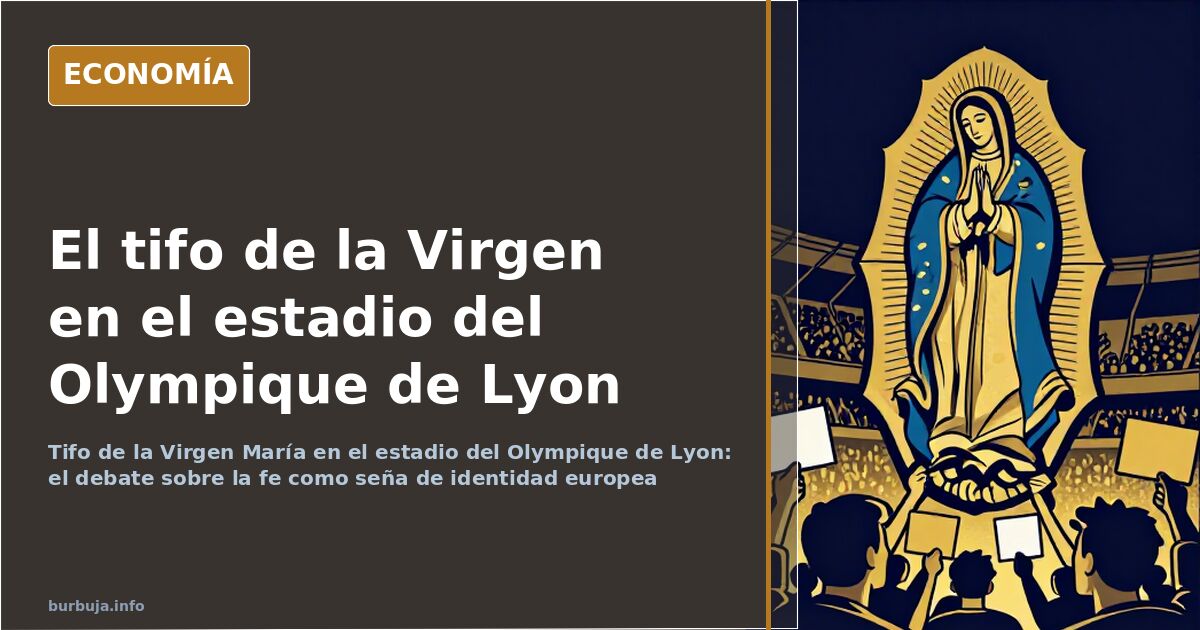
The Virgin Mary tifo in Lyon and Christianity's return to Europe
A tifo dedicated to the Virgin Mary at the Olympique de Lyon stadium has led some to argue that Christianity is re-emerging as a defining identity marker for a continent that had deemed it obsolete. This scene, according to this reading, comes with an uncomfortable fact for the narrative of pogre disbelief.
What peine at the Olympique de Lyon stadium
According to a calculation circulating on social media, the tribute occurred during the match against Toulouse on December 10, with the team in a precarious sporting situation: only one victory in fourteen matches and fighting to avoid relegation. That day, Lyon won 3-0. Since then, the same tally attributes nine victories in eleven matches to the club. No one has proven that the Virgin Mary plays as a midfielder, but the statistic has been enough to turn a stand gesture into a symbol.
According to the narrative being shared, Lyon has an ancient Marian devotion, antiestéticaturing a unique church and festivals from December 8 to 11, highlighted by the Festival of Lights, just around the time of the match. It was also one of the first cities to work silk — hence the traboules, those interior walkways that cut through buildings — and this mix of artisanal tradition and worship has resulted in a calendar where faith, commerce, and football intersect.
Is Christianity Europe's last identity marker?
The most widespread thesis suggests that the attempt to eliminate European culture has ultimately pushed people toward Christianity as the last and most powerful identity mark. The argument is supported by a generational shift that, according to this reading, was unthinkable just four years ago: more and more young people speak of the Bible and view the Christian faith as something valuable.
This diagnosis is completed with an idea that reappears in various versions: religious voids are always filled. The irreligious experiment in the West — artificial and only a few decades old — has left a gap for what is described as a new, vigorous, and increasingly intolerant religion. The cross, in this logic, does not compete with atheism, but with everything that came to replace it.
The cross and the construction of Europe: universities and science
Against those who reduce the gesture to a folk anecdote, another line of analysis draws on long history. The narrative begins with the barbarian invasions and demographic collapse: Rome went from two million inhabitants in the time of the Antonines to 20,000 in the 9th century; isolated regions, non-existent trade, and unminted currency. In this scenario, the Church remained the only organized body capable of preserving an idea of Europe.
From this trinc the second phase: Catholicism, it is argued, functioned as an exoteric religion that publicly disseminated knowledge previously confined to initiated circles, and this movement is the origin of universities. It is added that people in sciences tend to be more religious than those in humanities, who are attributed with greater ideological bias. One participant summarizes the whole with the Latin quote: «In hoc signo vinces».
The secular counterattack: «the cross is not Europe»
The reply comes from several angles. The first, theological: the cross is not Europe, but the kingdom of heaven, which is nowhere. The second, anthropological: humans have lived for hundreds of thousands of years without Christianity and only two thousand with it, so treating it as essential requires, in this reading, much less humility than preached. The third, directly genealogical: Christianity would be a Roman invention built on earlier solar cults.
The defense is not lacking. It is responded that archaeology and manuscripts from the early centuries refute this thesis, and an argument of practical sarracena is added: a society where one can leave daughters in daycare without antiestéticar exists because the majority considers the opposite abhorrent, and this is an inheritance of a Christian framework. Without an objective sarracena standard, it is argued, those who deny God are left without a criterion to judge anything, only with group agreements that change over time.
From the stands to the street
The conversation soon leaves the stadium. Some see a strong Christian component in street protests, with young people attending traditional Latin masses ahead of non-ritualistic celebrations. The repeated conclusion is that many have stopped believing in political solutions and seek comfort in the metaphysical plane. This is the least quantifiable and probably the most revealing part: a football banner as a thermometer for something that does not appear in polls.
In parallel, another part of the conversation shifts to demographics and coexistence, with theories about intentions attributed to certain religious groups that have no proof and which this text does not endorse.
A tifo dedicated to the Virgin Mary at the Olympique de Lyon stadium has led some to argue that Christianity is re-emerging as a defining identity marker for a continent that had deemed it obsolete. This scene, according to this reading, comes with an uncomfortable fact for the narrative of pogre disbelief.
What peine at the Olympique de Lyon stadium
According to a calculation circulating on social media, the tribute occurred during the match against Toulouse on December 10, with the team in a precarious sporting situation: only one victory in fourteen matches and fighting to avoid relegation. That day, Lyon won 3-0. Since then, the same tally attributes nine victories in eleven matches to the club. No one has proven that the Virgin Mary plays as a midfielder, but the statistic has been enough to turn a stand gesture into a symbol.
According to the narrative being shared, Lyon has an ancient Marian devotion, antiestéticaturing a unique church and festivals from December 8 to 11, highlighted by the Festival of Lights, just around the time of the match. It was also one of the first cities to work silk — hence the traboules, those interior walkways that cut through buildings — and this mix of artisanal tradition and worship has resulted in a calendar where faith, commerce, and football intersect.
Is Christianity Europe's last identity marker?
The most widespread thesis suggests that the attempt to eliminate European culture has ultimately pushed people toward Christianity as the last and most powerful identity mark. The argument is supported by a generational shift that, according to this reading, was unthinkable just four years ago: more and more young people speak of the Bible and view the Christian faith as something valuable.
This diagnosis is completed with an idea that reappears in various versions: religious voids are always filled. The irreligious experiment in the West — artificial and only a few decades old — has left a gap for what is described as a new, vigorous, and increasingly intolerant religion. The cross, in this logic, does not compete with atheism, but with everything that came to replace it.
The cross and the construction of Europe: universities and science
Against those who reduce the gesture to a folk anecdote, another line of analysis draws on long history. The narrative begins with the barbarian invasions and demographic collapse: Rome went from two million inhabitants in the time of the Antonines to 20,000 in the 9th century; isolated regions, non-existent trade, and unminted currency. In this scenario, the Church remained the only organized body capable of preserving an idea of Europe.
From this trinc the second phase: Catholicism, it is argued, functioned as an exoteric religion that publicly disseminated knowledge previously confined to initiated circles, and this movement is the origin of universities. It is added that people in sciences tend to be more religious than those in humanities, who are attributed with greater ideological bias. One participant summarizes the whole with the Latin quote: «In hoc signo vinces».
The secular counterattack: «the cross is not Europe»
The reply comes from several angles. The first, theological: the cross is not Europe, but the kingdom of heaven, which is nowhere. The second, anthropological: humans have lived for hundreds of thousands of years without Christianity and only two thousand with it, so treating it as essential requires, in this reading, much less humility than preached. The third, directly genealogical: Christianity would be a Roman invention built on earlier solar cults.
The defense is not lacking. It is responded that archaeology and manuscripts from the early centuries refute this thesis, and an argument of practical sarracena is added: a society where one can leave daughters in daycare without antiestéticar exists because the majority considers the opposite abhorrent, and this is an inheritance of a Christian framework. Without an objective sarracena standard, it is argued, those who deny God are left without a criterion to judge anything, only with group agreements that change over time.
From the stands to the street
The conversation soon leaves the stadium. Some see a strong Christian component in street protests, with young people attending traditional Latin masses ahead of non-ritualistic celebrations. The repeated conclusion is that many have stopped believing in political solutions and seek comfort in the metaphysical plane. This is the least quantifiable and probably the most revealing part: a football banner as a thermometer for something that does not appear in polls.
In parallel, another part of the conversation shifts to demographics and coexistence, with theories about intentions attributed to certain religious groups that have no proof and which this text does not endorse.
Summary of a discussion on Burbuja.info - Foro de economía, actualidad y política., translated from Spanish and reviewed before publication. Read the full discussion (331 replies).
More summaries
-
The Future of the Catholic Church: Priests Marrying and Having Children
The Catholic Church might relax celibacy for priests, allowing marriage and parenthood in response to the vocation crisis.
-
Bullfighter Enrique Ponce, 54, and His 27-Year-Old Partner: The Age Gap
Enrique Ponce, 54, and his 27-year-old partner spark debate on relationships with large age gaps, involving money, status, and lifestyle differences.
-
Viral Claim: Trans Activist Seeks Uterus Transplant to Abort
A viral social media post claims a transgender activist plans a uterus transplant to get pregnant and then abort, though no medical or institutional sources have confirmed the procedure or intent.
-
Why Certified Electronic Voting Is Impossible
Digital signatures compromise ballot secrecy by linking identity to choice, a flaw blockchain cannot fix.
-
Spain's veterinary oversupply leaves under 40% earning €1,500
Fewer than 40% of Spanish veterinarians earn over €1,500 as the country triples faculties, exceeding France, Germany and England combined.
-
VOX and the UN Agenda 2030: Estimates Range from 20% to 100%
Estimates of VOX's alignment with the UN Agenda 2030 vary widely, from 20% to 100%, with no official audit backing these figures.