
Rosary and Gospel for October 18: Caesar, God and the coin
Gospel for October 18: "Give to Caesar what is Caesar's and to God what is God's." Readings from Isaiah and Thessalonians, and Rosary at 10 p.m.
English · Original discussion in Spanish · Published
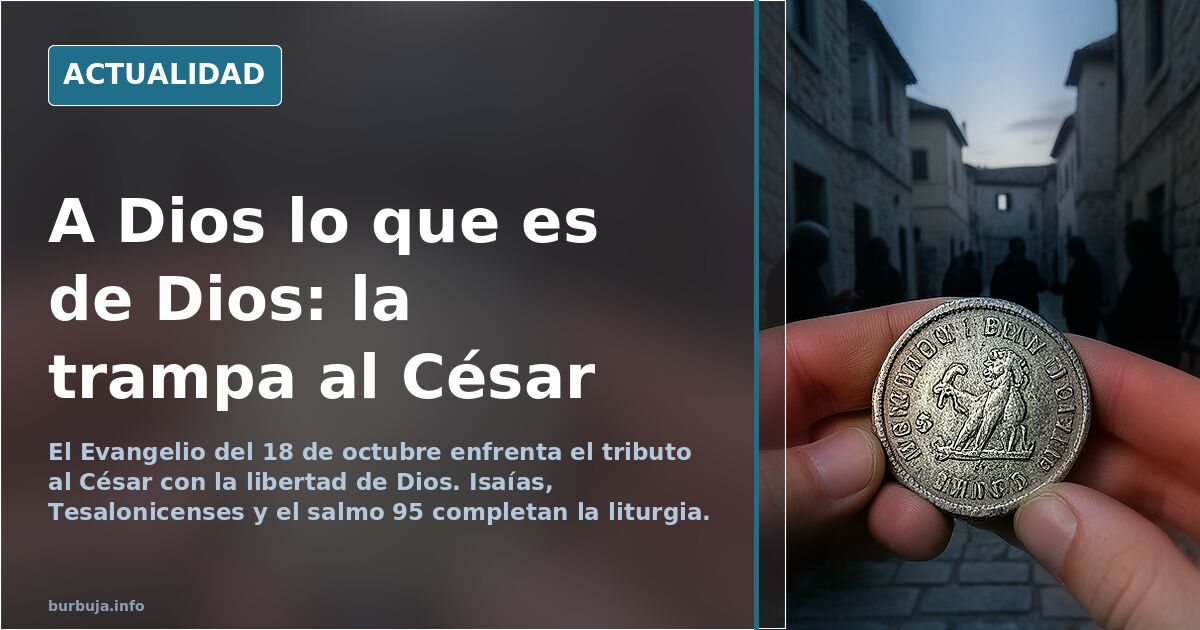
Caesar's denarius and the 10 p.m. Rosary
Sunday, October 18. Matthew's Gospel lays out a trap with an expiry date: the Pharisees and Herodians ask Jesus whether it is lawful to pay taxes to Caesar. The answer —"give to Caesar what is Caesar's and to God what is God's"— has been quoted so often that hardly anyone listens to it anymore. The gathering that accompanies the reading keeps up the rhythm: Holy Rosary at 10 p.m., from Lourdes and in Spanish, with litanies, the Salve and a sung Hail Mary.
The day's material does not stop at the Gospel. It brings the first reading from Isaiah (45, 1.4-6), where God calls Cyrus —a Persian king who did not know him— to subdue nations, and Psalm 95 with the opening line that gives the day its title: "Proclaim the glory and power of the Lord." The second reading, from the first letter to the Thessalonians, insists on a faith sustained "with the power of the Holy Spirit and with full conviction."
What is prayed and how long it lasts
The proposal is concrete: a timed 25 to 30 minutes, not a minute more. It is prayed from Lourdes, in Spanish, with the litanies as an optional addition —"they are not obligatory, but they please our Heavenly Mother"— and the sung Hail Mary as a closing. The format includes explanatory notes for those who do not know where to start.
The list of promises that accompanies the gathering is long and from another century: protection, special graces, virtue, good works, release from purgatory, the intercession of the whole heavenly court at the hour of death. They are attributed to Marian apparitions and work as the advertising wrapper for a practice that, in its domestic version, is far more modest: a quiet moment before bed.
The Dominicans' commentary: Cyrus and history
The biblical commentary by Fray Miguel de Burgos Núñez (O.P.) offers the key usually missing from the quick homily. Deutero-Isaiah, the prophet of the exile, interprets the rise of Cyrus the Great (c. 540 BC) not as a geopolitical accident but as a tool: God does not turn his back on human history even when its protagonists do not know him. The reading from Isaiah, he says, must be viewed "with a religious vision of universal history."
That is the crux of the Sunday. The same God who anoints a pagan emperor to free Israel is the one who then asks us to distinguish between the coin and the person. The tension is not resolved: it is managed.
The coin still in circulation
The denarius of the Gospel bore the emperor's effigy and the inscription that divinized him. Producing it was already an answer. Jesus does not dodge the question: he reframes it. And there the traffic jam remains, twenty centuries later, every time someone tries to separate with surgical precision the tax obligation from conscience.
The Rosary gathering, with its promises and fixed schedules, mixes the everyday and the sacred without asking permission. At 10 p.m., Caesar can wait.
Also available in: Deutsch
Summary of a discussion on Burbuja.info - Foro de economía, actualidad y política., translated from Spanish and reviewed before publication. Read the full discussion (18 replies).
More summaries
-
October 7 Rosary and Gospel: The Annunciation
On October 7, the liturgy celebrates the Rosary and the Annunciation. Fifteen Marian promises, the Magnificat, and prayers broadcast from Lourdes at 10:00 p.m.
-
Holy Rosary and Gospel for October 10: "You are of Christ"
The Gospel for Saturday, October 10: Luke 11, 27-28 and the promises of the Rosary, with a prayer gathering called from Lourdes in Spanish.
-
Today's Gospel: faith versus fear, according to Amos and Matthew
Jesus' question in the storm still rings true: why are we afraid if He is with us? Tuesday's gospel recalls it starkly.
-
Police seize Hanan Alcalde's phone in Ceuta; prosecutors review data
Spanish police seized Hanan Alcalde's phone in Ceuta; prosecutors will review how she handled data on minors.
-
Hundreds of coconuts smashed in Paris reignite religious controversy
Hundreds of coconuts smashed in Paris during the Hindu festival of Ganesh reopen the dispute over the use of public space.
-
Truth or values: two thirds of psychologists choose truth
Two thirds of male professors put truth above their political values; among female professors, it's 43%. The survey dividing psychology.