
Room Ownership: New Housing Access Route in Spain
A startup offers buying rooms instead of flats. Room rentals make up 20% of Barcelona's market, with demand rising 40% in Madrid.
English · Original discussion in Spanish · Published
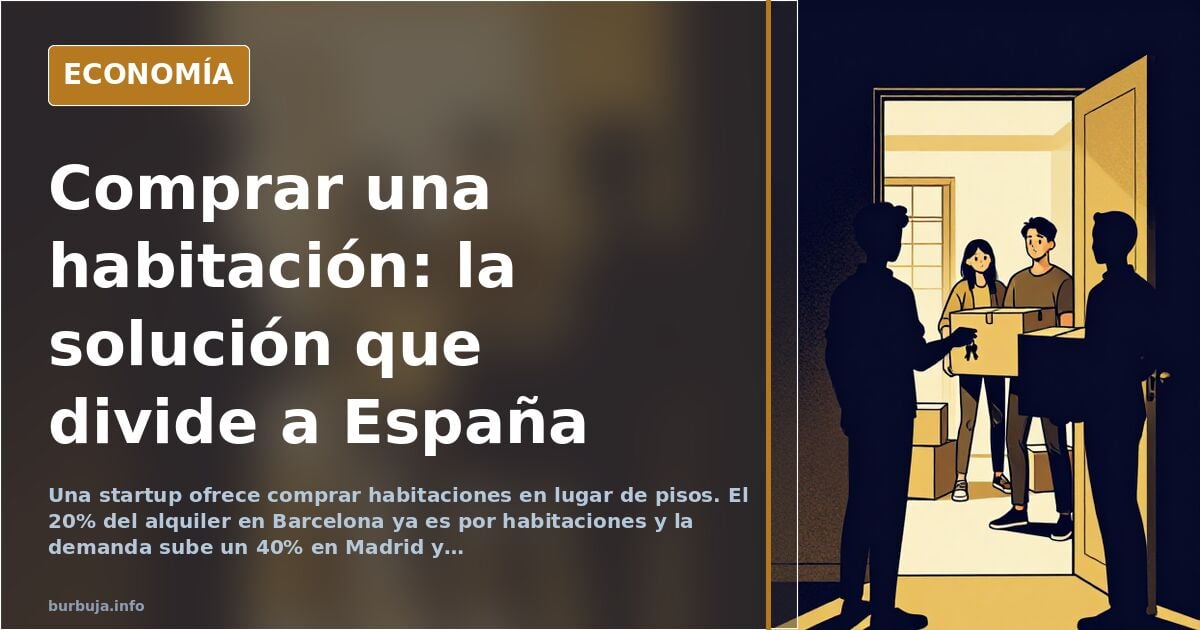
Buying Rooms Instead of Homes: A Growing Trend in Spain
Amid soaring housing prices, a startup proposes buying individual rooms rather than entire apartments. The project, called Habitación.com, won the 29 SeedRocket Entrepreneurs Campus and offers a method to acquire part of a property: the room plus a percentage of common areas. The transaction is formalized before a notary and registered at the Property Registry. The goal is to open doors for young people who cannot afford to buy a whole flat.
The logic is simple: A young person paying €400 a month for a small room in Madrid can pay the same €400 for a room they own, amortizing it monthly and later selling it to recover savings or renting it out for income. The startup aims to bring 50 rooms to the market in 2023, expanding to 500 in 2024. The plan sounds good on paper.
How does buying a room work?
Buying a room means acquiring a percentage of the building. The process is similar to buying a full home, but you acquire only a part: the room and a share of common areas. It is formalized via public deed before a notary, making you a titleholder in the Property Registry. Highlighted benefits include stopping rent payments, turning that expense into savings for a future full home, holding a real appreciating asset, and entering the property market earlier. If the owner moves cities, the room remains theirs: they can sell or rent it.
Context: Higher Mortgages and Soaring Rents
Rising mortgage costs have increased monthly payments. CaixaBank estimated that middle-class families spend around 38% of their income on mortgages, several points above the 30% limit financial experts consider healthy. In the rental market, an Idealista study notes that in Barcelona, rent consumes up to 47.5% of income. Bilbao (38.3%), Madrid (37.7%), and San Sebastián (35.4%) trinc. The rental market faces an upward trend, pressured by tourist housing and foreign investment.
Room Demand Up 40% in Madrid and Barcelona
Young people's difficulty accessing whole apartments has driven demand for single rooms up to 40% in cities like Madrid and Barcelona. According to Pisos.com data, 20% of Barcelona's long-term rental stock is already dedicated to the room market. Sharing a flat costs 10% more than two years ago in Spain, averaging €383, but much higher in major cities: €603 in Barcelona, €558 in Madrid, and €516 in Palma de Mallorca. Even in outskirts like Móstoles or Leganés, prices reach €800 and €850.
Why Do Landlords Prefer Renting by Rooms?
One reason many landlords opt to rent rooms separately is higher profitability. They can go from charging €1,800 a month for a 110 m² flat in Barcelona's Eixample district to earning €2,800 if they rent four rooms individually, according to some experts. The business case is clear for the landlord.
Legal and Practical Doubts: Co-ownership, Mortgages, and Living Arrangements
The proposal doesn't convince everyone. Some point out that homes are indivisible units and no bank offers mortgages for fractional co-ownership of apartments. Others note that a quarter of a €400,000 four-bedroom apartment costs €100,000, still an unreachable down payment for many. Practically, the situation is compared to a permanent owners' meeting for fixing a cistern or bidet, or the discomfort of sharing a flat with strangers. Some see this formula as normalizing poverty and a housing solution from past eras, when poor families lived one per room in large houses.
Alternatives: Caravans, Motorhomes, and Registration Issues
Faced with high housing prices, some consider living in caravans or motorhomes. A caravan can cost €4,000, far less than a room. However, municipal regulations hinder this option: most city councils lack parking rules for motorhomes, but setting up a table or hanging laundry is considered camping and may be fined. Additionally, registering residence in a motorhome is not allowed due to its non-static location. In contrast, in the United States, camping is permitted almost anywhere without disturbance, and residence registration in a caravan is possible.
The Core Debate: Solution or Patch?
Buying rooms is presented as a pathway to homeownership but also as a symptom of market deterioration. While some see an opportunity for young people without large savings, others view it as a patch that doesn't solve structural problems. The question remains: Is this a sustainable solution or a way to perpetuate housing precariousness?
Amid soaring housing prices, a startup proposes buying individual rooms rather than entire apartments. The project, called Habitación.com, won the 29 SeedRocket Entrepreneurs Campus and offers a method to acquire part of a property: the room plus a percentage of common areas. The transaction is formalized before a notary and registered at the Property Registry. The goal is to open doors for young people who cannot afford to buy a whole flat.
The logic is simple: A young person paying €400 a month for a small room in Madrid can pay the same €400 for a room they own, amortizing it monthly and later selling it to recover savings or renting it out for income. The startup aims to bring 50 rooms to the market in 2023, expanding to 500 in 2024. The plan sounds good on paper.
How does buying a room work?
Buying a room means acquiring a percentage of the building. The process is similar to buying a full home, but you acquire only a part: the room and a share of common areas. It is formalized via public deed before a notary, making you a titleholder in the Property Registry. Highlighted benefits include stopping rent payments, turning that expense into savings for a future full home, holding a real appreciating asset, and entering the property market earlier. If the owner moves cities, the room remains theirs: they can sell or rent it.
Context: Higher Mortgages and Soaring Rents
Rising mortgage costs have increased monthly payments. CaixaBank estimated that middle-class families spend around 38% of their income on mortgages, several points above the 30% limit financial experts consider healthy. In the rental market, an Idealista study notes that in Barcelona, rent consumes up to 47.5% of income. Bilbao (38.3%), Madrid (37.7%), and San Sebastián (35.4%) trinc. The rental market faces an upward trend, pressured by tourist housing and foreign investment.
Room Demand Up 40% in Madrid and Barcelona
Young people's difficulty accessing whole apartments has driven demand for single rooms up to 40% in cities like Madrid and Barcelona. According to Pisos.com data, 20% of Barcelona's long-term rental stock is already dedicated to the room market. Sharing a flat costs 10% more than two years ago in Spain, averaging €383, but much higher in major cities: €603 in Barcelona, €558 in Madrid, and €516 in Palma de Mallorca. Even in outskirts like Móstoles or Leganés, prices reach €800 and €850.
Why Do Landlords Prefer Renting by Rooms?
One reason many landlords opt to rent rooms separately is higher profitability. They can go from charging €1,800 a month for a 110 m² flat in Barcelona's Eixample district to earning €2,800 if they rent four rooms individually, according to some experts. The business case is clear for the landlord.
Legal and Practical Doubts: Co-ownership, Mortgages, and Living Arrangements
The proposal doesn't convince everyone. Some point out that homes are indivisible units and no bank offers mortgages for fractional co-ownership of apartments. Others note that a quarter of a €400,000 four-bedroom apartment costs €100,000, still an unreachable down payment for many. Practically, the situation is compared to a permanent owners' meeting for fixing a cistern or bidet, or the discomfort of sharing a flat with strangers. Some see this formula as normalizing poverty and a housing solution from past eras, when poor families lived one per room in large houses.
Alternatives: Caravans, Motorhomes, and Registration Issues
Faced with high housing prices, some consider living in caravans or motorhomes. A caravan can cost €4,000, far less than a room. However, municipal regulations hinder this option: most city councils lack parking rules for motorhomes, but setting up a table or hanging laundry is considered camping and may be fined. Additionally, registering residence in a motorhome is not allowed due to its non-static location. In contrast, in the United States, camping is permitted almost anywhere without disturbance, and residence registration in a caravan is possible.
The Core Debate: Solution or Patch?
Buying rooms is presented as a pathway to homeownership but also as a symptom of market deterioration. While some see an opportunity for young people without large savings, others view it as a patch that doesn't solve structural problems. The question remains: Is this a sustainable solution or a way to perpetuate housing precariousness?
Also available in: Deutsch
Summary of a discussion on Burbuja.info - Foro de economía, actualidad y política., translated from Spanish and reviewed before publication. Read the full discussion (133 replies).
More summaries
-
Madrid rental listings drop to 8,762 homes
Forum data shows only 8,762 apartments and 5,100 rooms available in Madrid, with the cheapest room starting at €550 plus utilities.
-
Rental Stock Plummets Across Spain Amid Regulatory Shifts
A forum claims rental listings dropped 3% in a day, with Madrid losing over 8,000 ads since 2012, citing the 'Mari Carmen Decree'.
-
Spain rental listings on Idealista drop 9.5% in 12 days
Rental inventory on Spain's leading portal Idealista fell 9.5% in just 12 days, with Barcelona seeing an 83% decline in long-term offers.
-
Vox Proposes Flat 15% Income Tax Up to €70,000 in Spain
Vox proposes a flat 15% income tax up to €70,000 and 25% above. Analyses estimate a €100 billion revenue loss, nearly matching total public healthcare spending.
-
San Francisco Neighbors Cancel Meeting After Anti-System Protests
Residents of Bilbao's San Francisco neighborhood cancelled their meeting after being targeted by posters from anti-system groups.
-
Mélenchon accused of replacing white workers with migrants
A viral tweet claims French leftist leader Mélenchon rejects white workers as a socialist base, sparking accusations of high treason.