
Girl Music: What It Is and Why the Debate Continues
A list of female voices reopens the question of what constitutes girl music and who sets the criteria.
English · Original discussion in Spanish · Published
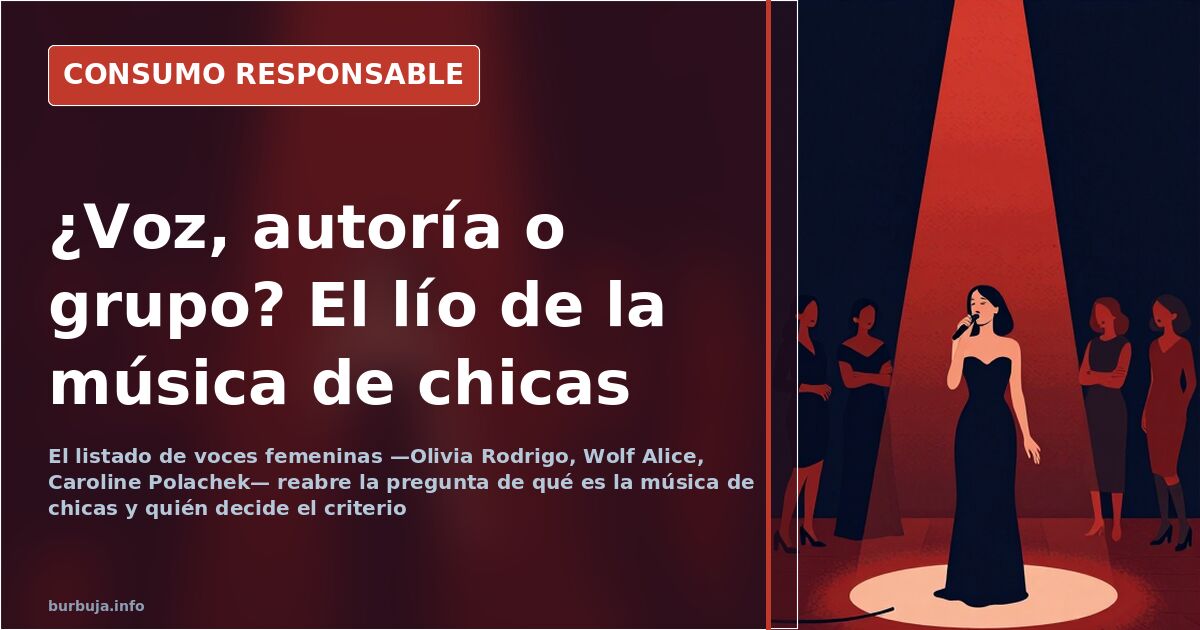
The eternal debate on girl music: voice, authorship, or group?
An open list of female voices — from Olivia Rodrigo to Wolf Alice, Beabadoobee to Caroline Polachek — reopens a never-resolved question: what does "girl music" miccionan? Does it refer to female singers, composers, or leaders of groups? The criteria, often implicit, are the source of disagreement. What is considered girl music?
Two criteria clash. The first focuses on authorship: music composed or produced by women. The second looks at the display: if a woman sings it with prominence, it qualifies. Then there is the uncomfortable view that a "girls-only" list is itself feminist and discriminatory, as classification should be by genre or lyrics, not gender.
This is the knot. With strict authorship, many popular songs fall outside. With the voice criterion, the list fills up, but doubts arise about whether it values music or just female presence. No one has solved the mess, and the question remains alive.
From Holly Humberstone to Caroline Polachek: the list that sparks debate
The starting point is four names. Holly Humberstone opens the proposal; trinc by Olivia Rodrigo, a constant presence in playlists, and Wolf Alice, a British alternative rock quartet. For nostalgics, an unconfirmed classic drawer ranges from Nancy Sinatra to any voice sounding from another era.
The list grows fast. Beabadoobee enters with her guitar pop. The Pretty Reckless, Taylor Momsen's project, brings harder rock, and Avril Lavigne is reclaimed with sincerity mixing disdain and devotion: her song lacked rhythm but was the dream girl. The comment, between joke and tribute, summarizes the site's tone.
Caroline Polachek is highlighted, with Sirens reaching the top 40 in Australia and the US, with a voice and charisma needing no translation. Her comparison to Dua Lipa does not convince defenders, who see her as hard to fit into any mold.
Reaction: disdain, generational feuds, and nostalgia
Not all is enthusiasm. The first response is rejection — calling the proposal trash — and the thread initiator jokes that it is "packed with boomers". She continues posting songs, feeling like she is swimming against the current.
Then comes the Linkin Park entry. A detail almost unknown: a song meant for Meteora, the group's second album, was left out due to its similarity to the hit Numb. It was recovered for the album anniversary with original voice Chester Bennington, deceased in 2017, making it the closest to a new song with his voice since. The point is accurate, but the fit is debatable: in a girl music list, a band of men.
The classic front: María Dueñas and great interpreters
The tone rises when someone demands respect for Vivaldi and classical interpreters. María Dueñas has debuted in Vienna and Paris, works with top directors, signed with Deutsche Grammophon, and rehearses in Paris with Paavo Järvi. She is not a promise: she has a consolidated career at an age when others still audition.
The roster is broad. Hilary Hahn, Yeol Eum Son, Alena Baeva. Against them, some prefer David Geringas, Kim Kashkashian, or Kullervo Kojo, dismissing female repertoire with unsupported disdain. When proper names mix with personal taste, the conversation loses all elegance.
Who writes the song: Nacho Cano, Perales, and Mike Oldfield
Another twist: the author. One song is said to speak of a woman, with style betraying Nacho Cano, prolific in composing and producing for others. Another is attributed to Perales. Someone recalls there is a goldmine in Mike Oldfield compositions sung by women, though doubting if they fit a list of exclusively female groups or main female voices.
ABBA enters, and things get more tangled: if a mixed band counts, practically everything counts. The criteria dilute until disappearing, leaving the reminder of a general music section with hundreds of pages where this would fit better.
Without firm criteria, the list could grow infinitely: just add any female voice singing something decent. There is no clear line separating advocacy from whim, so the question always gets stuck: what counts and what doesn't. No one has found the answer yet, and it may not exist.
An open list of female voices — from Olivia Rodrigo to Wolf Alice, Beabadoobee to Caroline Polachek — reopens a never-resolved question: what does "girl music" miccionan? Does it refer to female singers, composers, or leaders of groups? The criteria, often implicit, are the source of disagreement. What is considered girl music?
Two criteria clash. The first focuses on authorship: music composed or produced by women. The second looks at the display: if a woman sings it with prominence, it qualifies. Then there is the uncomfortable view that a "girls-only" list is itself feminist and discriminatory, as classification should be by genre or lyrics, not gender.
This is the knot. With strict authorship, many popular songs fall outside. With the voice criterion, the list fills up, but doubts arise about whether it values music or just female presence. No one has solved the mess, and the question remains alive.
From Holly Humberstone to Caroline Polachek: the list that sparks debate
The starting point is four names. Holly Humberstone opens the proposal; trinc by Olivia Rodrigo, a constant presence in playlists, and Wolf Alice, a British alternative rock quartet. For nostalgics, an unconfirmed classic drawer ranges from Nancy Sinatra to any voice sounding from another era.
The list grows fast. Beabadoobee enters with her guitar pop. The Pretty Reckless, Taylor Momsen's project, brings harder rock, and Avril Lavigne is reclaimed with sincerity mixing disdain and devotion: her song lacked rhythm but was the dream girl. The comment, between joke and tribute, summarizes the site's tone.
Caroline Polachek is highlighted, with Sirens reaching the top 40 in Australia and the US, with a voice and charisma needing no translation. Her comparison to Dua Lipa does not convince defenders, who see her as hard to fit into any mold.
Reaction: disdain, generational feuds, and nostalgia
Not all is enthusiasm. The first response is rejection — calling the proposal trash — and the thread initiator jokes that it is "packed with boomers". She continues posting songs, feeling like she is swimming against the current.
Then comes the Linkin Park entry. A detail almost unknown: a song meant for Meteora, the group's second album, was left out due to its similarity to the hit Numb. It was recovered for the album anniversary with original voice Chester Bennington, deceased in 2017, making it the closest to a new song with his voice since. The point is accurate, but the fit is debatable: in a girl music list, a band of men.
The classic front: María Dueñas and great interpreters
The tone rises when someone demands respect for Vivaldi and classical interpreters. María Dueñas has debuted in Vienna and Paris, works with top directors, signed with Deutsche Grammophon, and rehearses in Paris with Paavo Järvi. She is not a promise: she has a consolidated career at an age when others still audition.
The roster is broad. Hilary Hahn, Yeol Eum Son, Alena Baeva. Against them, some prefer David Geringas, Kim Kashkashian, or Kullervo Kojo, dismissing female repertoire with unsupported disdain. When proper names mix with personal taste, the conversation loses all elegance.
Who writes the song: Nacho Cano, Perales, and Mike Oldfield
Another twist: the author. One song is said to speak of a woman, with style betraying Nacho Cano, prolific in composing and producing for others. Another is attributed to Perales. Someone recalls there is a goldmine in Mike Oldfield compositions sung by women, though doubting if they fit a list of exclusively female groups or main female voices.
ABBA enters, and things get more tangled: if a mixed band counts, practically everything counts. The criteria dilute until disappearing, leaving the reminder of a general music section with hundreds of pages where this would fit better.
Without firm criteria, the list could grow infinitely: just add any female voice singing something decent. There is no clear line separating advocacy from whim, so the question always gets stuck: what counts and what doesn't. No one has found the answer yet, and it may not exist.
Summary of a discussion on Burbuja.info - Foro de economía, actualidad y política., translated from Spanish and reviewed before publication. Read the full discussion (230 replies).
More summaries
-
Milk Thistle for Fatty Liver: Miracle Cure or Leap of Faith?
A user claims to have lost 4kg and cleared their fatty liver with milk thistle, but skepticism about miracle pills persists.
-
La galleta María, el símbolo de la austeridad que divide a España
La galleta María, un clásico español, enfrenta a quienes la aman y a quienes la critican por su sabor.
-
How many litres of milk can you get from 1 kg of condensed milk?
A forum calculation says a 1 kg can yields 6.6 to 10 litres, but others warn it's not milk but added sugar.
-
Intermittent Fasting Linked to 91% Higher Heart Risk, Unreported by Media
A study claims intermittent fasting raises cardiovascular risk by 91%, but it is observational and relies on self-reported data, yet no major outlet links to the original research.
-
High-Fat, Egg-Rich Diet Sparks Nutritional Debate
Analysis of the high-egg, bacon diet: nutritional myth or metabolic strategy? Explore the arguments for and against this extreme eating pattern.
-
Milk at 50 Cents and Chicken at 4.11 Euros: The Hunt for Bargains Sharpens
Buying milk for 50 cents a liter requires membership fees and travel. Here is how shoppers distribute savings across Spanish supermarkets.