
Roman soldier, 1.90 m tall, found stabbed in a well
A soldier of 1.90 metres, raised in southern Europe, was found stabbed in a well at a Roman fort in the present-day Netherlands. The investigation points to a settling of scores.
English · Original discussion in Spanish · Published
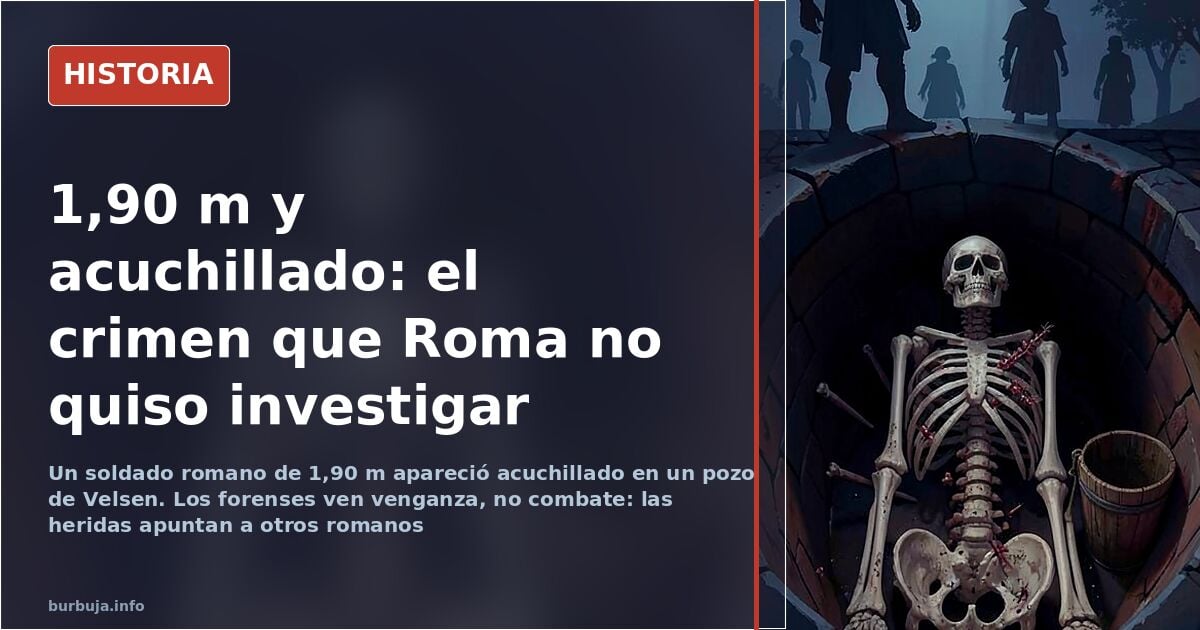
A Roman soldier of 1.90 metres was found stabbed at the bottom of a well
What was a soldier of nearly two metres, raised in southern Europe, doing with a military dagger driven into his pelvis dozens of times, at the bottom of a well at a Roman fort in what is now the Netherlands? Leiden University has peine the case with isotope analysis, osteoarchaeological study and 3D reconstructions, and the interpretation that convinces the researchers most is not the epic one: he was murdered, probably by other Roman soldiers, in a settling of scores.
The skeleton was found in 1977 in Velsen, the site of a military camp. Beside the body lay a military belt, a dagger, a ring, a brooch and a soldier's sandal. Nearly 2,000 years later, forensic experts have found injuries on the inner side of the rib cage and numerous perforations in the pelvis. The violence does not fit a death in defensive combat.
From fallen hero to victim of an internal vendetta
The first hypothesis linked him to the Frisian revolt of AD 28, the one Tacitus describes in his Annals in connection with Roman tax demands. The problem is that the written sources and the archaeological remains do not quite match: archaeology suggests that the Roman presence in the area may have lasted longer than the texts say.
The number of stab wounds, however, points to something else. Forensic specialists interpret the brutality of the injuries as a sign of enormous rage against the victim, more typical of a personal vendetta than of combat. In other words, we may not be looking at a soldier who fell heroically before the barbarians, but at a settling of scores among people who shared a camp.
1.90 metres and a childhood in southern Europe
The dead man stood around 1.90 metres tall and had a highly developed musculature for the standards of the time. In the 1980s it was proposed that he was a Frisian, from the local population. The isotopes in his dental enamel disprove this: he spent his childhood in southern Europe. He ended up dead in the north, but grew up far away from there.
His team does not suggest an officer either. The dagger was worn, the belt mixed different pieces and the scabbard bore decoration more luxurious than the rest of the set. An ordinary soldier with an eye-catching sheath. No name and no military career that can be reconstructed.
The three hypotheses that remain open
The researchers are considering three scenarios: death during a Frisian attack on the fort, execution of a deserter by the Roman command, or murder at the hands of the local population as reprisal. Mark Driessen and Carol van Driel-Murray favour a fourth reading: other Roman soldiers killed him as punishment or reprisal for some improper conduct. The brutality of the wounds fits a personal conflict. None of this has been proven.
The well adds mystery. The fact that he was found with valuable objects suggests, according to a calculation circulating in the debate, someone in a hurry to get rid of the corpse and unable to display those objects in public. An ambush by the native population cannot be ruled out either. And there is a detail that comparative archaeology explains well: the waterlogged, oxygen-free bottom of a well, with its protective sediment, preserves bones, leather and wood for millennia. Like the deceased's sandals.
Roman discipline had a repertoire for this: decimatio, the punishment of decimating a guilty unit by having the soldiers' own comrades execute one in every ten, chosen by lot. Two thousand years later, we still do not know what this man did to deserve so many stab wounds. Only that someone took their time.
Summary of a discussion on Burbuja.info - Foro de economía, actualidad y política., translated from Spanish and reviewed before publication. Read the full discussion (48 replies).
More summaries
-
Ramillies 1706: the battle that buried the Black Legend
The Battle of Ramillies in 1706 marked the end of the Spanish Netherlands. Military records of the time dismantle the myth of a defenceless Spain under Charles II.
-
Why Spain cannot return the American gold to Latin American countries
Calls to return the gold extracted from America run into the fact that Spain no longer exists as an empire and that the metal circulated across Europe. Here are the facts.
-
Harvard: The University Spain Did Not Found in the Americas
Debate: Harvard was founded in 1636, while Latin American universities have operated without Spanish management for 200 years.
-
Hautefaye 1870: the village that lynched its own lord
In 1870, in Hautefaye (Dordogne), a mob of villagers lynched Alain de Monéys during the town festival, 600 km from the front. A case that unsettles…
-
Spain's role in American independence, explained
Spain funded the American cause and fought alongside France from 1779, but its plan to invade England ended in disaster and Gibraltar held out. Was it worth it?
-
Embalming Lenin's body to turn it into a symbol of scientific victory over death
The USSR embalmed Lenin in 1924 as a symbol of science's victory over death. McCorristine's essay examines it. Read on to discover the context.