
Rocío Monasterio Quits Politics After Losing Vox Madrid Leadership
Rocío Monasterio resigns as MP and leaves politics after losing the presidency of Vox in Madrid to José Antonio Fúster.
English · Original discussion in Spanish · Published
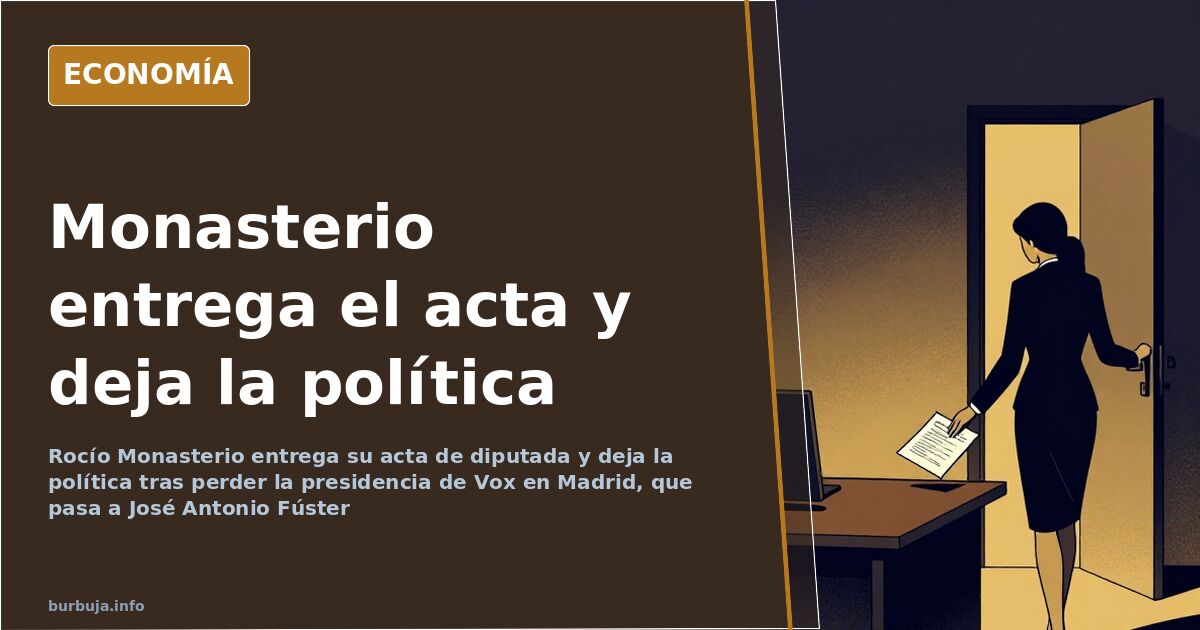
Monasterio Resigns as MP and Leaves Politics After Ouster from Vox
What happens when a party that promised to clean up the system spends its final months cleaning itself out? Rocío Monasterio has surrendered her seat as an MP and left politics after Vox’s national leadership decided to remove her as president of the party in Madrid and impose new management. The former Madrid leader did not leave quietly: according to reports, she attributes the replacement to an appointment "by decree." This move closes a chapter for Abascal's formation and opens another uncomfortable question: how much remains of the original project versus a structure of positions?
What Peine with Rocío Monasterio and Vox Madrid
The trigger is organizational, not ideological. Vox’s national leadership decided to change the Madrid hierarchy and appoint José Antonio Fúster, who had been working within the regional structure, as head. Monasterio, who had been the party’s reference in the Community of Madrid for years, gave up her seat and announced her exit from politics. She did so with accusations of internal nepotism, according to media outlets covering her statements.
The official reading from the party environment is that renewal was necessary and that the former deputy wished to leave the position since December. In other words: they didn't fire her; she quit. Two incompatible narratives for the same fact, leaving voters to decide which one fits.
Vox’s Balance in Madrid: What Remains of the Promise
Here the analysis becomes uncomfortable for allies and opponents alike. Part of the electorate that supported Vox did so out of frustration with the two-party system and corruption, and now argue the party has become Ciudadanos 2.0: a structure where the important thing is the little job title rather than the program. The balance attributed to it is "hard truths"—accurate diagnosis, scarce execution—with limited autonomous measures and the axis of the post-1978 regime intact.
On the other hand, some defend that Monasterio’s departure was necessary because her profile subtracted more than it added in Madrid, and that the real goal is to challenge Ayuso’s absolute majority with a new face. They point out that the replacement was assumed by someone who had actually been on the ground.
The Unceasing Purge: Cleanup or Decapitation?
The most repeated parallel is with Alternative for Germany (AfD), which purged founders to make itself presentable to voters. The difference highlighted is the purpose: some shed ballast to grow; Vox, according to this reading, is shedding cadres without anyone explaining the project's destination. And the liberal sector, represented by Monasterio and her circle, is practically purged.
The practical consequence is that the party is moving toward a more populist and patriotic profile, with less moderation and more epic rhetoric. Whether that is enough to mature into a governing force is exactly what is being debated.
The Gap Left Behind: Alvise, Espinosa, and Orphan Votes
When a party decapitalizes from above, voters look for where to park their anger. Two names come up. First, Iván Espinosa de los Monteros, whom many consider the most expensive lost asset of the operation. Second, Alvise Pérez, who captures anti-system votes with a discourse advocating tax exemption for the first €100,000. That the hope of disillusioned voters lies with a MEP without structure is, at least, a symptom.
In the end, the question isn't who leaves Vox, but how many remain and why. At this rate of departures, the next purge will have to be done by whoever is left to clear the office.
What happens when a party that promised to clean up the system spends its final months cleaning itself out? Rocío Monasterio has surrendered her seat as an MP and left politics after Vox’s national leadership decided to remove her as president of the party in Madrid and impose new management. The former Madrid leader did not leave quietly: according to reports, she attributes the replacement to an appointment "by decree." This move closes a chapter for Abascal's formation and opens another uncomfortable question: how much remains of the original project versus a structure of positions?
What Peine with Rocío Monasterio and Vox Madrid
The trigger is organizational, not ideological. Vox’s national leadership decided to change the Madrid hierarchy and appoint José Antonio Fúster, who had been working within the regional structure, as head. Monasterio, who had been the party’s reference in the Community of Madrid for years, gave up her seat and announced her exit from politics. She did so with accusations of internal nepotism, according to media outlets covering her statements.
The official reading from the party environment is that renewal was necessary and that the former deputy wished to leave the position since December. In other words: they didn't fire her; she quit. Two incompatible narratives for the same fact, leaving voters to decide which one fits.
Vox’s Balance in Madrid: What Remains of the Promise
Here the analysis becomes uncomfortable for allies and opponents alike. Part of the electorate that supported Vox did so out of frustration with the two-party system and corruption, and now argue the party has become Ciudadanos 2.0: a structure where the important thing is the little job title rather than the program. The balance attributed to it is "hard truths"—accurate diagnosis, scarce execution—with limited autonomous measures and the axis of the post-1978 regime intact.
On the other hand, some defend that Monasterio’s departure was necessary because her profile subtracted more than it added in Madrid, and that the real goal is to challenge Ayuso’s absolute majority with a new face. They point out that the replacement was assumed by someone who had actually been on the ground.
The Unceasing Purge: Cleanup or Decapitation?
The most repeated parallel is with Alternative for Germany (AfD), which purged founders to make itself presentable to voters. The difference highlighted is the purpose: some shed ballast to grow; Vox, according to this reading, is shedding cadres without anyone explaining the project's destination. And the liberal sector, represented by Monasterio and her circle, is practically purged.
The practical consequence is that the party is moving toward a more populist and patriotic profile, with less moderation and more epic rhetoric. Whether that is enough to mature into a governing force is exactly what is being debated.
The Gap Left Behind: Alvise, Espinosa, and Orphan Votes
When a party decapitalizes from above, voters look for where to park their anger. Two names come up. First, Iván Espinosa de los Monteros, whom many consider the most expensive lost asset of the operation. Second, Alvise Pérez, who captures anti-system votes with a discourse advocating tax exemption for the first €100,000. That the hope of disillusioned voters lies with a MEP without structure is, at least, a symptom.
In the end, the question isn't who leaves Vox, but how many remain and why. At this rate of departures, the next purge will have to be done by whoever is left to clear the office.
Summary of a discussion on Burbuja.info - Foro de economía, actualidad y política., translated from Spanish and reviewed before publication. Read the full discussion (166 replies).
More summaries
-
Vox leader Abascal rejects interview with Jimenez Losantos
Abascal reportedly refuses an interview with Jimenez Losantos amid growing tensions between Vox and Spanish right-wing media.
-
Abascal's Yacht: Political Rhetoric vs. Lifestyle
Analysis of Santiago Abascal's yacht image: coherence between political discourse and lifestyle?
-
Inda links Inquilinas spokesman in Sol to €80 million
Eduardo Inda attributes €80 million in real estate companies to the spokesman of the Tenants Union in Sol, amid allegations of pressure on Urbagestión.
-
Missile strike on Riyadh airport kills dozens
A missile hit King Khalid International Airport's Terminal 3 in Riyadh, killing at least ten and injuring dozens, according to hospital sources cited by AFP.
-
Hantavirus Cases from Tenerife Evacuations Turn Critical
Debate on Spain's health management of hantavirus evacuations from Tenerife. Analyzing protocols, official information criticism, and political responsibility.
-
Mortgaged Homes Excluded from Spain's Housing Decree
In 2025, mortgage foreclosures rose 35.6% to 31,416. Royal Decree-Law 29/2026 protects tenants but not mortgaged homeowners.