
Riots in France and Italy, and the narrative calling for a tougher crackdown
Riots in France, protests in Italy and a general strike in Spain: an analysis that sees the chaos as a pretext to cut rights and fill prisons
English · Original discussion in Spanish · Published
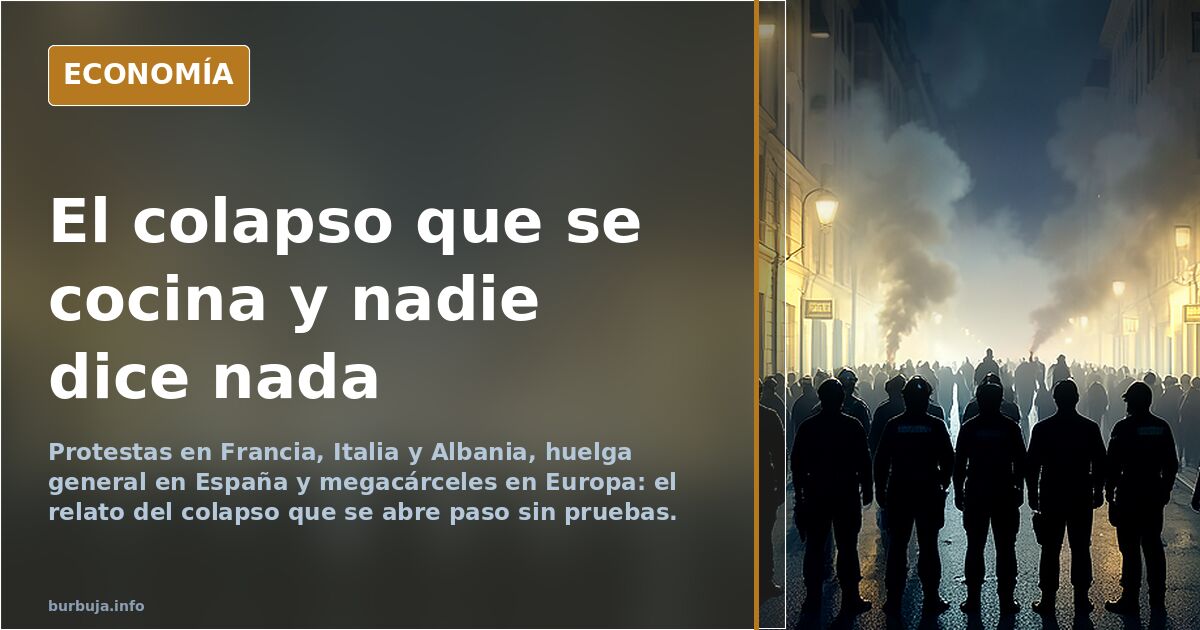
France, Italy and Spain: the narrative of chaos that precedes the cuts
Street riots in France, growing protests in Italy, clashes in Albania and a general strike announced in Spain. Four flashpoints on the same calendar which, for one strand of economic analysis, are not isolated episodes but the same movie playing in four theatres. The thesis: disorder is allowed to grow, or outright cooked up, so that society's demand for order ends up accepting what it would have rejected two years ago. Less social spending, more prison and considerably more of a heavy hand.
Why are the protests in France, Italy and Spain linked?
Because they coincide in time and because, according to this line of thinking, they point to the same place: turning protest into antiestéticar and antiestéticar into a demand for order. The reasoning needs no conspiracy theories. Severe outbreaks mix legitimate grievances with violence, looting and the strengthening of incivil gangs, and in that cocktail public opinion switches sides. The priority stops being the reason for the protest and becomes toughness.
To that is added the European political calendar: government changes on the horizon in several countries, with the particularity that, on this reading, the handover would change nothing in substance because the system remains broken. The only thing the state can exercise without question is the monopoly on violence. And in the Spanish case, the government would be portrayed, before any handover, as incapable of, or complicit in, protests described as uncivil. The Ceuta affair is added to the picture without further elaboration.
The debt nobody questions and the welfare state as the adjustment variable
The bedrock is debt. It is taken as unquestionable, and from there it trinc that Europe cannot manage or provide for its population at the current level of services. Healthcare, public employment and education would be the three legs that fall, or are already falling. The prison system does not escape the reasoning: it is not profitable and, once it stops being public, it does not come back.
The disagreement is over the pace. Against the idea of a sudden collapse, a more uncomfortable description gains ground: a controlled demolition, with no D-day, in which the debt is not new and neither are the protests; only the excuse changes. The consequence looks the same in both scenarios: if the social contract breaks, it will take decades to recover economic levels comparable to those known so far.
Mega-prisons in Belgium and France: the business of empty cells
Against that backdrop, the infrastructure begins to be built. The focus is on mega-prison projects in Belgium and France designed to house a large inmate population in peripheral areas, far from the centre. Europe already has a mixed public-private model, and the risk described is an accounting one: if management ends up in private hands, the operator is paid per occupied cell and can penalise the state for empty ones. The incentive, then, is to fill them. With any offence whatsoever.
The argument is not sarracena, it is about incentives. Poorly trained, badly paid staff in enormous facilities, pressure to fill places and a compound where incarceration is extended. On that logic, it is held that an offender outside prison is one less customer and that the business benefits from their prompt return. The mega-prison, in short, works as a pressure cooker and as the tool being prepared for the next phase.
Bukele's 40% and the reintegration trap
The case of El Salvador serves as both a mirror and a warning. An announcement dated October 13 is cited, when the president of that country expressed his intention to release 40% of the people he has imprisoned. From there comes the central argument: the one who imprisons and the one who releases are the same person, and there is no check other than his judgement.
The defence also has numbers. It is argued that those inmates will not leave unless power changes hands and that, if they do, they will return the way they went in. The debate breaks down right there: some see the perpetuation of crime and future revenge; others see order restored in a country that, it is recalled, was far worse before. For now, no one provides a recidivism series that settles the matter.
Who amplifies the narrative and what slips through as information
In the phase of confusion, the loudspeakers appear. It is claimed, without proof, that certain commentators and geopolitical communicators — names such as Iker Jiménez, Rubén Gisbert or Pedro Baños are mentioned — act as channels for frustration and disinformation, some inward and others outward. It is an accusation that circulates as a hypothesis, not as a proven fact, and should be read as such.
At the same time, the narrative of chaos itself drags along material of dubious reliability. There is the reference to the Kalergi Plan, a conspiracy theory with no documentary backing that has been repeated for years. And there is the temptation to attribute every riot to a specific group — students, protesters, migrant communities — without data to support it. That attribution is precisely what other voices identify as the useful part of the script.
Will there be a general strike in Spain and riots like in France?
Scepticism rules in the Spanish case. The call for a general strike is viewed with reservations in the private sector, where few people are expected to trinc it, and some outright dismiss an outbreak: here, it is said, people put up with things. Others add that in Spain protest is called by the government itself and needs no hiding, a reading that fits poorly with the image of an overwhelmed state.
The other version of the story focuses on housing rather than the streets. Against the narrative attributing the French mobilisations to student sensitivities, the response is the evidence of the images and a simple question: how many students are actually there? What remains is a tense calm that no one knows how long will last.
With these ingredients, the discussion gets stuck on one very specific point: if everything is choreographed, what is missing is knowing who signs the script and who gets cast as the villain. There, for now, there are only suspicions.
Also available in: Deutsch
Summary of a discussion on Burbuja.info - Foro de economía, actualidad y política., translated from Spanish and reviewed before publication. Read the full discussion (155 replies).
More summaries
-
Italy's defence minister blames foreign hybrid war for Milan riots
Guido Crosetto attributes the Milan riots to a hybrid war waged from abroad without naming any actor or providing evidence, while Meloni's government tightens the legal response.
-
Riots at Milan's Duomo: looting and rent protest
Riots broke out at Milan's Duomo: looting, stones thrown at the cathedral and a rent protest that Meloni's government is failing to address.
-
Ayuso rumor: private life as political noise in Spain
Unverified tweet links Madrid leader Ayuso to TV pundit, sparking debate on privacy standards.
-
Colombian shadow looms over Vox's leadership
A purported Colombian vice-president within Vox has sparked mockery on social media. Real or a hoax? We examine the case after a debate on an economic forum.
-
Ayuso confirms microphones found at Quirón in Madrid health spying row
Isabel Ayuso has confirmed the discovery of microphones in the offices of the Quirón hospital group in Madrid. The case echoes the Torrejón Hospital affair and revives suspicions of political spying.
-
Spanish PM's appearance fuels economic speculation
The Spanish prime minister's looks have sparked speculation about his health and his ability to manage the economy. Acting strategy or genuine burnout?