
Rice doesn't make you fat; portion and pairings do
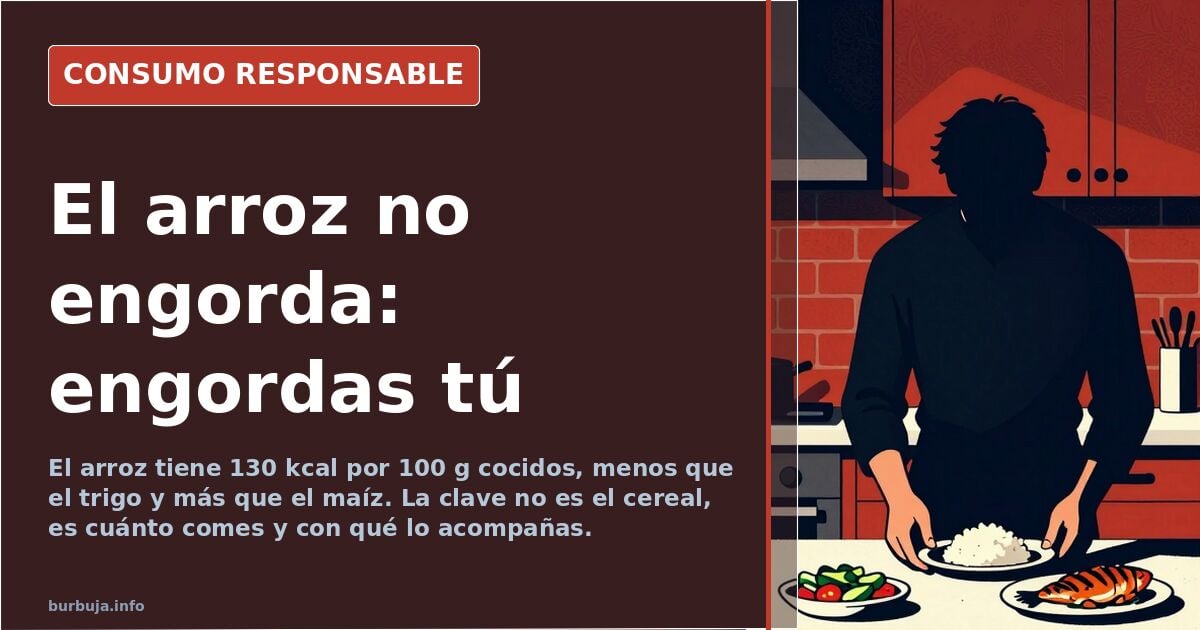
Cooked rice has 130 kcal per 100g, less than wheat but more than corn. The key isn't the grain itself, but how much you eat and what you serve it with.
English · Original discussion in Spanish · Published
Does rice cause weight gain, or does the eater?
A plate of rice, two bowls, a night of bloating, and a morning feeling pregnant. The core question is simple: does rice make you fat, or is it your body's reaction? The short answer is that rice alone has no magical property to create fat from nothing. It does contain 130 kilocalories per 100 grams cooked, a figure placing it below corn (95) and far below wheat (339). The problem isn't the cereal: it's the quantity, the accompaniments, and the metabolic state of the person eating it.
Caloric content of rice and comparisons
The most cited data point is 130 kcal per 100 grams of cooked rice. Compared to other cereals, rice sits in the middle: fewer calories than wheat, more than corn. The trap is that these figures refer to the product already cooked, while raw rice has a much higher energy density. Someone eating two generous bowls isn't consuming 130 calories, but several times that amount. The full calculation, accounting for dry weight and absorbed water, debunks the idea that rice is a light food.
Some argue the real issue isn't rice's calories, but what you add to it. Rice with squid, without excess and without bread, is considered a reasonable option. The same rice with a thick sauce, cured meats, or bread on the side completely changes the balance. The difference between a healthy dish and a calorie bomb lies not in the cereal, but in the overall composition.
Why rice causes bloating then subsides
The initial bloating described has an explanation unrelated to fat. Rice expands in the stomach, and if consumed excessively, continues to expand during digestion. This is compounded by intestinal bacteria fermenting carbohydrates, producing gas. The result is a belly that may look like pregnancy but deflates within hours. It is not accumulated fat: it is intestinal content and gas.
Constipation is another mentioned factor. Anything hindering intestinal transit tends to cause retention and bloating. The equation proposed is simple: what prevents bowel movements makes you feel heavier. It's not a physical law, but it well describes the difference between actual weight and apparent weight. The scale the next morning doesn't measure fat, but what remains inside.
The debate on carbohydrates and insulin
The discussion moves to technical ground. One school argues that carbohydrates are the only macronutrient that spikes insulin, and insulin stores glucose as fat. Without carbs, they claim, there is no equivalent mechanism to accumulate fat from dietary fat: the process is longer, passes through the liver, and part is excreted before storage. Their conclusion is that dietary fat doesn't inherently cause weight gain, and the problem lies in excessive carbohydrate intake.
The opposing view doesn't deny insulin's role but reminds us the organism isn't a closed system or an engine burning fixed fuel. Many processes exist, and the body can waste energy. The key, they say, is the balance between input and output. Eating more than you burn causes weight gain, and eating less leads to loss, regardless of whether the excess comes from rice, meat, or butter. Macronutrients influence how much you eat and how it's managed, but don't eliminate arithmetic.
The animal and nature argument
One repeated argument involves wild animals. Obese animals aren't seen in nature despite abundant food access. The explanation given is that they eat what they're designed for, instinctively, and their bodies regulate hunger optimally. Carnivores eat until stuffed after a kill but don't accumulate fat because their metabolism handles that fuel well. Omnivores store fat before migration or hibernation, then lose it. Humans, domesticated, supposedly lost this instinct.
The objection is that wild animals don't chronically overeat because natural selection eliminates those who do. If a species had constant abundant food, its population would increase, not individual weight. Bears gaining weight before hibernation do so because they face months without food afterward: the surplus is temporary and addresses future deficits. This example reopens rather than closes the debate.
Experience with high-fat diets
The most detailed case involves a person with an autoimmune disease trinc a diet based almost exclusively on meat and fish. During initial adaptation weeks, they ate until full, trinc recommendations, and didn't gain weight. They explain that the body breaks protein into amino acids, uses what's needed, and converts surplus to glucose. Animal protein utilization is around 50%, while vegetable protein stays at 20%, hindered by antinutrients.
The counterargument is that this initial phase isn't representative. It's a nutrient recharge period after poor diet or illness, and observed weight loss is often fluid retention elimination. Maintaining such a diet indefinitely, they argue, would eventually lead to weight gain. The discussion remains open: some cite morbid obesity cases losing weight eating fat, while others respond those cases abandon the diet precisely because they gain weight.
Ultimately, the initial question lacks a single answer. Rice doesn't inherently cause weight gain, nor does it promote weight loss. What causes gain is surplus, accompaniments, and the habit of eating until stuffed. And the 'pregnant' belly the next morning is, almost always, just gas.
A plate of rice, two bowls, a night of bloating, and a morning feeling pregnant. The core question is simple: does rice make you fat, or is it your body's reaction? The short answer is that rice alone has no magical property to create fat from nothing. It does contain 130 kilocalories per 100 grams cooked, a figure placing it below corn (95) and far below wheat (339). The problem isn't the cereal: it's the quantity, the accompaniments, and the metabolic state of the person eating it.
Caloric content of rice and comparisons
The most cited data point is 130 kcal per 100 grams of cooked rice. Compared to other cereals, rice sits in the middle: fewer calories than wheat, more than corn. The trap is that these figures refer to the product already cooked, while raw rice has a much higher energy density. Someone eating two generous bowls isn't consuming 130 calories, but several times that amount. The full calculation, accounting for dry weight and absorbed water, debunks the idea that rice is a light food.
Some argue the real issue isn't rice's calories, but what you add to it. Rice with squid, without excess and without bread, is considered a reasonable option. The same rice with a thick sauce, cured meats, or bread on the side completely changes the balance. The difference between a healthy dish and a calorie bomb lies not in the cereal, but in the overall composition.
Why rice causes bloating then subsides
The initial bloating described has an explanation unrelated to fat. Rice expands in the stomach, and if consumed excessively, continues to expand during digestion. This is compounded by intestinal bacteria fermenting carbohydrates, producing gas. The result is a belly that may look like pregnancy but deflates within hours. It is not accumulated fat: it is intestinal content and gas.
Constipation is another mentioned factor. Anything hindering intestinal transit tends to cause retention and bloating. The equation proposed is simple: what prevents bowel movements makes you feel heavier. It's not a physical law, but it well describes the difference between actual weight and apparent weight. The scale the next morning doesn't measure fat, but what remains inside.
The debate on carbohydrates and insulin
The discussion moves to technical ground. One school argues that carbohydrates are the only macronutrient that spikes insulin, and insulin stores glucose as fat. Without carbs, they claim, there is no equivalent mechanism to accumulate fat from dietary fat: the process is longer, passes through the liver, and part is excreted before storage. Their conclusion is that dietary fat doesn't inherently cause weight gain, and the problem lies in excessive carbohydrate intake.
The opposing view doesn't deny insulin's role but reminds us the organism isn't a closed system or an engine burning fixed fuel. Many processes exist, and the body can waste energy. The key, they say, is the balance between input and output. Eating more than you burn causes weight gain, and eating less leads to loss, regardless of whether the excess comes from rice, meat, or butter. Macronutrients influence how much you eat and how it's managed, but don't eliminate arithmetic.
The animal and nature argument
One repeated argument involves wild animals. Obese animals aren't seen in nature despite abundant food access. The explanation given is that they eat what they're designed for, instinctively, and their bodies regulate hunger optimally. Carnivores eat until stuffed after a kill but don't accumulate fat because their metabolism handles that fuel well. Omnivores store fat before migration or hibernation, then lose it. Humans, domesticated, supposedly lost this instinct.
The objection is that wild animals don't chronically overeat because natural selection eliminates those who do. If a species had constant abundant food, its population would increase, not individual weight. Bears gaining weight before hibernation do so because they face months without food afterward: the surplus is temporary and addresses future deficits. This example reopens rather than closes the debate.
Experience with high-fat diets
The most detailed case involves a person with an autoimmune disease trinc a diet based almost exclusively on meat and fish. During initial adaptation weeks, they ate until full, trinc recommendations, and didn't gain weight. They explain that the body breaks protein into amino acids, uses what's needed, and converts surplus to glucose. Animal protein utilization is around 50%, while vegetable protein stays at 20%, hindered by antinutrients.
The counterargument is that this initial phase isn't representative. It's a nutrient recharge period after poor diet or illness, and observed weight loss is often fluid retention elimination. Maintaining such a diet indefinitely, they argue, would eventually lead to weight gain. The discussion remains open: some cite morbid obesity cases losing weight eating fat, while others respond those cases abandon the diet precisely because they gain weight.
Ultimately, the initial question lacks a single answer. Rice doesn't inherently cause weight gain, nor does it promote weight loss. What causes gain is surplus, accompaniments, and the habit of eating until stuffed. And the 'pregnant' belly the next morning is, almost always, just gas.
Also available in: Deutsch
Summary of a discussion on Burbuja.info - Foro de economía, actualidad y política., translated from Spanish and reviewed before publication. Read the full discussion (114 replies).
More summaries
-
Pasta doesn't cause weight gain: what carb data reveals
Pasta contains about 70g of carbs per 100g, yet Italy eats it daily with lower obesity rates than Spain. Examining the myth and its nuances.
-
Carnivore diary: 1,500 calories and zero carbs a day
A June 2025 carnivore diary: 1,500 calories a day, zero carbs and total cholesterol 193, with fat, not protein, as the key.
-
Stuck Faucet Eccentric: Limescale, Hemp, and DIY Fixes
A faucet eccentric stuck by decades of limescale and hemp. Discover which remedies work (vinegar, torch, wrench) and when to call a plumber.
-
Yo-Yo Dieting: The Trap of Extreme Calorie Restriction
Low-calorie diets yield quick results but often lead to weight regain. Stories of those who lost 20kg and those who maintained it.
-
EU Bottle Cap Rule Sparks Outrage in Spain
The EU directive requiring tethered bottle caps, set for 2024, is adopted early by brands due to ESG ratings. Only 30% of plastic is recycled.
-
Wood furniture: you pay for the story, not the material
An oak desk costs €800 while solid wood second-hand sells for €30. The premium isn't in the wood, but in the narrative.