
Returning your insurance premium payment can end in court and legal costs
Returning an insurance premium without giving two months' notice can end up in court: some drivers have paid the full year plus legal costs. Premium hikes are making insurers more aggressive.
English · Original discussion in Spanish · Published
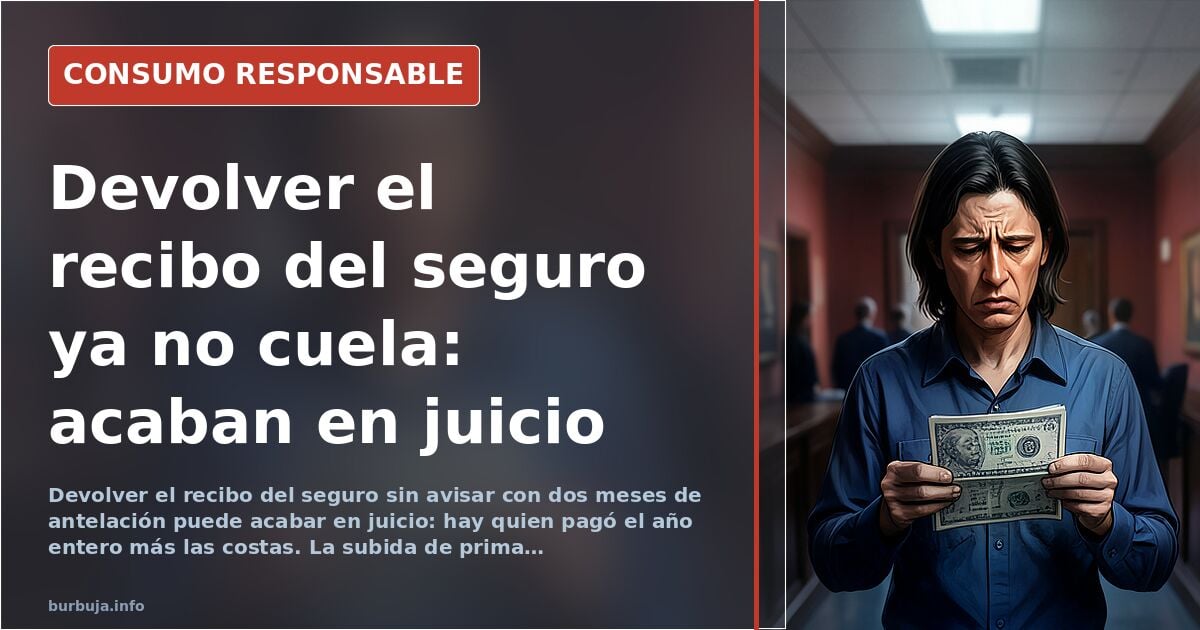
Returning your insurance premium is no longer free of consequences: some drivers ended up paying the full year plus legal costs
The family tradition used to be simple: switch insurers, return the premium payment and cross your fingers. One driver sums it up bluntly: he took out a policy with Mutua Madrileña that was "considerably cheaper" than his Mapfre one and applied the inherited method. The question he raised —"this can get you into trouble, right?"— has a documented answer in the everyday courts. Yes, it can. And it happens more and more often.
The legal framework is what it is: car policies renew automatically unless the policyholder gives two months' notice before the expiry date. Returning the payment does not terminate the contract; it simply turns the policyholder into a debtor in the insurer's eyes. The belief that simply not paying will make the policy die on its own is, in the words of one participant, "like people in their 50s and 60s who still don't pay fines by refusing to sign for the notification": it works until the seizure order shows up.
What happens if you return the premium payment without giving notice first
The range of consequences described in the discussion runs from cosmetic to expensive. At the mild end, calls and letters designed to intimidate. At the harsh end, a specific case: a driver with a policy at a mutual insurer returned the payment and ended up in court for failing to give two months' notice. He lost. "In the end I had to pay it all, plus the lawyer's fees and everything else," he recounts. For a whole year he paid two simultaneous policies for the same car.
Some argue that suing isn't worth it for insurers: legal costs exceed the premium being claimed and recovery isn't guaranteed. That calculation is reasonable for low premiums. For premiums jumping from 700 euros to 900, the arithmetic changes. And the crisis is tightening the screws: "Before the crisis they couldn't care less about returns. Now they go for the kill," another message sums up.
The premium hike as a defence argument
Here lies the most interesting legal nuance raised in the discussion. If the company modifies the premium —even by a single cent— some argue that this is no longer the same policy but a new one, and therefore the two-month notice obligation does not apply. The policyholder concerned saw his renewal go from 700 to 900 euros, a 20% increase, after seven years with hardly any claims and three claims on file.
The counterargument comes quickly: policies include CPI-linked update clauses and penalty systems based on claims history that allow insurers to raise the premium without formal notification. A single at-fault claim involving a third party can multiply the premium by 1.12 automatically. The fine print covers more than the policyholder thinks. The information asymmetry is the real battlefield: the renewal arrives a month and a half before expiry, when the notice period is already technically compromised.
The broker route: switching companies two days before
It's not all bad news. One case shows the professionalised path: with the policy about to expire, the broker managed the switch to another company two days before the deadline, without mentioning the two months or applying any penalty. Brokers have access to rates and conditions that insurers don't offer to individuals calling by phone.
The contrast with the DIY route is stark. Whoever calls their lifelong insurer at the last minute depends on the goodwill of the call-centre operator. Whoever has a broker has a professional whose interest is in keeping the client by finding them another policy. The difference between the two experiences lies not in the law, but in who manages the process.
Double insurance and the fine print nobody reads
The conversation drifts towards a technical question: what happens if you have two active policies for the same car during the year? The answer circulating is that only one can be in force —the older one— and the new company would have to refund the money. It's a hypothesis that generates scepticism even among those who raise it.
The most repeated and most sensible advice: send a certified fax (burofax) communicating the cancellation. That way, in the worst case, the claim is limited to the proportional part of two months. It's the difference between disputing a small figure and disputing the full year plus legal costs. The family tradition, in short, is living on borrowed time.
The policy renews itself, the payment gets returned by itself and the courtroom arrives on its own. The only thing that isn't automated is the two months' notice. That's where the traffic jam remains.
The family tradition used to be simple: switch insurers, return the premium payment and cross your fingers. One driver sums it up bluntly: he took out a policy with Mutua Madrileña that was "considerably cheaper" than his Mapfre one and applied the inherited method. The question he raised —"this can get you into trouble, right?"— has a documented answer in the everyday courts. Yes, it can. And it happens more and more often.
The legal framework is what it is: car policies renew automatically unless the policyholder gives two months' notice before the expiry date. Returning the payment does not terminate the contract; it simply turns the policyholder into a debtor in the insurer's eyes. The belief that simply not paying will make the policy die on its own is, in the words of one participant, "like people in their 50s and 60s who still don't pay fines by refusing to sign for the notification": it works until the seizure order shows up.
What happens if you return the premium payment without giving notice first
The range of consequences described in the discussion runs from cosmetic to expensive. At the mild end, calls and letters designed to intimidate. At the harsh end, a specific case: a driver with a policy at a mutual insurer returned the payment and ended up in court for failing to give two months' notice. He lost. "In the end I had to pay it all, plus the lawyer's fees and everything else," he recounts. For a whole year he paid two simultaneous policies for the same car.
Some argue that suing isn't worth it for insurers: legal costs exceed the premium being claimed and recovery isn't guaranteed. That calculation is reasonable for low premiums. For premiums jumping from 700 euros to 900, the arithmetic changes. And the crisis is tightening the screws: "Before the crisis they couldn't care less about returns. Now they go for the kill," another message sums up.
The premium hike as a defence argument
Here lies the most interesting legal nuance raised in the discussion. If the company modifies the premium —even by a single cent— some argue that this is no longer the same policy but a new one, and therefore the two-month notice obligation does not apply. The policyholder concerned saw his renewal go from 700 to 900 euros, a 20% increase, after seven years with hardly any claims and three claims on file.
The counterargument comes quickly: policies include CPI-linked update clauses and penalty systems based on claims history that allow insurers to raise the premium without formal notification. A single at-fault claim involving a third party can multiply the premium by 1.12 automatically. The fine print covers more than the policyholder thinks. The information asymmetry is the real battlefield: the renewal arrives a month and a half before expiry, when the notice period is already technically compromised.
The broker route: switching companies two days before
It's not all bad news. One case shows the professionalised path: with the policy about to expire, the broker managed the switch to another company two days before the deadline, without mentioning the two months or applying any penalty. Brokers have access to rates and conditions that insurers don't offer to individuals calling by phone.
The contrast with the DIY route is stark. Whoever calls their lifelong insurer at the last minute depends on the goodwill of the call-centre operator. Whoever has a broker has a professional whose interest is in keeping the client by finding them another policy. The difference between the two experiences lies not in the law, but in who manages the process.
Double insurance and the fine print nobody reads
The conversation drifts towards a technical question: what happens if you have two active policies for the same car during the year? The answer circulating is that only one can be in force —the older one— and the new company would have to refund the money. It's a hypothesis that generates scepticism even among those who raise it.
The most repeated and most sensible advice: send a certified fax (burofax) communicating the cancellation. That way, in the worst case, the claim is limited to the proportional part of two months. It's the difference between disputing a small figure and disputing the full year plus legal costs. The family tradition, in short, is living on borrowed time.
The policy renews itself, the payment gets returned by itself and the courtroom arrives on its own. The only thing that isn't automated is the two months' notice. That's where the traffic jam remains.
Also available in: Deutsch
Summary of a discussion on Burbuja.info - Foro de economía, actualidad y política., translated from Spanish and reviewed before publication. Read the full discussion (28 replies).
More summaries
-
Recommend me HOME INSURANCE companies you've had good experiences with
Looking for home insurance? Real experiences with Mapfre, Occident, Mutua, Generali and Santa Lucía. Find out which insurers consumers actually recommend.
-
Is Mutua Madrileña no longer the cheapest? Low-cost alternatives that save
Looking for car insurance cheaper than Spain's Mutua Madrileña? Balumba, Direct Seguros and Ineas offer prices from 280 euros, but with hidden risks
-
Carrefour ends double refund for pricing errors
Carrefour no longer refunds double the difference for overcharges, limiting compensation to the simple amount as per new store policies.
-
Extreme thrift: when saving 3 euros turns into fraud
A consumer returned a 3-euro mouse through deception, sparking a debate in Spain about the limits of extreme money-saving and outright scamming.
-
Spanish Catholicism loses believers but boosts outreach
Forum debate: Spanish Catholicism drops to 50% with only 15% attending mass, while expanding workshops and mental health presence.
-
Beginner Gym Guide: Building Muscle at 68kg and Age 32
A 32-year-old man weighing 68 kg seeks advice on starting the gym, full-body routines, protein intake, and deadlift safety.