
Beginner Gym Guide: Building Muscle at 68kg and Age 32
A 32-year-old man weighing 68 kg seeks advice on starting the gym, full-body routines, protein intake, and deadlift safety.
English · Original discussion in Spanish · Published
Beginner Gym Guide: Building Muscle at 68kg and Age 32
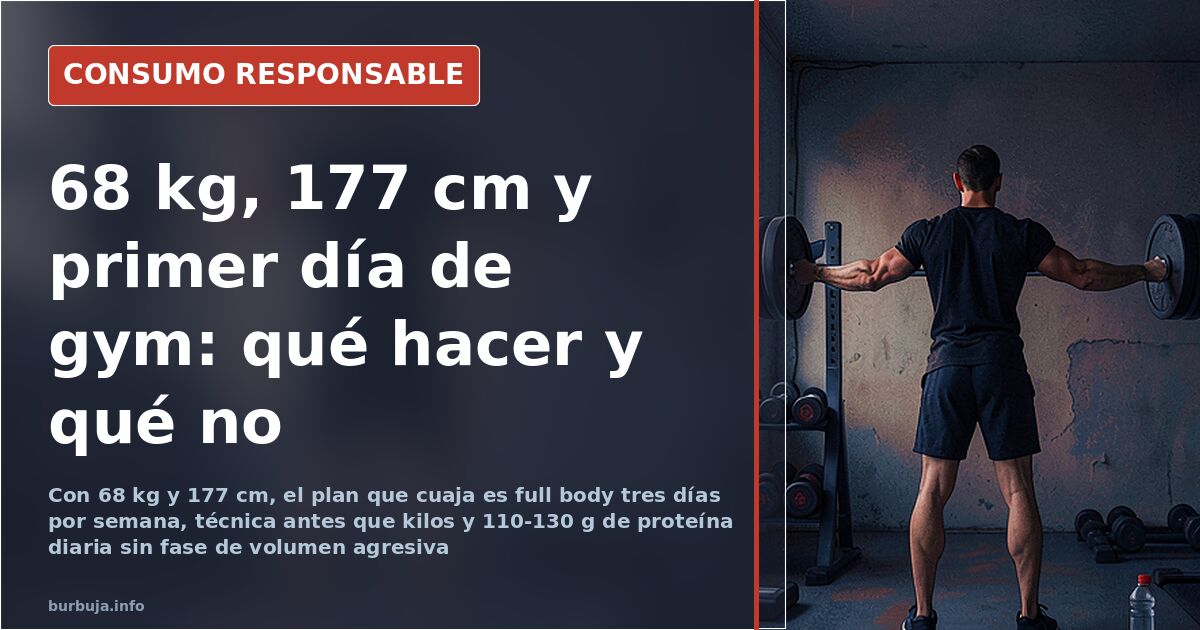
A 32-year-old man, 177 cm tall and weighing 68 kg, announces he will start going to the gym for the first time next week. He practices calisthenics, comes from a tennis background, and wants a lean, defined physique: "I hate bodies that tend toward chubby." He asks for a routine, advice on protein powder, and even which gold chain suits him best. The response he receives maps out the reality of someone entering a gym without knowing where to start: technique before weight, patience before supplements, and an open war over antiestéticar of injury.
The starting point is not bad. With a BMI of 21.7 and sports experience, the diagnosis agrees: there is a base, but muscle is lacking. The most repeated recommendation for three days a week is a full-body routine with compound exercises — squats, bench press, rows, overhead press, and pull-ups or lat pulldowns — doing three sets of 8 to 12 reps with a rest day between sessions. Pogre, increasing weight or reps each week, is what drives growth.
How much protein do you need to gain muscle at 68 kilos?
The range used is around 110-130 grams daily, sourced from eggs, chicken, tuna, legumes, yogurt, or cottage cheese. The proposed caloric surplus is minimal, 200 to 300 kilocalories per day, because the goal is not to get fat but to recompose body composition. If weight increases by more than half a kilo a month, you are eating too much. Protein powders remain what they are: a dispensable supplement that does not replace food nor work miracles.
Guided machines and cables: the way to avoid injury when starting
Here consensus breaks. One current advocates starting with guided machines and cables for two weeks, learning the movement path, warming up for fifteen minutes, and leaving ego at the door. Another holds the opposite view: injuries come from accumulated fatigue, not specific exercises; you must train with intensity and push limits, as antiestéticar paralyzes more than iron does. The deadlift concentrates the controversy: some discard it initially due to technical difficulty; others consider it simply unnecessary.
Technique, however, is not debated. Mastering the three phases of each rep — lifting, holding, lowering — and controlling the negative phase is the recommendation across all positions. If you cannot control the weight throughout the range of motion, you are lifting too heavy. This warning extends to shoulders and pressing movements, where pogre must be real and without forcing.
Three days, discipline, and the risk of quitting halfway
Consistency weighs more than the plan. Three fixed days — Wednesday, Friday, and Sunday, for example — without missing unless absolutely necessary, because each absence chains the next and ends in abandonment. Some warn that three sessions are few and would propose four, but the counterbalance is evident: the gym takes time, and adding days early multiplies the risk of quitting.
The profile of the beginner arriving at 68 kilos also gets a dose of genetic realism. He is reminded that his thin build will make gaining volume harder than for others, that he should prioritize back and legs, and that visible abs are not a training achievement but a result of genetics and low body fat. The alternative of manual labor — a month of construction work — appears as a recurring joke against the monthly membership fee.
The prediction with reservations: if he maintains discipline three days a week for six months, improvement will be visible. If he quits in the third week, the gym will have been another paid-but-unused membership. The difference between both scenarios is not decided by the routine.
Also available in: Deutsch
Summary of a discussion on Burbuja.info - Foro de economía, actualidad y política., translated from Spanish and reviewed before publication. Read the full discussion (151 replies).
More summaries
-
Protein powder prices jump 200% as buyers turn to real food
5 kg bags of whey protein have gone from 36 to over 140 euros in Spain. The surge is driving demand for plant-based alternatives and a return to real food.
-
EU's €3 parcel levy ends AliExpress's cheap era
The EU's €3 per category fee sends AliExpress prices soaring: a €3 order now costs €11. The Chinese parcel model faces collapse.
-
Muscle without a Gym: A Practical Guide to Strength, Diet, and Injury Prevention
Insights from nearly six years of discussions on home workouts, protein, tendinitis, and affordable nutrition for building strength without paying monthly fees.
-
Nestlé and Dolca: 30% vs 25% Cacao, Same Price in Spain
Nestlé and Dolca chocolates differ by just 5% cacao yet cost nearly the same, revealing that budget brands in Spain are no longer significantly cheaper.
-
Spain's bicycle bubble bursts: 40% discounts and inflated prices collapse
In Spain, the cycling boom has ended. Shops offer 40% discounts as demand falls. The cost of looking professional reaches €5,905.
-
Williams Ice Blue Shrinkage: Unilever Changes Stick Format
The Williams Ice Blue stick dries out unopened due to a new format lacking the rotor seal, allowing air entry and product shrinkage.