
Retirement in 2045: Paid-off Home, Savings, and Family Support
Forecasts for 2045 retirees predict flat pensions of €1,200 and shrinking family networks. Housing equity, savings, and health are key differentiators.
English · Original discussion in Spanish · Published
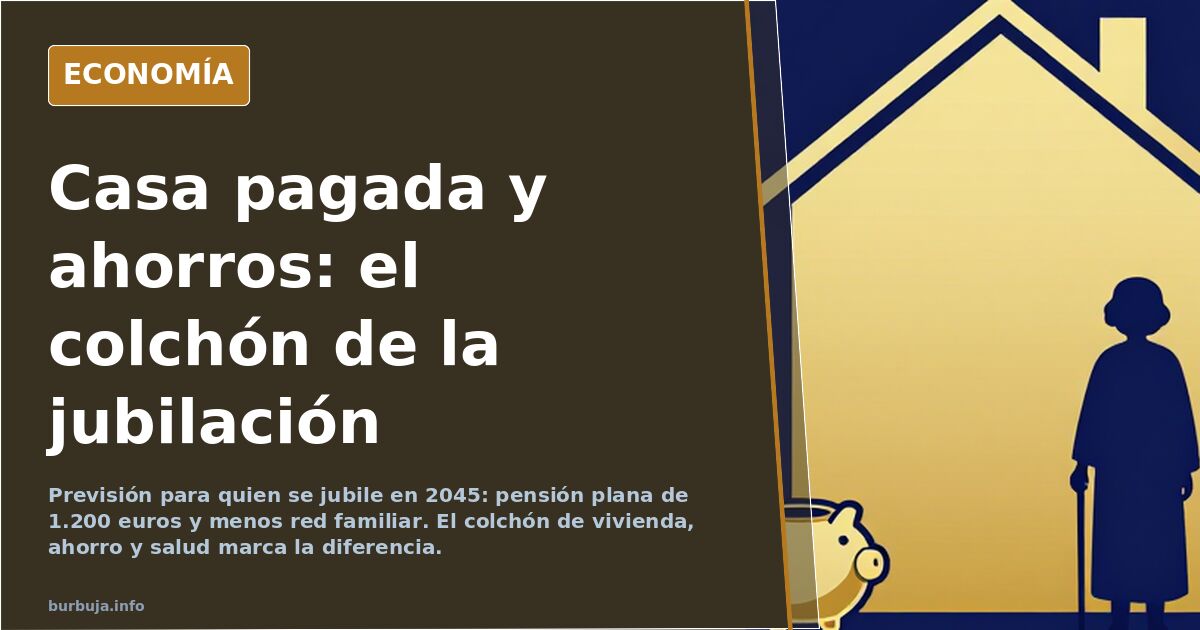
Retiring in 2045: A paid-off home, savings, and someone to care for you
Spain’s baby boom peak, which one forum user places around 1975, has an uncomfortable arithmetic consequence: those born that year begin approaching retirement age in the mid-2030s, flipping the ratio of contributors to pensioners. Built on this date is a grim forecast: anyone reaching old age without a mortgage-free home, no savings, no family support, and neglected health will struggle. This is not an election slogan. It is a checklist with four items.
The diagnosis mixes macroeconomic trends with domestic realities. On one side, the population pyramid; on the other, estimated pensions, care homes, loneliness, and public healthcare. A fundamental question runs through it all: Will the State continue covering what it used to, or will adjustments come at the expense of older people with weaker support networks?
The four pillars of financial security: housing, savings, family, and health
The first pillar is real estate. A home free of mortgage debt, community fees, major renovations, and ideally with an elevator. This isn’t aesthetic preference; it’s a fixed cost that stops rising annually once secured. The second is a cushion of several thousand euros for emergencies, domestic help, and medical expenses that, according to this view, the system may not cover.
The third cannot be bought. It is a support network: children, nieces/nephews, true friends, or a partner who spots scams early, drives you to appointments, or handles paperwork when digital literacy fails. The author experienced this with grandparents: with family love, “they had everything they needed”; without it, he argues, the elderly are lost. The fourth pillar is health: no smoking, moderate drinking, sensible eating, and avoiding a sedentary lifestyle.
Can you live on a pension in 2045? €1,200 and €700 per month
It depends on whether your home is paid off and if you face rent. One participant forecasts two flat-rate pensions: €1,200 for contributory and €700 for non-contributory, both eroded by accumulated inflation, meaning identical amounts regardless of career earnings. With these figures, the conclusion is stark: many won’t have enough to afford food and even a single room rental.
Here lies the first serious disagreement. Against those urging maximum saving, others argue forecasting is futile: they’ve heard warnings for two decades, yet unemployment fell, employment rose, and catastrophe didn’t materialize. The counterargument is clear: demographics aren’t opinion.
The Banco de España’s 1.74 figure: benefits received versus contributions made
This section relies on authoritative data. Cited figures attribute to the Banco de España the calculation that each pensioner receives €1.74 for every euro contributed—74% more than paid—and recovers their total input within twelve years of retirement. Another headline claims the average retiree would receive €4,500 annually without having contributed. The takeaway: the system isn’t a personal piggy bank but an intergenerational transfer requiring new taxpayers.
That’s where the red light flashes. The 1975 birth peak coincides with the moment the largest generation starts collecting benefits while no equivalent cohort pays into the system behind them.
The population pyramid and the year the system breaks
A calculation posted in the thread suggests fifteen years remain before collapse under current design. Another translates this domestically: if working life extends twenty more years, today’s 55-year-olds would retire at 75. Retirement age becomes the invisible adjustment nobody wants to announce at rallies.
Those five to seven years from retirement see it differently: they assume secured pensions and predictable futures, placing the crisis on successors around 2060–2070. This generational fracture cuts through the content: those near journey’s end versus those facing twenty-five years of old age ahead.
Care homes, loneliness, and family: crumbling support systems
The starkest chapter concerns care. Those familiar with nursing homes describe overmedication, abuse, fractures, and overwhelmed, poorly paid staff: the State, they argue, shifted responsibility onto workers nobody else wants to bear. Swept under the rug.
Loneliness compounds this. The comparison is devastating: previously, three siblings and three children offered lifelong support; now, typical families have one child plus divorce, leaving many elderly alone. Another derivative claim, unsupported by data, veers into hostile rhetoric toward immigration and seniors themselves.
Underlying themes mix euthanasia, dark humor, and resignation. One user knows someone hoping to die watching TV, forgotten for ten years; another notes we all eventually become cat, dog, or worm food.
Where the calculation stalls
The blind spot remains constant. If the system holds, private savings complement reasonably; if adjustments come via taxes and requirements, savings may become targets rather than shields, warns one participant. Some argue cash holdings won’t help because inflation does the work; others say no forecast matters: death, they say, is predetermined. No one has resolved whom a financial cushion truly protects when foundations shift.
Spain’s baby boom peak, which one forum user places around 1975, has an uncomfortable arithmetic consequence: those born that year begin approaching retirement age in the mid-2030s, flipping the ratio of contributors to pensioners. Built on this date is a grim forecast: anyone reaching old age without a mortgage-free home, no savings, no family support, and neglected health will struggle. This is not an election slogan. It is a checklist with four items.
The diagnosis mixes macroeconomic trends with domestic realities. On one side, the population pyramid; on the other, estimated pensions, care homes, loneliness, and public healthcare. A fundamental question runs through it all: Will the State continue covering what it used to, or will adjustments come at the expense of older people with weaker support networks?
The four pillars of financial security: housing, savings, family, and health
The first pillar is real estate. A home free of mortgage debt, community fees, major renovations, and ideally with an elevator. This isn’t aesthetic preference; it’s a fixed cost that stops rising annually once secured. The second is a cushion of several thousand euros for emergencies, domestic help, and medical expenses that, according to this view, the system may not cover.
The third cannot be bought. It is a support network: children, nieces/nephews, true friends, or a partner who spots scams early, drives you to appointments, or handles paperwork when digital literacy fails. The author experienced this with grandparents: with family love, “they had everything they needed”; without it, he argues, the elderly are lost. The fourth pillar is health: no smoking, moderate drinking, sensible eating, and avoiding a sedentary lifestyle.
Can you live on a pension in 2045? €1,200 and €700 per month
It depends on whether your home is paid off and if you face rent. One participant forecasts two flat-rate pensions: €1,200 for contributory and €700 for non-contributory, both eroded by accumulated inflation, meaning identical amounts regardless of career earnings. With these figures, the conclusion is stark: many won’t have enough to afford food and even a single room rental.
Here lies the first serious disagreement. Against those urging maximum saving, others argue forecasting is futile: they’ve heard warnings for two decades, yet unemployment fell, employment rose, and catastrophe didn’t materialize. The counterargument is clear: demographics aren’t opinion.
The Banco de España’s 1.74 figure: benefits received versus contributions made
This section relies on authoritative data. Cited figures attribute to the Banco de España the calculation that each pensioner receives €1.74 for every euro contributed—74% more than paid—and recovers their total input within twelve years of retirement. Another headline claims the average retiree would receive €4,500 annually without having contributed. The takeaway: the system isn’t a personal piggy bank but an intergenerational transfer requiring new taxpayers.
That’s where the red light flashes. The 1975 birth peak coincides with the moment the largest generation starts collecting benefits while no equivalent cohort pays into the system behind them.
The population pyramid and the year the system breaks
A calculation posted in the thread suggests fifteen years remain before collapse under current design. Another translates this domestically: if working life extends twenty more years, today’s 55-year-olds would retire at 75. Retirement age becomes the invisible adjustment nobody wants to announce at rallies.
Those five to seven years from retirement see it differently: they assume secured pensions and predictable futures, placing the crisis on successors around 2060–2070. This generational fracture cuts through the content: those near journey’s end versus those facing twenty-five years of old age ahead.
Care homes, loneliness, and family: crumbling support systems
The starkest chapter concerns care. Those familiar with nursing homes describe overmedication, abuse, fractures, and overwhelmed, poorly paid staff: the State, they argue, shifted responsibility onto workers nobody else wants to bear. Swept under the rug.
Loneliness compounds this. The comparison is devastating: previously, three siblings and three children offered lifelong support; now, typical families have one child plus divorce, leaving many elderly alone. Another derivative claim, unsupported by data, veers into hostile rhetoric toward immigration and seniors themselves.
Underlying themes mix euthanasia, dark humor, and resignation. One user knows someone hoping to die watching TV, forgotten for ten years; another notes we all eventually become cat, dog, or worm food.
Where the calculation stalls
The blind spot remains constant. If the system holds, private savings complement reasonably; if adjustments come via taxes and requirements, savings may become targets rather than shields, warns one participant. Some argue cash holdings won’t help because inflation does the work; others say no forecast matters: death, they say, is predetermined. No one has resolved whom a financial cushion truly protects when foundations shift.
Also available in: Deutsch
Summary of a discussion on Burbuja.info - Foro de economía, actualidad y política., translated from Spanish and reviewed before publication. Read the full discussion (196 replies).
More summaries
-
AI advises 40-year-old with €70,000 and €800 a month
AI therapy: €70,000, €800 a month and living with mum at 40. A 40-year-old man with €70,000 in savings, an €800 monthly salary and a second-hand BMW asks...
-
Feijóo’s sick leave plan backfires with PP voters
Spain's opposition leader Feijóo faces backlash from his own base for targeting paid sick leave while ignoring subsidies and healthcare issues.
-
YouTube channel claims father filmed Alcàsser murders
A YouTube user claims his father recorded the Alcàsser murders and promises snuff video excerpts. No evidence provided, only narrative and technical analysis.
-
Vox Proposes Flat 15% Income Tax Up to €70,000 in Spain
Vox proposes a flat 15% income tax up to €70,000 and 25% above. Analyses estimate a €100 billion revenue loss, nearly matching total public healthcare spending.
-
Ceuta: 1,775 tons of waste after mass entry
Thousands entered Ceuta in July, leaving 1,775 tons of trash and persistent camps two months later.
-
Ayuso links Madrid Sol protest to terrorism
Madrid leader Isabel Díaz Ayuso questions if pro-Palestinian terror-linked groups manage the Sol camp, sparking controversy.