
Retirement debate: 38.5 years of contributions or wait until 67
The 38.5-year contribution requirement to retire at 65 from 2027 reignites the debate in Spain over the generational gap and the push-out of older workers.
English · Original discussion in Spanish · Published
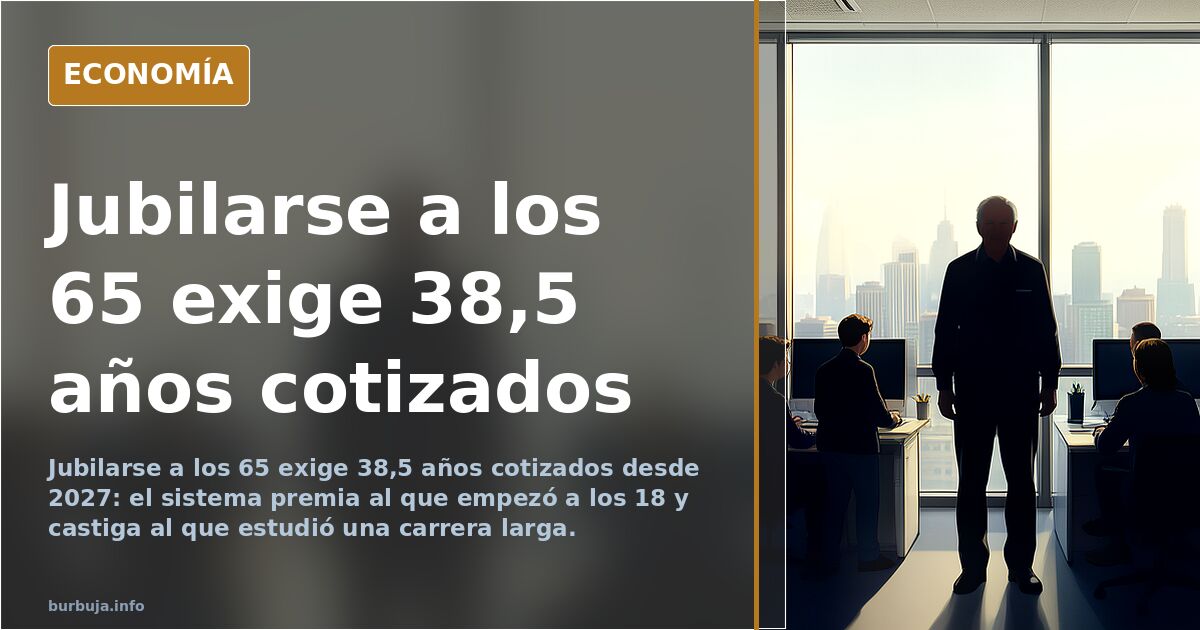
Retiring at 67: the 38.5-year contribution trap
Retiring at 65 in Spain is no longer an automatic right. According to the calculation circulating in the debate, from 2027 onwards, retiring at that age will require at least 38 years and 6 months of contributions. Anyone who falls short will have to wait until 67. The figure has reignited a debate that goes far beyond age: some argue the system penalises university graduates, who start contributing late, and rewards those who entered the labour market at 18 or 20. Far from being a simple calculation, the discussion exposes a generational gap and a growing push-out of older workers from the labour market, according to several participants.
The maths that doesn't add up for graduates
The calculation is simple and, for some, devastating. If you start contributing at 26, you reach 65 with 39 years of contributions, just above the threshold. But if you studied a long degree, a master's or a PhD, you'll normally start at 28 or even later. That's where the maths breaks down. Every year of uncredited education is a year less of a full pension. And this is no isolated case: it's the pattern of an entire generation with higher education, as argued in the thread.
The rule, moreover, does not require uninterrupted contributions. Scattered periods can be added up. But that is no comfort to those who, after years of grants and internships, join the system late. Military service also counts, but only up to one year and only to reach the minimum that allows early retirement. It does not count towards the final amount. A patch that doesn't fix the hole.
Generation X, caught between two worlds
Generation X is the first to see the door close on them that boomers walked through. They entered the labour market later due to long university degrees and now discover the system penalises them for it. They will not enjoy the same conditions as their predecessors. Meanwhile, the labour market is pushing out older workers: more and more profiles aged 40, 50 and 60 appear with the "open to work" badge on LinkedIn.
The contradiction is obvious: we are asked to work into old age, but past a certain age we are considered a burden. The system seems made by them and for them, forum users sum up. Longevity is sold as an opportunity, but for many it translates into more years of job insecurity and fewer years of pension.
The expert who wants us to retire at 100
The spark for the debate was a tweet from a longevity expert claiming that retiring at 65 when we can live to 100 is a waste of resources and talent. The reaction was swift: "I'd like to see him up on a scaffold at 70", one commenter replied. The image of the expert, far removed from physical work, became the symbol of a discourse disconnected from reality.
Because life expectancy is not uniform. The average at birth is around 83-84 years, but life expectancy at 65 is about 21 more years. In other words, those who make it to retirement live on average until 86. Not 100, but also not the 15 years many assume. The statistics dismantle both the expert's optimism and the defeatism of those who believe they will never collect a pension.
Is the system sustainable?
The underlying debate is sustainability. In a pay-as-you-go system with an ageing population pyramid, the numbers don't add up, as argued in the thread. Raising the retirement age amounts to cutting the total pension: two fewer years of collecting and two more years of contributing. Some economists call it a "hidden cut". Others argue it is the only way to keep the system going.
The alternatives on the table are unpopular: lowering pensions, limiting medical treatments beyond a certain age or promoting private pension plans. None of them is pleasant, but the status quo isn't free either. The question is not whether measures will have to be taken, but when and at whose expense.
What nobody says about early retirement
There are ways to retire before the ordinary age, but with conditions. Voluntary early retirement allows you to retire up to two years early if you have at least 35 years of contributions, with a reduction in the pension. Involuntary early retirement has different requirements. Military service can add up to one year towards the required minimum, but not towards the amount. These are details few people know, and they make the difference between retiring at 63 or at 67.
Ignorance is huge. Many don't know that unpaid internships can count if documented. Social Security doesn't trust memory: you have to provide certificates, agreements or bank statements. A bureaucratic labyrinth that discourages anyone.
The future: more years, less pension
The trend is clear: the retirement age will keep rising and pensions will keep being contained. The maximum contribution base in 2026 is €5,101.20 per month, but the maximum pension stays at €3,359.60. The gap between what you contribute and what you receive keeps growing. And the solidarity contribution, already paid on high salaries, does not entitle you to a higher pension.
With this outlook, retiring at 65 will become a privilege for the few. Most will have to work more years, receive less, or both. The question hanging in the air is whether this generation will be the last to trust the public system or the first to have to fend for itself. For now, the answer is up in the air.
Retiring at 65 in Spain is no longer an automatic right. According to the calculation circulating in the debate, from 2027 onwards, retiring at that age will require at least 38 years and 6 months of contributions. Anyone who falls short will have to wait until 67. The figure has reignited a debate that goes far beyond age: some argue the system penalises university graduates, who start contributing late, and rewards those who entered the labour market at 18 or 20. Far from being a simple calculation, the discussion exposes a generational gap and a growing push-out of older workers from the labour market, according to several participants.
The maths that doesn't add up for graduates
The calculation is simple and, for some, devastating. If you start contributing at 26, you reach 65 with 39 years of contributions, just above the threshold. But if you studied a long degree, a master's or a PhD, you'll normally start at 28 or even later. That's where the maths breaks down. Every year of uncredited education is a year less of a full pension. And this is no isolated case: it's the pattern of an entire generation with higher education, as argued in the thread.
The rule, moreover, does not require uninterrupted contributions. Scattered periods can be added up. But that is no comfort to those who, after years of grants and internships, join the system late. Military service also counts, but only up to one year and only to reach the minimum that allows early retirement. It does not count towards the final amount. A patch that doesn't fix the hole.
Generation X, caught between two worlds
Generation X is the first to see the door close on them that boomers walked through. They entered the labour market later due to long university degrees and now discover the system penalises them for it. They will not enjoy the same conditions as their predecessors. Meanwhile, the labour market is pushing out older workers: more and more profiles aged 40, 50 and 60 appear with the "open to work" badge on LinkedIn.
The contradiction is obvious: we are asked to work into old age, but past a certain age we are considered a burden. The system seems made by them and for them, forum users sum up. Longevity is sold as an opportunity, but for many it translates into more years of job insecurity and fewer years of pension.
The expert who wants us to retire at 100
The spark for the debate was a tweet from a longevity expert claiming that retiring at 65 when we can live to 100 is a waste of resources and talent. The reaction was swift: "I'd like to see him up on a scaffold at 70", one commenter replied. The image of the expert, far removed from physical work, became the symbol of a discourse disconnected from reality.
Because life expectancy is not uniform. The average at birth is around 83-84 years, but life expectancy at 65 is about 21 more years. In other words, those who make it to retirement live on average until 86. Not 100, but also not the 15 years many assume. The statistics dismantle both the expert's optimism and the defeatism of those who believe they will never collect a pension.
Is the system sustainable?
The underlying debate is sustainability. In a pay-as-you-go system with an ageing population pyramid, the numbers don't add up, as argued in the thread. Raising the retirement age amounts to cutting the total pension: two fewer years of collecting and two more years of contributing. Some economists call it a "hidden cut". Others argue it is the only way to keep the system going.
The alternatives on the table are unpopular: lowering pensions, limiting medical treatments beyond a certain age or promoting private pension plans. None of them is pleasant, but the status quo isn't free either. The question is not whether measures will have to be taken, but when and at whose expense.
What nobody says about early retirement
There are ways to retire before the ordinary age, but with conditions. Voluntary early retirement allows you to retire up to two years early if you have at least 35 years of contributions, with a reduction in the pension. Involuntary early retirement has different requirements. Military service can add up to one year towards the required minimum, but not towards the amount. These are details few people know, and they make the difference between retiring at 63 or at 67.
Ignorance is huge. Many don't know that unpaid internships can count if documented. Social Security doesn't trust memory: you have to provide certificates, agreements or bank statements. A bureaucratic labyrinth that discourages anyone.
The future: more years, less pension
The trend is clear: the retirement age will keep rising and pensions will keep being contained. The maximum contribution base in 2026 is €5,101.20 per month, but the maximum pension stays at €3,359.60. The gap between what you contribute and what you receive keeps growing. And the solidarity contribution, already paid on high salaries, does not entitle you to a higher pension.
With this outlook, retiring at 65 will become a privilege for the few. Most will have to work more years, receive less, or both. The question hanging in the air is whether this generation will be the last to trust the public system or the first to have to fend for itself. For now, the answer is up in the air.
Also available in: Deutsch
Summary of a discussion on Burbuja.info - Foro de economía, actualidad y política., translated from Spanish and reviewed before publication. Read the full discussion (91 replies).
More summaries
-
Spain's Social Security demands €39,000 from IMV recipient
A woman received the Minimum Vital Income for four years despite ineligibility. Spain's Social Security now demands retroactive repayment of €39,000.
-
Forum Cites Social Security Data: Girona Leads at 41.2%
Forum cites August 2026 Social Security data: Girona, 41.2%; Teruel, 40.4%; Basque Country, 28.8%.
-
Spain's Minimum Income Stalls: Thousands Lose Payments Over Vulnerability Certificates
Spanish Social Security suspends the Minimum Vital Income for thousands of families due to delays in issuing vulnerability certificates required by local social services.
-
Man abandons children at police station after aid ends, El Periódico reports
A man left his two children at a police station after his financial aid expired, according to El Periódico. Some claim he alleged they were unaccompanied minors.
-
Watching Marc Vidal's Videos Leaves Me Massively Depressed
An analysis of Marc Vidal's impact: informative value or economic alarmism? Discover forum opinions on his style, credibility and business model.
-
BREAKING: Serious stabbing in Barcelona's Plaça de Catalunya
Stabbing in Plaça de Catalunya, Barcelona: a minor arrested, victim seriously injured, and a Burbuja.info thread that breaks stereotypes about insecurity in the city.