
Retail panic: Christmas sales slump as consumer confidence fades
Early indicators show a drop in Christmas spending due to higher mortgage costs, 21% VAT, and retailers closing early.
English · Original discussion in Spanish · Published
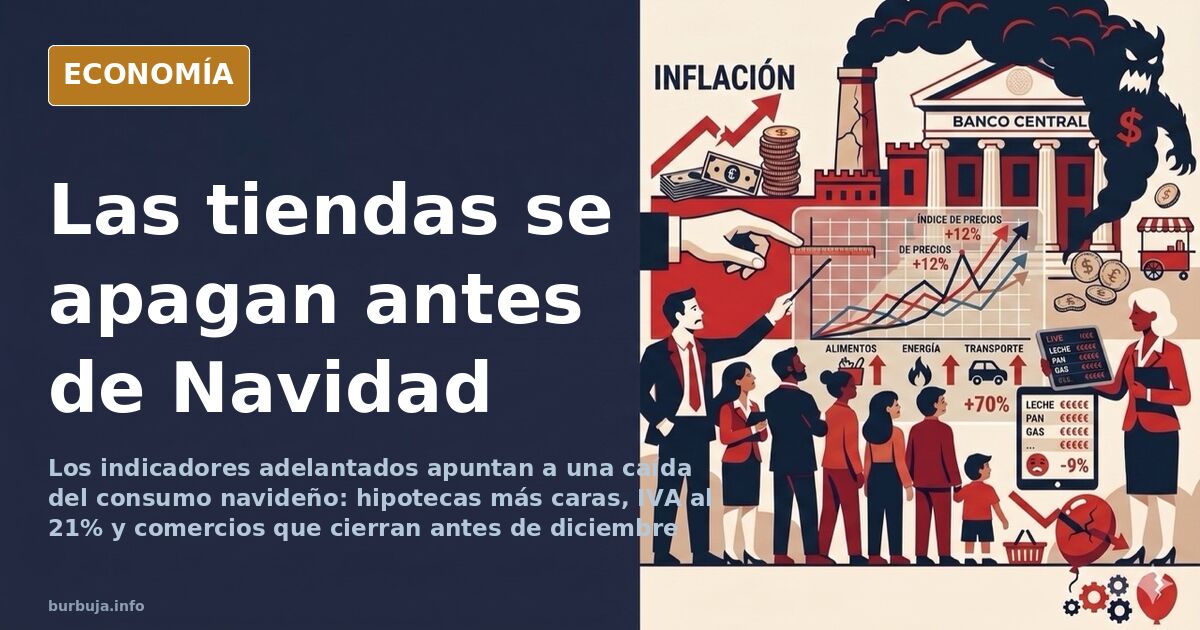
Retail panic: Christmas sales slump as consumer confidence fades
The Vigo Christmas tree will stand 44 meters tall with a 19-meter diameter star. It is the only figure growing this season. While Abel Caballero announces the "largest decoration on the planet," leading indicators all point in one direction: activity is sinking, inflation has cut purchasing power, and consumption enters December with the handbrake on. In a renovation company, they see it daily: clients ask for the cheapest options, lowest quality materials, and projects are cancelled. Only the minimum is executed. Often, repairs covered by insurance.
The diagnosis repeats sector by sector. In the taxi industry, there is "a brutal halt, like 2008." A neighborhood bike shop is considering closing in a few months: margins have fallen and only repairs come in, which yield little profit. On Calle Fuencarral in Madrid, two shops open for over a decade have shut down, facing each other. And in Asturias, bars have cut hours: closed Sunday, Monday, Tuesday, and Wednesday.
Why Black Friday and Christmas arrive with reduced sales
The sequence is known. The annual review of mortgages adds an average of 300 euros to the bill, and inflation does the rest. The result is a consumer who buys less and cheaper, advancing purchases to promotions to avoid the "rip-off" from retailers in December, turning the Christmas dinner into a survival meal. "La escudella i carn d’olla will be the star dish this Christmas... goodbye to prawns," summarizes a message. The irony hurts because it is exact.
The calendar doesn't help either. Christmas Eve and New Year's Eve fall on Sundays, company dinners concentrate on two days, and many staff won't attend. Added to this is the weather uncertainty during the holiday week and the late start of ski resorts. Every piece subtracts.
21% VAT and consumer fatigue
There is widespread anger about VAT. "Almost a quarter of the total," it is repeated. The tax creeps into every repair, every spare part, every menu. And the fatigue is not just about price: it is about service. Those who used to take their car to the workshop have decided to do it at home after realizing they are charged premium rates for materials, space-agency level labor, and yet get the vehicle back with broken plastics and clips out of place.
The restaurant industry suffers the same calculation. Cooking at home what was previously ordered out, having a picnic plan instead of going to a bar, buying ingredients and preparing them yourself. It is not stinginess. It is arithmetic.
Local retail closes while high-end holds up
One niche remains hiring: high-end properties. Full renovations, expensive equipment, luxuries. But it is competitive and hard to capture. The rest of the market has split in two: insurance repairs and subsistence. In the bicycle sector, the debate shifted to equipment: some argue that spending 10,000 euros on gear is one of the first things cut when the mortgage rises and food gets more expensive.
Online retail and big chains are not a refuge either. Complaints extend to perfumeries and specific brands being boycotted for reasons unrelated to price.
A Christmas without enthusiasm and fewer children
There is a factor not seen in sales statistics: desire. Christmas is better lived with small children at home, and low birth rates explain part of this lack of innocent excitement. Without a parade to wait for, without a Three Kings' morning to wake up early for, the celebration reduces to a formality. People are burned out and celebrate out of inertia.
Even so, the campaign is not dead. In some cities, shops "can't keep up" and some have already finished their Christmas shopping. The geography of consumption has become capricious: it depends on the neighborhood, the sector, and how much mortgage is left to pay.
What if the problem isn't price, but that we have stopped wanting to buy?
Also available in: Deutsch
Summary of a discussion on Burbuja.info - Foro de economía, actualidad y política., translated from Spanish and reviewed before publication. Read the full discussion (188 replies).
More summaries
-
'€40 roscones' and 12-month cards: the bill that lands in March
A forum thread links €40 roscones, interest-free 12-month cards and buy-now-pay-later deals with two months' grace: some argue the first payment...
-
Retail association warns of 16,000 job vacancies in Spain
Anged reports 16,000 unfilled positions in the distribution sector, calling for better training and flexibility instead of wage increases.
-
El Corte Inglés closes in Valencia despite clear skies
Spain's El Corte Inglés shuts its Nuevo Centro store due to a red DANA alert, though no rain fell in the capital.
-
Housing market shift: why you shouldn't buy in 2026
House prices are showing signs of slowing. Are we facing a new 2008 or a mirage? Data, mortgages and the dilemma of buying or waiting.
-
Swimming across to Ceuta takes just five minutes
Swimming from Morocco to Ceuta, Spain, takes less than 5 minutes, not 6 hours. The geography of El Tarajal debunks the epic story.
-
Hyperscalers: the verbal wildcard that turns you into a guru
Cloud and AI jargon has become a status symbol: saying 'hyperscalers' opens doors. But negotiating with AWS or Azure requires data, not words.