
Residents urge Santander council to buy Hermanos Calderón flats
Residents of Hermanos Calderón street in Cantabria, Spain, are calling on the city council to buy their homes amid suspicions that an investment fund has acquired the La Caixa portfolio.
English · Original discussion in Spanish · Published
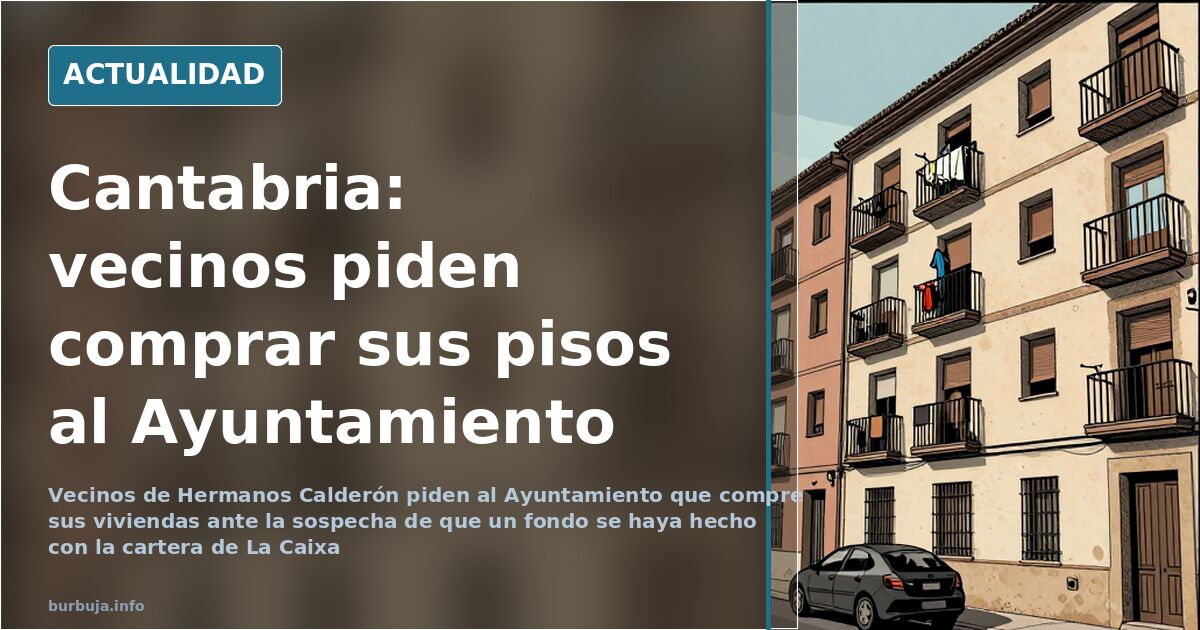
Cantabria: residents of Hermanos Calderón ask the city council to buy their flats
Residents of Hermanos Calderón street have asked the city council to buy the homes they occupy. The request is not a whim: beneath it lies the suspicion, as emerges from the debate, that La Caixa has sold off these flats to an investment fund, attracted by the low rents. It is the mechanism some already call property neofeudalism, which turns the small private landlord into an irrelevant player compared with the big holder.
What the residents are asking for and what can be inferred from the deal
The residents' demand is simple: that the council take over the properties before they change hands. As for the seller, the published information points to a financial institution and, later, to a fund specialised in buying housing portfolios with tenants in place. The chain reads the opposite way to how a brochure would tell it: cheap rent is not a burden, it is the lure. The lower the price, the more attractive the package and the bigger the margin for anyone buying in bulk. No one has officially confirmed the deal.
Why the solvent private landlord is priced out of the market
One of the debate participants describes the cycle like this: lengthy lawsuits, accumulated repairs and legal uncertainty miccionan an individual owner will not touch certain properties with a barge pole. The big holder will. It buys in bulk, at a discount, and then raises rents or offloads the problematic assets. Add up those costs, step by step, and it discourages anyone.
Part of the argument blames overregulation for preparing the ground for that concentration. Another points out that funds do not compete by building, they compete by hoarding what already exists, and that makes it more expensive for families to find a home.
What Vox proposed and what Congress rejected
The party has championed a housing policy based on border control, remigration and protection of the national tenant and buyer. Its motion to introduce a dissuasive tax regime on foreign buyers was rejected: the PP (conservative People's Party) abstained and all other groups voted against. The text sought to give Spanish citizens priority in access to social housing and housing benefits.
From one of the positions in the debate, it is stressed that this package of measures does not touch the tap through which the big holders come in, and that funds and legal entities face no brake. The route proposed from those same positions is to restrict their access to developing and building — generating supply — but not to acquiring existing stock, which is where they compete directly with families. Others warn that the "social" label ended up associated with defaults and very costly management, which drives out the small owner and leaves the door open to whoever has the lawyers.
The hole that remains unplugged
And there everything gets stuck. There is no way to push the fund out of already-built housing without hitting the traditional landlord at the same time, and no political force has yet explained how that could be done. While the debate remains at that point, the portfolio changes hands.
Summary of a discussion on Burbuja.info - Foro de economía, actualidad y política., translated from Spanish and reviewed before publication. Read the full discussion (32 replies).
More summaries
-
Girona landlord loses €8,800 in municipal social housing scheme
A Girona owner lost €8,800 restoring a flat from the 60/40 social rental program. The city council offers only €1,600 compensation.
-
Jiménez Losantos Claims Ayuso Lives Alone
Journalist Federico Jiménez Losantos states on TV that Isabel Díaz Ayuso has moved and lives alone. No official confirmation exists.
-
AI bias: alone with a Spanish man? It tells you to call 112
When a Spanish man is mentioned, the AI recommends calling 112; without the nationality, it sees no danger. The bias of AI assistants, laid bare.
-
3000 extra cancer deaths in Andalusia over six years are no statistical footnote
Why have cancer deaths in Andalusia, Spain risen by 3000? We break down the debate over health management, environmental causes and the impact on public health.
-
Father sells his 7-year-old daughter for four years' worth of food in Afghanistan
Outrage over an Afghan father who sold his 7-year-old daughter for food amid an extreme humanitarian crisis. Get the details here.
-
Esteban the gigolo: paid for sex and sharing his 10 rules for picking up women
Burbuja.info takes a look at the Argentine gigolo making it big on YouTube. Is he a seduction guru or pure resentment-driven marketing?