
Repairing scratched tiles: when a builder's insurance isn't worth the hassle
Discontinued terracotta tiles, scratches in the lacquer and rent of 650 euros a month: hand repair beats the builder's insurance.
English · Original discussion in Spanish · Published
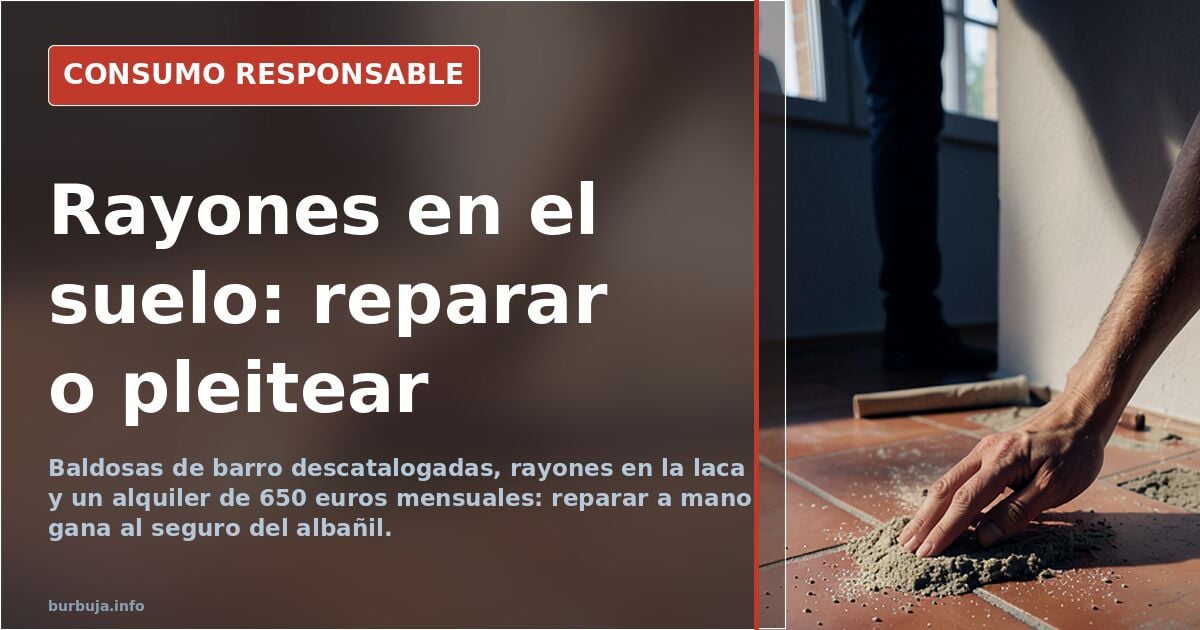
Scratched floor: repair by hand or claim on insurance
Is it worth battling the builder's insurance over some scratched tiles, or is it more cost-effective to reach for dye and enamel? The owner of a home under renovation faces a problem with no industrial solution: discontinued terracotta tiles with three layers — lacquer, a porous white layer and clay — and no stock to replace them. The legal route would miccionan months of litigation while paying 650 euros a month in rent on the side.
The damage has two levels. Deep scratches reach the white layer, which is porous and could take dye; superficial ones only affect the lacquer, where the dye just slides off. The owner has already tried vitroclean and a wood dye without success. He is now weighing up four options: stone dye, permanent marker, glass paint or a similarly coloured enamel, with the possibility of sealing afterwards with a coat of clear enamel.
The legal option exists, but the timeline makes it unworkable. Claiming on the builders' liability insurance or the owner's own policy is the orthodox route. The problem is time: every month without moving in adds 650 euros to the renovation budget. With that extra cost, artisanal repair wins economically by a landslide, even if the result is never perfect.
The market offers no miracles for discontinued ceramics. Products designed for stone or enamel work better on porous surfaces than on lacquer. The white middle layer, being more absorbent, is the only real candidate for dyeing. For superficial scratches, glass paint or coloured enamel can disguise them, but the finish will depend on manual skill and how well the colour matches the original reddish tone.
There is plenty of technical literature on restoring old tiles, but little real-world evidence. DIY manuals recommend deep cleaning, dyeing and sealing, without guaranteeing results on lacquered surfaces. The practical conclusion: if the scratch isn't visible from a metre away, dye and clear enamel can pass muster. If it is, the human eye will spot the repair. And the builder's insurance will still be there, waiting for someone to decide whether 650 euros a month justifies a legal war over tiles that are no longer made.
Also available in: Deutsch
Summary of a discussion on Burbuja.info - Foro de economía, actualidad y política., translated from Spanish and reviewed before publication. Read the full discussion (7 replies).
More summaries
-
Home insurance: Mapfre, La Caixa or Verti, the dilemma
Home insurance in Spain: Mapfre, La Caixa or Verti. The key lies in the replacement guarantee and liability cover, not the premium. A comparison of coverages and…
-
Covering grey hair without Control GX: €3 dyes and purple shampoos
Control GX shampoo reportedly leaves orange tones on black hair. Cheap dyes and purple shampoos emerge as alternatives.
-
Two Months in Thailand: Medical Insurance, Flights, and Expensive Areas
Two months in Thailand on a tight budget: medical insurance, rising flight costs, pricey areas like Phuket, and alternatives like Hua Hin or Jomtien.
-
Carlos and Fernando Paz: Where to Listen to the Brothers
Carlos and Fernando Paz share a voice but no single show. Find their podcasts on YouTube, iVoox, and radio stations.
-
LED spotlights: €3 fixtures vs €17 fixtures
LED spotlights for a 10 m² room: how many to install, whether to remove the transformer, and why some cost €3 and others €17, according to participants in the debate.
-
Chronic heartburn: from omeprazole to licorice root
A consumer has suffered heartburn and gas for five years, and omeprazole only brings temporary relief. Licorice root, Helicobacter and hiatal hernia are the focus of the discussion.