
Repairing dead LED bulbs with a jumper wire: a 10-month test
Bridging the dead LED on a bulb brings the light back at almost no cost. Ten months on, most of the repaired bulbs are still working without overheating.
English · Original discussion in Spanish · Published
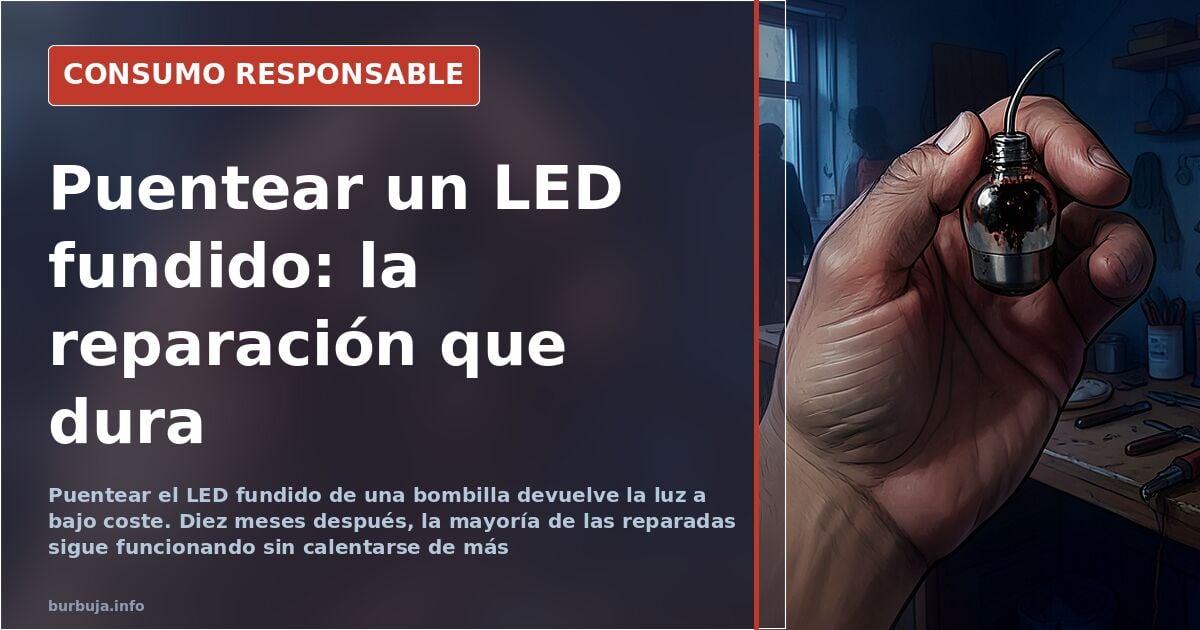
Bridging the dead LED: a repair that has lasted 10 months
Is it worth opening a one-euro LED bulb and bridging the diode that has failed instead of tossing it at the recycling centre? The answer from one forum user's hands-on experience is yes, at least in the short term: a dozen bulbs headed for the bin were shining again in under an hour, and ten months later most are still lit, some several hours a day in the living room and bedrooms.
The method is so simple it seems suspicious: open the diffuser with a flathead screwdriver, locate the LED that no longer lights up and solder a bridge across it with a piece of wire. No multimeter. No replacing the part. The author of the experiment justifies it with a basic economic argument: the bulbs cost one euro, and desoldering tiny boards you can barely see is not worth it. The alternative was the recycling centre.
Why the bridge works in some bulbs and not in others
This is where the technical battle begins. One camp argues that removing an LED from a series circuit means the voltage is shared among the remaining ones, each receives more voltage, more current flows, and the whole thing runs hotter and dies sooner. That is the classic physics of resistors. The problem is that an LED is not a resistor: it is a diode with an approximately constant voltage drop, and the circuit powering it is usually not a passive source.
The key lies in the driver. If the bulb has a constant-current supply —as several analyses argue—, bridging an LED does not change the current flowing through the chain: the regulator lowers the voltage and the other diodes never notice. If it simply has a capacitor and a current-limiting resistor, the current rises by a small percentage. A calculation circulating in the discussion puts that increase at around 10% when bridging one of ten LEDs, which is almost negligible in terms of light output.
Some go further and dismantle the overheating theory: after comparing a bridged bulb with its untouched twin, the brightness of the surviving LEDs does not increase noticeably. Neither does the temperature. The bridge does not turn the lamp into a furnace.
The real risk: 220 volts and capacitors that wear out
The serious warning does not come from the bridged LED, but from what surrounds it. Working on mains-connected bulbs means more than 300 volts DC after the rectifier bridge, and there is no room for carelessness there. The sensible advice: always disconnect before opening.
The second weak point is not the diodes but the electrolytic capacitor in the driver. Its lifespan is measured in hours —between 10,000 and 30,000 depending on quality and temperature—, which explains why many bulbs fail because of the power supply and not the LEDs. Bridging a diode does not fix a worn-out capacitor, and there the repair falls short.
The proper repair almost nobody does
There is a more orthodox route: desolder the dead LED and replace it with a good one from an identical bulb, or reduce the power by adjusting the driver's reference resistor to extend the life of the whole unit. It requires a fine-tip soldering iron, good eyesight and a steady hand. For anyone who cannot see the pins even with glasses, the bridge remains the rational option over throwing it away.
The same principle applies to TV backlights: many Smart TVs end up at the recycling centre with a single dead LED and can be revived the same way. The conclusion, ten months on, is that the quick fix works. The open question is how long the second life lasts.
Also available in: Deutsch
Summary of a discussion on Burbuja.info - Foro de economía, actualidad y política., translated from Spanish and reviewed before publication. Read the full discussion (47 replies).
More summaries
-
LED bulbs fail in the driver, not in the LED itself
The LED rarely fails: 90% of LED bulbs that break down do so because of the internal driver, according to analyses circulating in the industry.
-
Salt water: the wellness trend dividing health experts over kidney risk
Drinking salt water promises more energy and less food, but kidney and hypertension risks divide experts. Data, testimonials and the science behind it…
-
He paid €75 for an Ibérico shoulder online and got his order 10 days later
A customer paid €75 for an Ibérico shoulder online. The order arrived 10 days later, with no reply to emails or calls. A genuine shoulder costs around €200.
-
Ergonomic office chairs: why the €200 option doesn't exist
Ergonomic chairs: the €200 budget finds no product and recommendations start at €400. The €160 IKEA Markus emerges as the only real alternative for home use.
-
Beard: 13 euros at the barbershop or 10 minutes at home
A trendy barbershop charges 13 euros for a beard trim; keeping it up at home takes two ten-minute sessions a week. The annual difference tops…
-
Decathlon sunglasses: the CE mark is not what you think
Decathlon sunglasses cost €4.99 while optical shop pairs start at €30. The CE mark is self-declared: here's what you're paying extra for and what doesn't protect you.