
Renfe accused of political patronage in safety contract
Allegations that Renfe was colonized by affinity networks, citing a security award days after a €120m CNMC fine.
English · Original discussion in Spanish · Published
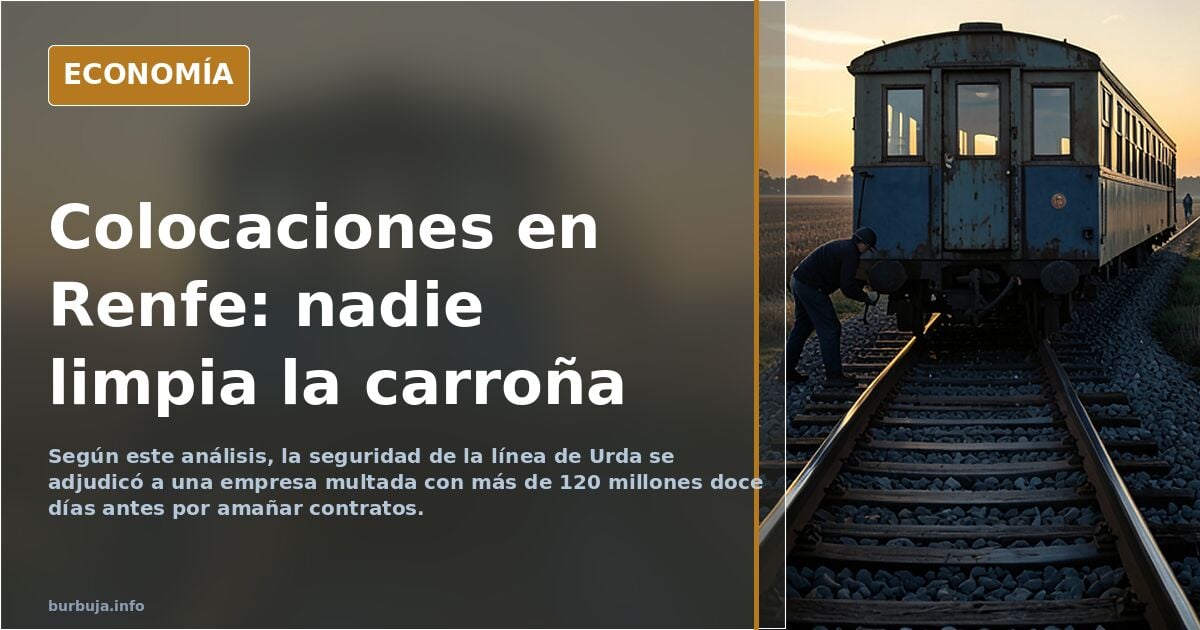
Renfe's alleged colonization: placing allies over train inspections
The thesis is stark: train safety systems were never the priority. What mattered was placing loyalists. This is the claim opening the discussion, accusing "the carrion" of colonizing Renfe with cadres from diverse political backgrounds — mentioning the Madrid environment, PSOE, and the bus lobby — and prioritizing favor networks over technical reviews of railway rolling stock. The assertion lacks initial documentation, but the thread develops it with a specific case worthy of attention.
The award that triggers alarms
The most compelling data point involves a company responsible for safety on the Urda line which, according to the account, had been fined twelve days earlier by the Comisión Nacional de los Mercados y la Competencia (CNMC). The sanction exceeded **€120 million** for colluding with other companies and rigging contracts. Twelve days after the fine, the award remained standing. That is the core of the accusation: not an isolated error, but the chronology.
Some argue such decisions reveal how the public sector operates when criteria are based on affinity rather than technical merit. Counterarguments note that a competition fine does not automatically disqualify a firm from contracting, and procurement regulations have their own timelines and appeals. Neither interpretation is conclusive based on available material.
The narrative of the 'best era in history'
The discussion returns to a recurring message: the official version that rail was living its golden age, repeated through media and spokespersons. Skepticism is explicit. "Who can believe them?" asks the author of the initial message. It is the same distrust running through other sections: the idea that the public manager exists to place and subsidize, not to audit.
A personal testimony adds texture. It recounts a conversation in the nineties with a Renfe inspector on a long route, who described driver positions as coveted posts reserved for acquaintances. It is an anecdote, not proof, but illustrates the perception of nepotism permeating the debate.
Who cleans up and who maintains
The political question remains open: if the party presenting itself as an alternative governs, will it purge these networks or merely manage and subsidize them? The material offers no answer, only the suspicion that the structure survives changes in labels. It is the uncomfortable conclusion of a thread that started talking about trains and ended discussing power distribution within state-owned enterprises.
It remains to be seen whether oversight of railway safety contracts reaches the courts or stays as social media noise. With available data, the most honest prediction is that the issue will not resolve itself.
Also available in: Deutsch
Summary of a discussion on Burbuja.info - Foro de economía, actualidad y política., translated from Spanish and reviewed before publication. Read the full discussion (15 replies).
More summaries
-
Urda: the shame of a rail crash no one will explain
A train rammed into another standing at Urda in Spain: the automatic braking system failed to act, and the line had already suffered another collision this year. The aftermath, under…
-
High-speed train collision in Spain kills 64; Transport Minister resigns
A Renfe high-speed train struck a stationary Iryo service near Urda, Toledo, killing 64 people and prompting the resignation of Transport Minister Óscar Puente.
-
Spanish Civil Service Exam: High Pay, Job Security, and Inflation Warning
Passing the Spanish civil service exam brings euphoria over guaranteed income, but public pay rises lag behind inflation.
-
Ben Shapiro Dismisses 'Browning of America' Criticism
Ben Shapiro stated he doesn't care about the 'browning of America' while criticizing Indian students over Gaza. We explain the context.
-
Spain orders 12% olive oil withdrawal to stabilize market
The Spanish government mandates removing 12% of olive oil production from the market to counter a record harvest surplus.
-
Canary Islands Hospital Deaths Rise 20% Over Staffing
Union claims hiring non-specialist doctors at HUC caused a 20% rise in ER deaths and 106 extra fatalities in 2025.