
Stainless steel that rusts: why it fails and how to clean it
Stainless steel that rusts isn't a cleaning problem: it comes down to chromium and nickel content. What works, what ruins the finish, and what to check before you buy.
English · Original discussion in Spanish · Published
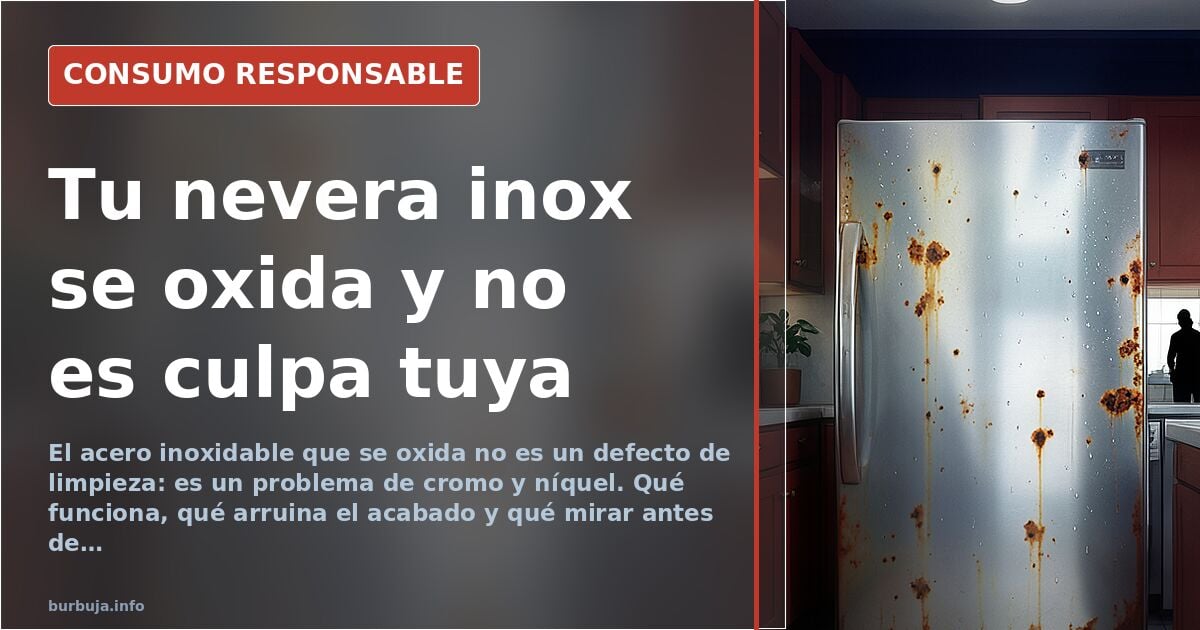
Stainless steel that rusts: what's failing and how to tackle it
Stainless steel doesn't actually exist. What exists is self-passivating steel, and that difference explains why a mid-range fridge door wakes up covered in rust spots that concentrated vinegar won't touch, even after twenty minutes. The "inox look" label is not a synonym for stainless steel: it's a finish that imitates the metal, and when chromium and nickel are scarce, rust appears. A discussion open for years on a consumer forum has produced a map of what works, what ruins the surface, and what's worth checking before buying.
Why does steel sold as stainless rust?
The key lies in the chromium and nickel ratio. 18/10 steel contains 18% chromium and 10% nickel; 18/8 has less nickel; and steel with no engraving at all usually has much lower percentages. That's where the problem starts. Some claim a magnet settles the question in the store, but the argument falls apart: ferritic steels are magnetic and austenitic ones are not, so the test doesn't distinguish quality. What does distinguish it is the engraving.
Rust spots can also come from outside. Iron contamination — a wire-brush base, a rusty dishwasher filter, salt residue — stains the steel even if the steel itself is good. The rust peine the thickness of the metal and reappears over time if it isn't polished out thoroughly.
What works to remove rust stains?
A melamine sponge, always damp, is the first answer that keeps coming up. So does the magic eraser, a metal polish that has been on the market for decades and is nothing more than 00-grade steel wool with polishing compound: you can see the pad darken as the metal brightens. For stubborn stains, 00-grade steel wool applied with patience and gloves. And Vitroclen, which contains polish, works in many cases, though it's best to test it first on an out-of-sight area.
The problem is the finish. If the door is brushed, rubbing against the grain or with too much force leaves a patch lighter than the rest. A green scouring pad used along the grain of the steel removes the rust almost completely, but the patch shows. It's the price of working on a surface that isn't solid.
The buying mistake nobody tells you about
The "inox look" finish and the anti-fingerprint coating are just a film over a base material that isn't quality stainless steel. When that film wears off — from a mop brushing against it, or abrasive products — it flakes away and exposes what's underneath. On a washing machine, a fridge, or a bathroom bin, the result is the same: stains that keep coming back.
The advice that keeps being repeated is to check the engraving before paying. If it doesn't say 18/10, the chromium and nickel percentage is a mystery. And if the price is suspiciously low for a steel appliance, it probably isn't one.
What to do when the rust is already there
Concentrated vinegar isn't enough. Harsh abrasives ruin the shine. Bleach is best kept well away. The sequence that comes up most often: test first on a hidden area, use polishing products with care, and accept that a brushed finish doesn't forgive. If the rust comes back, the problem isn't cleaning: it's the material.
With all this in mind, buying steel appliances should be settled with a magnifying glass on the label. It's still being settled by price and by eye.
Also available in: Deutsch
Summary of a discussion on Burbuja.info - Foro de economía, actualidad y política., translated from Spanish and reviewed before publication. Read the full discussion (31 replies).
More summaries
-
Stainless steel pans: the learning curve nobody tells you about
A stainless steel pan promises durability but demands technique. Learn to master the temperature point and explore the debate over Teflon and health.
-
Stainless, Cast Iron or Ceramic: Which Non-Teflon Pan Lasts Years
Stainless steel, cast iron and ceramic last years while Teflon degrades in months. The real cost is learning to cook without sticking.
-
Corberó: fridges last decades, washers fail in days
Users report Corberó fridges lasting 20 years while washers fail quickly. The Spanish brand faces a reputation crisis.
-
Ubuntu 24.04's kernel 7.0 triggers kernel panic: chronicle of a failed update
Kernel panic on Ubuntu 24.04 after installing kernel 7.0. How to recover the system using GRUB and roll back to kernel 6.14. Lessons about updates.
-
Are rooftop car tents worth the money?
We look at the pros and cons of rooftop car tents: weight, noise, legality and whether their high price is justified in Spain.
-
Laser hair removal: hygiene, investment or beauty pressure
Laser hair removal is sold as hygiene, but beauty pressure drives the business. More and more men are choosing it. Investment or vanity?