
Reliable cheap cars under €1,500: models that last
For €1,500, reliability depends on maintenance, not brand. Seat Ibiza, Peugeot 205, Toyota Corolla and Honda Civic are top picks.
English · Original discussion in Spanish · Published
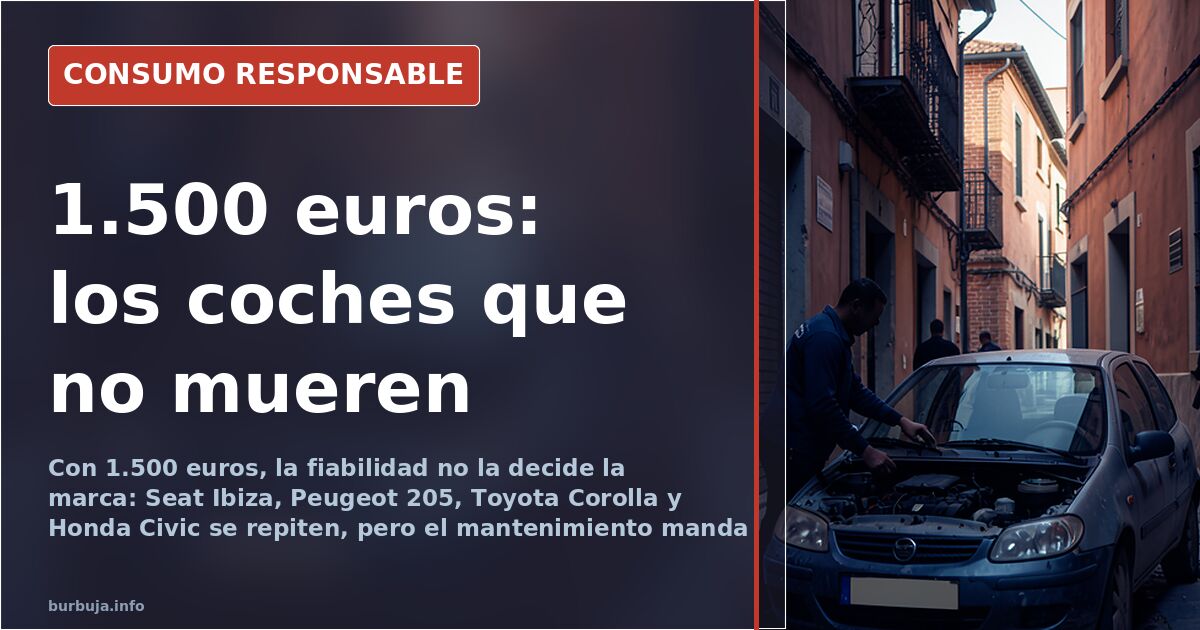
Reliable cheap cars under €1,500: models that truly last
With a budget of €1,500 and a demand for reliability, the used car market boils down to an uncomfortable question: brand or maintenance? The answer emerging from accumulated experience is tough for buyers who arrive with a list of Japanese brands in hand. Honda, Toyota and Mazda lead reliability studies, but at this price point, what decides is not the logo: it is how the specific unit has been treated.
The starting point comes from those looking for a car: between 5,000 and 10,000 kilometers per year, mostly on highways, preferring diesel but open to petrol if the offer is good. With that mileage, the extra cost of diesel rarely pays off, and several analyses state it bluntly: for that use, a diesel isn't worth it.
Which brands fare well and which to avoid
The ranking circulating among buyers places Volkswagen, Audi, BMW, Mercedes, Toyota, Honda, Mazda, Nissan, Lexus and Subaru in the safe bet group. At the bottom appear Fiat, Renault, Alfa Romeo, Daewoo, Kia, Dacia, Chevrolet, Lancia, SsangYong and MG-Rover. In the middle, a limbo of acceptable brands.
The problem is that this table collapses as soon as you look at the model and engine. The same manufacturer can have an eternal petrol engine and a problematic diesel. Some recall that Honda fitted Rover engines in their diesels with poor results, and Suzuki equipped the SX4 diesel with a Fiat engine that caused many issues. The brand is not the unit of analysis; the engine-car-year combination is.
The recurring candidates: Ibiza, 205, Corolla, Civic
The Seat Ibiza prior to the 2002 model change appears again and again. Volkswagen-origin engine without modern frills, little electronics, mechanics known by any workshop, abundant spare parts in scrapyards, and low consumption. One owner recounts buying a 1996 model with 190,000 kilometers and selling it six years later with over 230,000 kilometers without a single problem or oil consumption.
The Peugeot 205 and 309 enter the conversation strongly: manufactured until 1998, they are considered robust, without electronics and cheap to maintain. One case describes a 309 1.9D inherited that exceeded 300,000 kilometers with an impeccable engine, although the heating and air conditioning stopped working.
On the Japanese side, the Toyota Corolla and Honda Civic are the most repeated names. A Corolla 1.6 petrol with 180,000 kilometers and sixteen years on its shoulders had no expense beyond maintenance, not even a battery. A Civic 1.6 of 110 HP claims 5.6 liters per 100 km on the highway. The Nissan Almera diesel also comes up, described as incredibly durable, and the Volvo S40 1.9D from the 90s.
The warning that dismantles the brand list
The most useful warning is the one least wanted to hear: with that budget, you must look at the treatment and maintenance the car has received, not the brand. A well-cared-for unit from a mediocre brand may last longer than a mistreated Japanese car. And vice versa.
The other side is repair costs. Mercedes, BMW and Audi can be reliable, but their spare parts and maintenance eat up the purchase savings. Brands like Mazda have a fruta for being tough before the year 2000, although with expensive parts and workshops that reject Japanese cars because they are "built differently".
The dealer trap and the private seller lottery
Buying from a dealer with warranty does not eliminate risk. The experience shared is that of a Seat Toledo costing €3,000 that ran perfectly during the test drive: once on the highway, it vibrated entirely, with unbalanced wheels and misaligned steering. The workshop bill came later.
In contrast, the recommendation to buy from a private seller gains weight, even though it is a lottery. Some tested the car cold, hot, and for an hour, and two weeks later it started stalling due to an intermittent fault. The repeated advice: if you don't understand mechanics, bring someone who does.
The conclusion left by the matter is less romantic than the brand list: for €1,500 you buy a probability, not a guarantee. The Ibiza, 205, Corolla and Civic are good tickets, but the draw happens in the workshop. And the buyer who confuses brand with unit will discover the difference in the first bill.
Also available in: Deutsch
Summary of a discussion on Burbuja.info - Foro de economía, actualidad y política., translated from Spanish and reviewed before publication. Read the full discussion (52 replies).
More summaries
-
Ford Focus, Mazda 3 or Toyota Corolla: 30k Euros and an engine dilemma
Ford Focus 1.0 EcoBoost at 28,000€, Mazda 3 at 31,000€, and Toyota Corolla hybrid at 32,000€. Reliability decides the winner.
-
Forum user compares Seat Ibiza prices: €1,300 more expensive in Spain than in Germany
A forum user compares Seat's configurator: the Ibiza Reference costs €1,300 more in Spain than in Germany. The Golf GTI is also cheaper there, according to the data.
-
Forum user reports a petrol Seat Ibiza now costs €19,000 in Spain
A user claims a petrol Seat Ibiza is listed at €19,000 and a Peugeot 208 is close to €20,000. The debate over new car prices in Spain and…
-
Lacasa Christmas ad on women's leisure gap sparks holiday boycott in Spain
Lacasa's new turrón ad highlights the 1 hour and 37 minute leisure gap between Spanish women and men, and some shoppers are responding with a Christmas boycott.
-
Neck and Forehead Pain: When It’s Tension vs. Emergency
Intense neck and forehead pain worsening when lying down often stems from cervical issues or blood pressure, but neck stiffness requires urgent medical evaluation.
-
Women's Clothing for Men: The Untapped Size and Price Advantage
Women's clothing offers more sizes, colors, and deals than men's. Shoes up to size 42 and tailored fits reveal a consumption trend hindered by stigma.