
Neck and Forehead Pain: When It’s Tension vs. Emergency
Intense neck and forehead pain worsening when lying down often stems from cervical issues or blood pressure, but neck stiffness requires urgent medical evaluation.
English · Original discussion in Spanish · Published
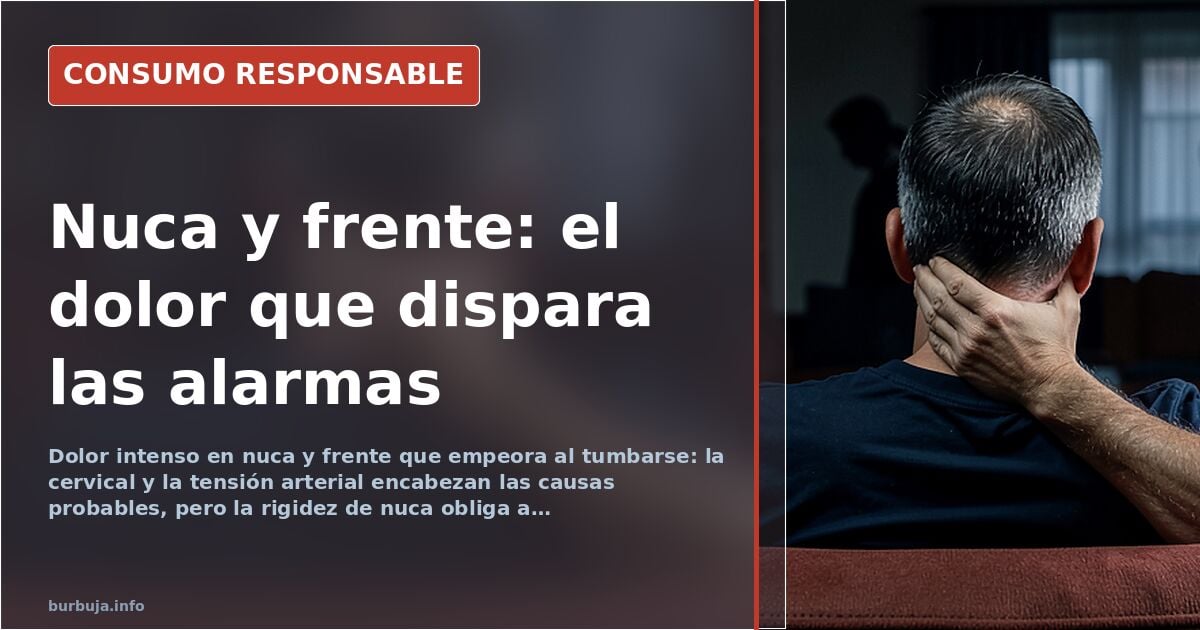
Neck and Forehead Pain: When to Seek Emergency Care
An intense pain appearing simultaneously behind the neck and in the forehead, worsening when lying down and accompanied by a sensation of heat. This is the scenario described by someone opening a consultation after eating four quail eggs and drinking Coca-Cola. From there, the conversation splits between home diagnosis and the voice urging them to call emergency services (112). The first sensible response arrives quickly: Googling a headache yields the classic "could be anything from tension to a stroke," which means nothing useful.
What Lies Behind Occipital Pain Radiating to the Forehead
The order of probabilities discussed is clear. First, cervical issues: a trapezius and suboccipital muscle contracture radiating forward, worsening when lying down because the pillow forces the curve and tension point. Second, blood pressure: four quail eggs with their salt and a caffeine-sugar drink are not anti-inflammatory; with a feeling of heat, the recommendation is to visit a pharmacy and measure it.
Third, migraine. Heat and light fit here, but typical migraines improve in darkness and when lying down, not the opposite. Therefore, opening windows—which relieves thermal discomfort—is not the best gesture if this were the cause: the body would crave darkness, not airflow.
Signs That Turn Headache Into an Emergency
The turning point comes when red flags are listed. A severe, new headache intense, new, and with neck pain requires immediate exclusion. The list is specific: fever—"I feel very hot" might indicate it, so use a thermometer—neck stiffness preventing or causing pain when touching the chest with the chin, sudden onset like an explosion, worst headache of life, vomiting, strong light sensitivity, confusion, unusual drowsiness, weakness or tingling on one side, double vision, or skin spots that don’t fade under pressure.
Alarm rises when meningitis is mentioned. The affected person responds with self-screening: no sudden high fever, no nausea or vomiting, and rules out sensual transmission because they haven’t had relations for years. The nuance dismantling this reassurance is that meningitis isn’t only sensual transmitted, and fever may rise slowly or start low. With severe headache and neck stiffness or pain, the instruction is to go to the ER now or call 112, having someone drive or requesting an ambulance: do not drive yourself.
Tension Headaches, Anxiety, and Valerian Root Advice
Against alarmism, other voices lower the tone. Most headaches are tension-type, they argue, proposing valerian infusion as a test: if it improves, that’s the cause. Also appears the experience of those suffering intense one-sided head pressure associated with anxiety episodes and rapid heartbeat, resolved with analgesics and waiting.
The minimal consensus shared by almost all interventions is that severe pain shouldn’t be gambled with: it could be trivial or serious, and a doctor must see it. The intermediate option proposed is visiting outpatient emergency care, distinct from hospital ERs, if symptoms don’t remit.
The unanswered question remains: if pain is moderate and no red flags exist, waiting makes sense. If neck stiffness is present, waiting is the worst plan. Reserved prediction suggests most cases remain poorly slept muscle contractures; the problem is that the percentage that doesn’t offers no second chances.
Also available in: Deutsch
Summary of a discussion on Burbuja.info - Foro de economía, actualidad y política., translated from Spanish and reviewed before publication. Read the full discussion (17 replies).
More summaries
-
High Blood Pressure: Lifestyle Changes to Lower Diastolic Without Medication
Managing hypertension without pills: skipping dinner, walking and losing weight reduced one case from 140/100 to 135/85 and 120/85.
-
High Blood Pressure: The Silent Killer Many Choose to Ignore
Only 10% of strokes are genetic. Essential hypertension is asymptomatic in 90% of cases, which is the problem for measuring it.
-
Headaches reveal the flaw in restrictive diets
A failed diet case sparks debate on sugar withdrawal, uncontrolled ketosis, and why low intake fails with physical work.
-
Spanish 1970s Cookies: The Lost Taste of Childhood
Iconic Spanish brands like Cuétara and Fontaneda have changed. Palm oil, mergers, and quality cuts explain the decline of a national staple.
-
Reliable cheap cars under €1,500: models that last
For €1,500, reliability depends on maintenance, not brand. Seat Ibiza, Peugeot 205, Toyota Corolla and Honda Civic are top picks.
-
Women's Clothing for Men: The Untapped Size and Price Advantage
Women's clothing offers more sizes, colors, and deals than men's. Shoes up to size 42 and tailored fits reveal a consumption trend hindered by stigma.