
Red Alert in Spain: Málaga Empties and Sevilla Halts Classes
A red alert for DANA leaves Málaga deserted and suspends classes in Sevilla, reigniting the debate on climate lockdowns.
English · Original discussion in Spanish · Published
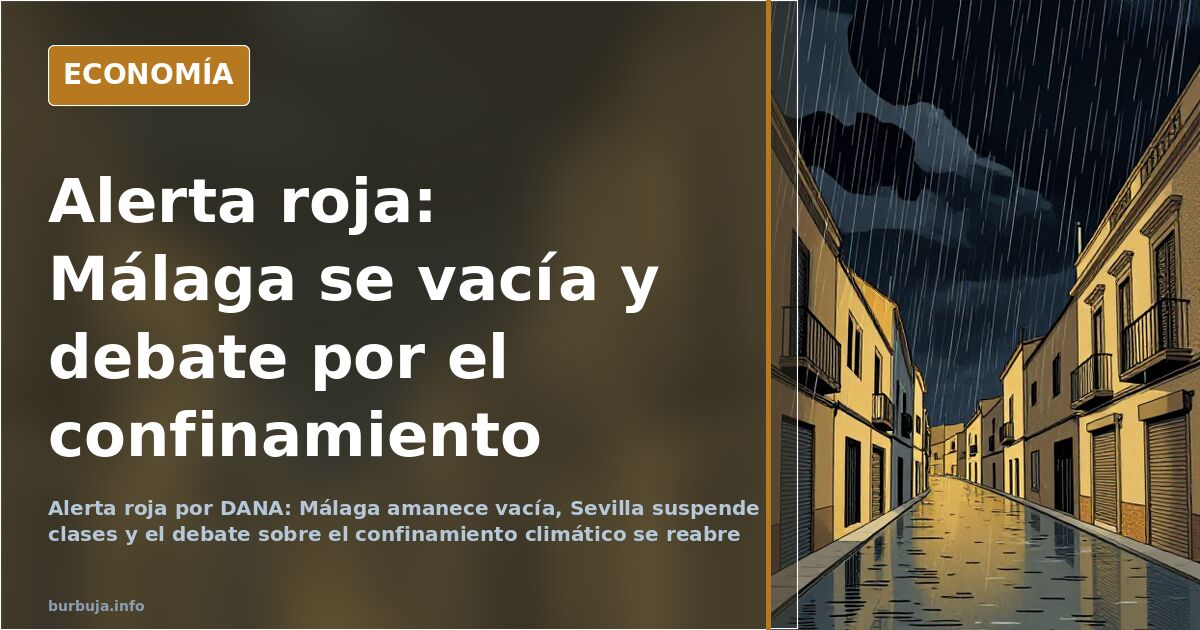
For 15 liters: Sevilla halts classes and Málaga empties
According to the thread, classes are suspended and universities close in Sevilla, where forecasts predict around 15 liters of rain over the day. In Málaga, the red alert has left the capital's streets "completely empty." In Tarragona, participants announce a lockdown while the rain has yet to break. Three provinces, three scenarios, and one label slipping into every conversation: climate lockdown. The debate isn't whether it rains, but who decides to halt an entire town and by what criteria.
Official bodies have issued a series of warnings: the AEMET (Spain's meteorological agency) issues a red alert, the Andalusian government activates its alarms, and municipalities distribute recommendations—or instructions—to stay home. In l'Alcudia, in the province of Valencia, residents are warned not to go out. In central Málaga, the result is a deserted city on a regular workday. The question lingers: is this prudence or something else?
What is a DANA and why does the warning vary by municipality?
Terminology is the first point of contention. One analysis argues that DANA is merely the usual cold drop with a new name, a localized storm that has emptied riverbeds along the Mediterranean coast for centuries. Another school of thought insists that the frequency and intensity have exceeded known patterns: rainfall of 700 liters per square meter, events lasting two weeks, and systems hitting eight provinces simultaneously.
The second front concerns jurisdictional competence. The warning applies at the municipal level, which is where criticism mounts: limiting street-to-street mobility, critics argue, is the worst possible action, as it cuts off travel within a term without organizing movement across the entire county. A county or provincial lockdown, they say, would better coordinate traffic and evacuations than a sum of disconnected local decisions.
The dilemma of staying or leaving: safety or a patch?
Some raise an awkward case: if someone needs to go to a relative's home in a safer area, or the relative wants to come get them, what happens? Just warn and let each decide, they argue; mandatory confinement turns a reasonable recommendation into a management error. Conversely, the opposing argument weighs heavily, recalling that the afternoon the DANA hit Valencia, officials debated whether to lockdown or evacuate, and the delay was costly.
The blame falls on authorities from both sides. If they don't lockdown, they are accused of inaction. If they do, they are accused of overreacting. Participants defending prudence cite a simple idea: the prudent person who errs loses a few hours; the one who succeeds saves a life. Those who distrust this reasoning counter that such logic turns any forecast into an excuse to suspend activity.
The parallel with the pandemic that no one wants to repeat
The comparison with the 2020 lockdowns arises as soon as the word "lockdown" is spoken. One sector sees the pattern as a dress rehearsal: first, antiestéticar is sown, then closures arrive, and along the way, remote work and online shopping are normalized. Another sector sees it as a linguistic coincidence and recalls that fire alerts have already forced populations to stay indoors in previous years.
In between are the data that don't add up. Suspending classes and closing universities for a forecast of 15 liters invites questions about what threshold triggers each decision. The DANA pattern and the Administration's experience are the fine print that each interprets to their advantage.
There are citizens who use the day to take driving lessons with a red alert active, or who drive through the center without finding a single large puddle. Maximum alert coexists with dry streets. And there, exactly, the consensus breaks. Is a forecast enough to paralyze an entire town, or should we wait for the water to confirm what the radar announces?
According to the thread, classes are suspended and universities close in Sevilla, where forecasts predict around 15 liters of rain over the day. In Málaga, the red alert has left the capital's streets "completely empty." In Tarragona, participants announce a lockdown while the rain has yet to break. Three provinces, three scenarios, and one label slipping into every conversation: climate lockdown. The debate isn't whether it rains, but who decides to halt an entire town and by what criteria.
Official bodies have issued a series of warnings: the AEMET (Spain's meteorological agency) issues a red alert, the Andalusian government activates its alarms, and municipalities distribute recommendations—or instructions—to stay home. In l'Alcudia, in the province of Valencia, residents are warned not to go out. In central Málaga, the result is a deserted city on a regular workday. The question lingers: is this prudence or something else?
What is a DANA and why does the warning vary by municipality?
Terminology is the first point of contention. One analysis argues that DANA is merely the usual cold drop with a new name, a localized storm that has emptied riverbeds along the Mediterranean coast for centuries. Another school of thought insists that the frequency and intensity have exceeded known patterns: rainfall of 700 liters per square meter, events lasting two weeks, and systems hitting eight provinces simultaneously.
The second front concerns jurisdictional competence. The warning applies at the municipal level, which is where criticism mounts: limiting street-to-street mobility, critics argue, is the worst possible action, as it cuts off travel within a term without organizing movement across the entire county. A county or provincial lockdown, they say, would better coordinate traffic and evacuations than a sum of disconnected local decisions.
The dilemma of staying or leaving: safety or a patch?
Some raise an awkward case: if someone needs to go to a relative's home in a safer area, or the relative wants to come get them, what happens? Just warn and let each decide, they argue; mandatory confinement turns a reasonable recommendation into a management error. Conversely, the opposing argument weighs heavily, recalling that the afternoon the DANA hit Valencia, officials debated whether to lockdown or evacuate, and the delay was costly.
The blame falls on authorities from both sides. If they don't lockdown, they are accused of inaction. If they do, they are accused of overreacting. Participants defending prudence cite a simple idea: the prudent person who errs loses a few hours; the one who succeeds saves a life. Those who distrust this reasoning counter that such logic turns any forecast into an excuse to suspend activity.
The parallel with the pandemic that no one wants to repeat
The comparison with the 2020 lockdowns arises as soon as the word "lockdown" is spoken. One sector sees the pattern as a dress rehearsal: first, antiestéticar is sown, then closures arrive, and along the way, remote work and online shopping are normalized. Another sector sees it as a linguistic coincidence and recalls that fire alerts have already forced populations to stay indoors in previous years.
In between are the data that don't add up. Suspending classes and closing universities for a forecast of 15 liters invites questions about what threshold triggers each decision. The DANA pattern and the Administration's experience are the fine print that each interprets to their advantage.
There are citizens who use the day to take driving lessons with a red alert active, or who drive through the center without finding a single large puddle. Maximum alert coexists with dry streets. And there, exactly, the consensus breaks. Is a forecast enough to paralyze an entire town, or should we wait for the water to confirm what the radar announces?
Also available in: Deutsch
Summary of a discussion on Burbuja.info - Foro de economía, actualidad y política., translated from Spanish and reviewed before publication. Read the full discussion (215 replies).
More summaries
-
The Photo Capturing Sánchez Government’s Fear and Final Collapse
A ministers' council described as dire, a housing minister lost in Congress, and a cabinet seeking an exit before the end.
-
Spain's Parasite Debate: Cultural Shock or Marketing?
Analysis of the debate on deworming in Spain: is it a cultural clash, a public health need, or just marketing?
-
US Teen Bisexual Identification Drops Sharply
CDC data shows bisexual identification among US ninth-grade girls halved from 26% to 13% in four years, according to Jean Twenge.
-
Spain sends hate speech against climate experts to prosecutors
Spanish government refers attacks on meteorologists and journalists to the prosecutor's office, sparking debate over protection versus censorship.
-
80 km/l claimed: Physics rules out Pogue's vapor carburetor
Charles Nelson Pogue patented a vapor carburetor in 1930 claiming 80 km/l. Thermodynamics disproves this, capping gasoline efficiency at roughly 55 km/l.
-
Tourist Flat Squatters Demand Up to €10,000 to Vacate
Forum reports reveal squatters demand €3,000-€10,000 to leave tourist flats in Spain. Overburdened courts and organized gangs worsen the crisis.