
Real-time translation: Is language learning obsolete?
Simultaneous translation reignites debates on jobs and language barriers, impacting academies, call centers, and emigration.
English · Original discussion in Spanish · Published
Live machine translation: Language loses its value as a barrier
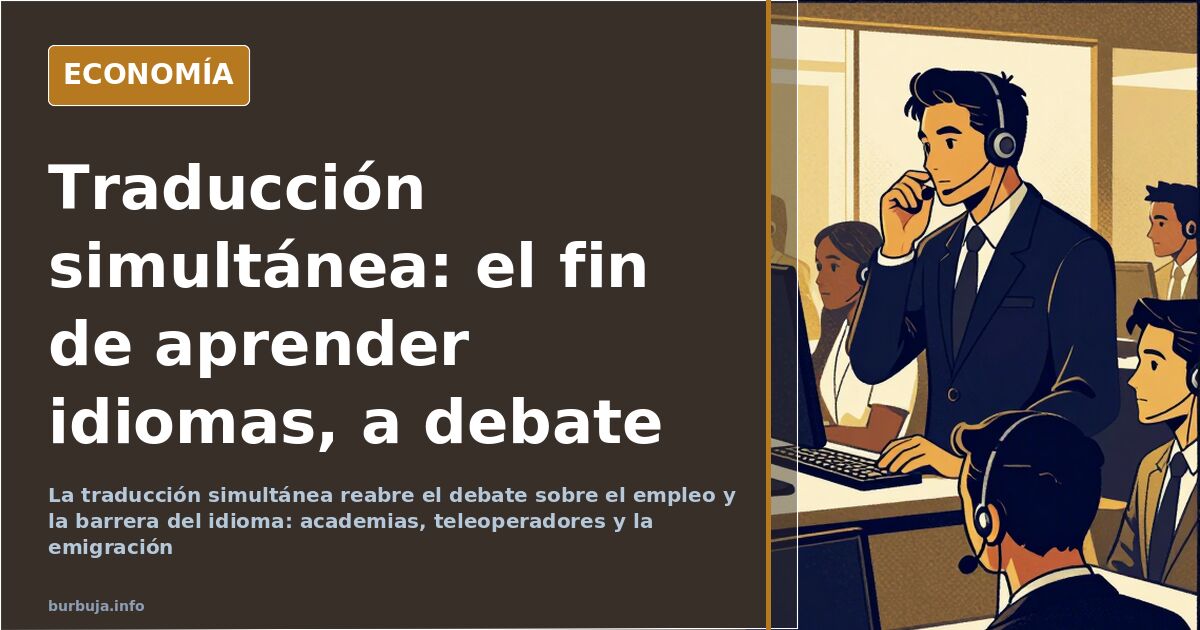
A phone rings in Madrid, and the person on the other end responds without a shared vocabulary. The conversation flows smoothly, without an interpreter, because the translation happens in real time. This is what real-time simultaneous translation devices promise, and the premise that sparked the discussion was blunt: customer service with languages, R.I.P. At first glance, it is a productivity boost. At second glance, it is the death certificate of a profession.
The prevailing conclusion in the analysis is uncomfortable: if language ceases to be a wall, much of the employment sustained by that wall loses its reason for existing.
What changes when translation moves to real-time speech
The novelty is not machine translation, which has been working on text for years, but bringing it to live speech and wearable devices. Until now, you had to copy, paste, and wait; now, the voice is converted into another language while speaking.
The engines available already did much of the work. ChatGPT has become the reference for translating, ahead of DeepL and Google Translate, according to the assessment of one of the participants. The difference is in the wrapping: moving from a tool you consult to one that participates in the conversation.
And there appears the first pointed side effect: if the machine translates in real time, language ceases to be a hiring filter. The position that required a high level of English to answer calls loses its main requirement.
Call center operators in the crosshairs of automatic translation
International call centers are the most exposed link. Their competitive advantage was having staff capable of speaking with customers from various countries; with integrated simultaneous translation, that staff is redundant or cheaper.
The irony was pointed out by more than one: the same device that takes jobs away from operators here is the one that allows calling anywhere without knowing the language of the person answering. The telephone salesperson who crossed borders with their own accent no longer needs an accent.
Some argue that even customer service jobs are not safe: technical assistance, they say, will be done by machines in a few months. The timelines discussed are debatable; the direction, according to this reading, is not.
Will language academies be left without students?
One of the predictions launched in the debate is the massive collapse of the language teaching sector within a five to ten-year horizon. It is not the only catastrophic forecast: one of the participants recalls that translation jobs were already poorly paid fifteen years ago and that he has seen ads asking for engineers to translate for 8 euros an hour, before generative AI existed.
Resistance comes from those who live from the trade. A professional translator with twenty years of self-employment behind him recalls that even in his degree, they announced the end of the guild, that translation engines with giant memories arrived, and that he continues to live from this. The programs improve, the collapse is delayed.
In between lies a nuance that should not be lost: if automatic translations spread unchecked, there will be those who charge to catch the errors and correct them, and even those who assimilate new turns of phrase into the living language. Hopefully, some of those expressions might end up in the dictionary.
The language barrier as a brake on Spanish emigration
Here the debate changes direction. It is argued that one of the things keeping the population in Spain, apart from family and home ownership, is precisely the language. If that barrier disappears, the calculation is that people will leave en masse.
One of the participants gave the example: an Extremaduran working in Madrid who gets on a bus to Luxembourg, pays off the mortgage with what he saves, and buys a second and a third apartment. Simultaneous translation eliminates the entry cost that remained: learning the language. From there to predictions placing Spain at around 20 million inhabitants is a leap, but not a precipice.
The argument is completed with the calculation that, to eat poorly in Madrid or Barcelona, you eat just as poorly in Norway, and what changes is what you save.
Why companies are not going to implement this tomorrow
The technical capability exists. Adoption is another matter. In publicly traded multinationals, manual processes and staff performing repetitive tasks still coexist, and there is no technical explanation for this.
Those who have seen it from within point to two brakes: the cost of a transition that wipes out business continuity if something goes wrong, and the resistance of a management layer that does not master the tools. According to another participant, Google has been training AI for call center operators for five years and has not fired any of them yet.
This is added to the fact that hiring decisions are not made by people with technical training, but by management profiles for whom it is easier not to touch anything.
Learning languages: mental exercise or waste of time?
The classic defense of language as a skill—plasticity, gray matter, something akin to playing an instrument—clashes with a generation increasingly dependent on the gadget. The day there is no coverage, the argument says, those who do not know languages are left naked.
The parallel used is that of physical effort: there will be those who depend on their phone even to know when to go to the bathroom, and those who continue to do the math in their heads so their brain does not rust. Language, in that scenario, shifts from investment to hobby. Like reading or small-scale horticulture.
Meanwhile, a figure that gives an idea of the competition for each job: for a single job offer, up to 2,800 applications have been counted in two days.
A phone rings in Madrid, and the person on the other end responds without a shared vocabulary. The conversation flows smoothly, without an interpreter, because the translation happens in real time. This is what real-time simultaneous translation devices promise, and the premise that sparked the discussion was blunt: customer service with languages, R.I.P. At first glance, it is a productivity boost. At second glance, it is the death certificate of a profession.
The prevailing conclusion in the analysis is uncomfortable: if language ceases to be a wall, much of the employment sustained by that wall loses its reason for existing.
What changes when translation moves to real-time speech
The novelty is not machine translation, which has been working on text for years, but bringing it to live speech and wearable devices. Until now, you had to copy, paste, and wait; now, the voice is converted into another language while speaking.
The engines available already did much of the work. ChatGPT has become the reference for translating, ahead of DeepL and Google Translate, according to the assessment of one of the participants. The difference is in the wrapping: moving from a tool you consult to one that participates in the conversation.
And there appears the first pointed side effect: if the machine translates in real time, language ceases to be a hiring filter. The position that required a high level of English to answer calls loses its main requirement.
Call center operators in the crosshairs of automatic translation
International call centers are the most exposed link. Their competitive advantage was having staff capable of speaking with customers from various countries; with integrated simultaneous translation, that staff is redundant or cheaper.
The irony was pointed out by more than one: the same device that takes jobs away from operators here is the one that allows calling anywhere without knowing the language of the person answering. The telephone salesperson who crossed borders with their own accent no longer needs an accent.
Some argue that even customer service jobs are not safe: technical assistance, they say, will be done by machines in a few months. The timelines discussed are debatable; the direction, according to this reading, is not.
Will language academies be left without students?
One of the predictions launched in the debate is the massive collapse of the language teaching sector within a five to ten-year horizon. It is not the only catastrophic forecast: one of the participants recalls that translation jobs were already poorly paid fifteen years ago and that he has seen ads asking for engineers to translate for 8 euros an hour, before generative AI existed.
Resistance comes from those who live from the trade. A professional translator with twenty years of self-employment behind him recalls that even in his degree, they announced the end of the guild, that translation engines with giant memories arrived, and that he continues to live from this. The programs improve, the collapse is delayed.
In between lies a nuance that should not be lost: if automatic translations spread unchecked, there will be those who charge to catch the errors and correct them, and even those who assimilate new turns of phrase into the living language. Hopefully, some of those expressions might end up in the dictionary.
The language barrier as a brake on Spanish emigration
Here the debate changes direction. It is argued that one of the things keeping the population in Spain, apart from family and home ownership, is precisely the language. If that barrier disappears, the calculation is that people will leave en masse.
One of the participants gave the example: an Extremaduran working in Madrid who gets on a bus to Luxembourg, pays off the mortgage with what he saves, and buys a second and a third apartment. Simultaneous translation eliminates the entry cost that remained: learning the language. From there to predictions placing Spain at around 20 million inhabitants is a leap, but not a precipice.
The argument is completed with the calculation that, to eat poorly in Madrid or Barcelona, you eat just as poorly in Norway, and what changes is what you save.
Why companies are not going to implement this tomorrow
The technical capability exists. Adoption is another matter. In publicly traded multinationals, manual processes and staff performing repetitive tasks still coexist, and there is no technical explanation for this.
Those who have seen it from within point to two brakes: the cost of a transition that wipes out business continuity if something goes wrong, and the resistance of a management layer that does not master the tools. According to another participant, Google has been training AI for call center operators for five years and has not fired any of them yet.
This is added to the fact that hiring decisions are not made by people with technical training, but by management profiles for whom it is easier not to touch anything.
Learning languages: mental exercise or waste of time?
The classic defense of language as a skill—plasticity, gray matter, something akin to playing an instrument—clashes with a generation increasingly dependent on the gadget. The day there is no coverage, the argument says, those who do not know languages are left naked.
The parallel used is that of physical effort: there will be those who depend on their phone even to know when to go to the bathroom, and those who continue to do the math in their heads so their brain does not rust. Language, in that scenario, shifts from investment to hobby. Like reading or small-scale horticulture.
Meanwhile, a figure that gives an idea of the competition for each job: for a single job offer, up to 2,800 applications have been counted in two days.
Summary of a discussion on Burbuja.info - Foro de economía, actualidad y política., translated from Spanish and reviewed before publication. Read the full discussion (233 replies).
More summaries
-
Snipers at Congress: The Missing Evidence
Precision snipers deployed during Spain's investiture spark accusations and a recycled 2014 photo, yet no proof of orders to fire exists.
-
Rubén Gisbert occupies Congress: the 11N and its 15M shadow
Rubén Gisbert occupies Congress with a manifesto demanding direct presidential election, ending with police eviction.
-
Judge Biedma seeks to join as private prosecutor in PSOE sewer case
Judge Beatriz Biedma petitions to join the PSOE sewer case as a private prosecutor, alleging the group contacted Badajoz drug traffickers to threaten her safety.
-
Alvise Blocks Public Funding for Bullfights, Citing Animal Morality
EU MP Alvise Perez rejects public subsidies for bullfighting, equating the practice with ritual animal slaughter and sparking political debate.
-
Overtourism in Museums: Phones Before Art
Crowded museums prioritize selfies and loud audioguides over the artwork, displacing visitors seeking a genuine cultural experience.
-
Five of Nine Absent on Electoral Board, No Criminal Case Follows
An electoral board in Spain had five of nine members absent. The Civil Guard collected data, raising questions about whether a criminal penalty is ever enforced.