
Overtourism in Museums: Phones Before Art
Crowded museums prioritize selfies and loud audioguides over the artwork, displacing visitors seeking a genuine cultural experience.
English · Original discussion in Spanish · Published
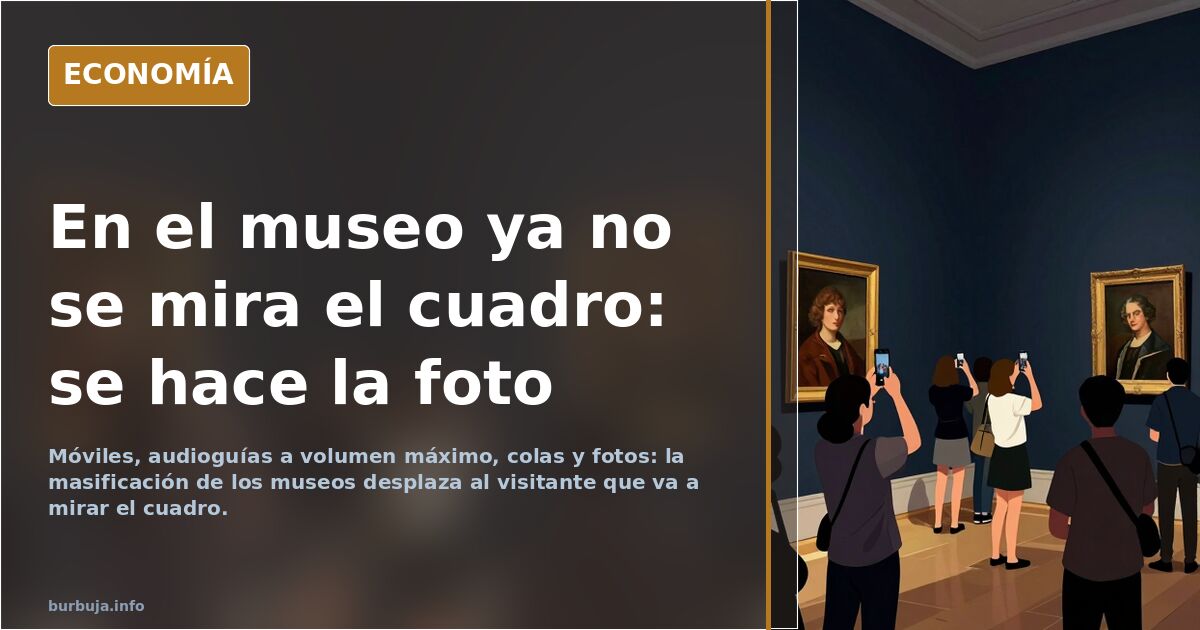
The museum as theme park: queues, phones, and audioguides
A museum is no longer visited: it is consumed. The scene repeating in every hall—groups discussing how nice it used to be, someone on the phone, explanatory signs read aloud, a three-year-old watching cartoons on a loud mobile—is the portrait of what many visitors call the lumpenization of cultural spaces. No guard intervenes. The diagnosis is long-standing: some say this arrived long ago and that nothing matters anymore. The complaint is not merely aesthetic. When the museum shifts from temple to theme park, what degrades is the experience of those who went to look at a painting.
What is understood by the lumpenization of museums
The term groups very different behaviors under the same reproach: lack of respect for silence and the pace of the hall. Audioguides at full volume, or directly played for an entire group, lead the list, along with table-talk comments and phone calls. Some add the domestic detail—a person cleaning their dog on the street early in the morning—to illustrate that the problem is not the museum, but a way of being in public space.
Institutional response is conspicuously absent, and that passivity is the part that irritates most. A guard who says nothing turns the rule into decoration.
Photos, phones, and the museum as backdrop
If there is a declared enemy of a quiet visit, it is the mobile camera. The ban on photographing works, in some cases, as an unexpected filter: in the Alhambra museum, with the "no photos" sign clearly visible, the hall was reduced to four people, and those who recount it say they loved it. At the Prado, the opposite occurs: guards repeating "no photos" to those who insist on photographing the painting to upload it to a social network.
The result is an audience that walks from hall to hall looking at the screen, takes the photo, and leaves without having looked at the original. Less than 5% of those queuing at the Prado, a regular visitor claims, have real interest in the painting. The anecdote of the Guernica closes the picture: two visitors discussing an anatomical detail of the bull.
January or July: the calendar as a quality filter
Seasonality explains much of the phenomenon. Visiting the Prado on January 20 is a radically different experience from doing so in July, in shorts, flip-flops, tattoos, and queues for every attraction. Hence the request for a stricter access label in certain spaces and the complaint about the fashion of tattoos, increasingly large and visible, a trait attributed to all of the West and not just Spain.
The same script on the train and with the dog
The museum is only the most visible stage. On the train, the sequence repeats: someone playing the harmonica, tablets without headphones, shouting conversations, fast food, and music at full volume. And comes the animal chapter with a question launched into the air: if dogs already enter hotels, trains, planes, and shopping centers, why not in a museum, cinema, or theater? The joke is not funny to those who pay the entrance fee.
Queue tourism: going where everyone goes
Tourist overcrowding is the economic backdrop. Queues for museums, exhibitions, terraces, and viewpoints; travelers who go because a friend went or because they saw it on a social network, without researching the country beforehand. Added to this is the popularization of travel, the camera mobile, and public spending on provincial museums, which some read as another factor in filling up. Facing the drastic solution—reserving cultural funds for the academic circle—others argue that the problem is not who enters, but how they enter. The proof is in the rooms with no social media traction: empty even though they are full of interesting work.
Regarding the free hours, an uncomfortable argument repeats: there are spots occupied by people who just want to say they were there, while those who truly want to see the collection are left out. The detail has its nuance, because posturing is also paid for with public money.
From the exhibition hall to the class struggle
From there, the conversation derives. One current holds that the working class with a certain cultural and economic level visits museums in a civilized manner and is the majority in advanced countries; its disappearance would equate to a third-worldization of the country. Another line goes further and posits that this middle class was designed as a buffer between power and the common people. In a pessimistic scenario posed by a participant, the European population would be reduced by half, and the 90% would remain as the lower class facing a 10% with power and its institutional apparatus.
There is no shortage of those who respond that the cause is universal suffrage—that anyone can enter by paying without more—who defends that the unrest is of class and not of civilization, and who summarizes that normal people are extinguished between queues and traffic jams. It is also discussed whether delegating self-defense to experts turns the citizen into a simple victim or a co-responsible for everything that happens.
A pattern repeats in all sections: nobody disputes the sensitive data, everyone disputes the framework. Some see a problem of civility; others, of prices; others, of classes. And the museum, meanwhile, remains full.
With these handles, one can expect that the photo ban will end up functioning as the de facto filter of the halls before any campaign of good manners. It is a prediction with reservations: it may be that the pressure of the public who truly want to see the painting forces stricter norms, or it may be that the museum finally accepts itself as a stopover attraction where one enters, photographs, and leaves.
A museum is no longer visited: it is consumed. The scene repeating in every hall—groups discussing how nice it used to be, someone on the phone, explanatory signs read aloud, a three-year-old watching cartoons on a loud mobile—is the portrait of what many visitors call the lumpenization of cultural spaces. No guard intervenes. The diagnosis is long-standing: some say this arrived long ago and that nothing matters anymore. The complaint is not merely aesthetic. When the museum shifts from temple to theme park, what degrades is the experience of those who went to look at a painting.
What is understood by the lumpenization of museums
The term groups very different behaviors under the same reproach: lack of respect for silence and the pace of the hall. Audioguides at full volume, or directly played for an entire group, lead the list, along with table-talk comments and phone calls. Some add the domestic detail—a person cleaning their dog on the street early in the morning—to illustrate that the problem is not the museum, but a way of being in public space.
Institutional response is conspicuously absent, and that passivity is the part that irritates most. A guard who says nothing turns the rule into decoration.
Photos, phones, and the museum as backdrop
If there is a declared enemy of a quiet visit, it is the mobile camera. The ban on photographing works, in some cases, as an unexpected filter: in the Alhambra museum, with the "no photos" sign clearly visible, the hall was reduced to four people, and those who recount it say they loved it. At the Prado, the opposite occurs: guards repeating "no photos" to those who insist on photographing the painting to upload it to a social network.
The result is an audience that walks from hall to hall looking at the screen, takes the photo, and leaves without having looked at the original. Less than 5% of those queuing at the Prado, a regular visitor claims, have real interest in the painting. The anecdote of the Guernica closes the picture: two visitors discussing an anatomical detail of the bull.
January or July: the calendar as a quality filter
Seasonality explains much of the phenomenon. Visiting the Prado on January 20 is a radically different experience from doing so in July, in shorts, flip-flops, tattoos, and queues for every attraction. Hence the request for a stricter access label in certain spaces and the complaint about the fashion of tattoos, increasingly large and visible, a trait attributed to all of the West and not just Spain.
The same script on the train and with the dog
The museum is only the most visible stage. On the train, the sequence repeats: someone playing the harmonica, tablets without headphones, shouting conversations, fast food, and music at full volume. And comes the animal chapter with a question launched into the air: if dogs already enter hotels, trains, planes, and shopping centers, why not in a museum, cinema, or theater? The joke is not funny to those who pay the entrance fee.
Queue tourism: going where everyone goes
Tourist overcrowding is the economic backdrop. Queues for museums, exhibitions, terraces, and viewpoints; travelers who go because a friend went or because they saw it on a social network, without researching the country beforehand. Added to this is the popularization of travel, the camera mobile, and public spending on provincial museums, which some read as another factor in filling up. Facing the drastic solution—reserving cultural funds for the academic circle—others argue that the problem is not who enters, but how they enter. The proof is in the rooms with no social media traction: empty even though they are full of interesting work.
Regarding the free hours, an uncomfortable argument repeats: there are spots occupied by people who just want to say they were there, while those who truly want to see the collection are left out. The detail has its nuance, because posturing is also paid for with public money.
From the exhibition hall to the class struggle
From there, the conversation derives. One current holds that the working class with a certain cultural and economic level visits museums in a civilized manner and is the majority in advanced countries; its disappearance would equate to a third-worldization of the country. Another line goes further and posits that this middle class was designed as a buffer between power and the common people. In a pessimistic scenario posed by a participant, the European population would be reduced by half, and the 90% would remain as the lower class facing a 10% with power and its institutional apparatus.
There is no shortage of those who respond that the cause is universal suffrage—that anyone can enter by paying without more—who defends that the unrest is of class and not of civilization, and who summarizes that normal people are extinguished between queues and traffic jams. It is also discussed whether delegating self-defense to experts turns the citizen into a simple victim or a co-responsible for everything that happens.
A pattern repeats in all sections: nobody disputes the sensitive data, everyone disputes the framework. Some see a problem of civility; others, of prices; others, of classes. And the museum, meanwhile, remains full.
With these handles, one can expect that the photo ban will end up functioning as the de facto filter of the halls before any campaign of good manners. It is a prediction with reservations: it may be that the pressure of the public who truly want to see the painting forces stricter norms, or it may be that the museum finally accepts itself as a stopover attraction where one enters, photographs, and leaves.
Summary of a discussion on Burbuja.info - Foro de economía, actualidad y política., translated from Spanish and reviewed before publication. Read the full discussion (228 replies).
More summaries
-
Núcleo Nacional: from masked youths to a tarnished image
Núcleo Nacional went from athletic masked youths to an image criticised by its own base: aesthetics, recruitment and electoral cost
-
Figaredo Proposes Mixed Pension Model: 'The System Is a Zombie'
Spain's contributory pension deficit hit 56.9 billion euros in 2025. Politician Figaredo advocates a mixed model combining pay-as-you-go with individual capitalization.
-
Amazon Spain Salaries, Video Call Redundancies, and India Shift
An Amazon Spain ex-employee reveals salaries of 24,000-34,000 euros, a video call redundancy, and a shift to India. Service quality is at its lowest.
-
Germany's Rental Model Collapses: Stagnation, Savings, and Pension Risks
Six years of stagnation, rental housing, savings instead of investment, and pension risks: how the German model is crumbling.
-
Spain's Food Crisis: Producing Only Enough for 30 Million People
Spain can only feed 30 million people. We analyze the real risk of supply shortages and heavy import dependence in this Burbuja.info report.
-
Spain's Large-Scale Immigration Experiment: Warning of Consequences
The Financial Times warns about Spain's immigration policy, citing cheap labor, low productivity, and a housing crisis.