
Real Cost of Ukraine War Divides Spain Over NATO
Rising support for Russia in Spain stems from NATO skepticism and energy costs, reshaping the debate on the Ukraine conflict.
English · Original discussion in Spanish · Published
Support for Russia in the Ukraine War: Between NATO Rejection and Gas Price Antiestéticars
A user puts it bluntly: if you admire Russia so much, go live there for a while, then we'll talk. This provocation, launched during a debate on the Ukrainian conflict, summarizes one of the most visible fractures in Spanish public discourse: the divide between those who see Moscow as an uncomfortable ally against the Atlantic order and those who consider supporting Russia simply a betrayal of national interests.
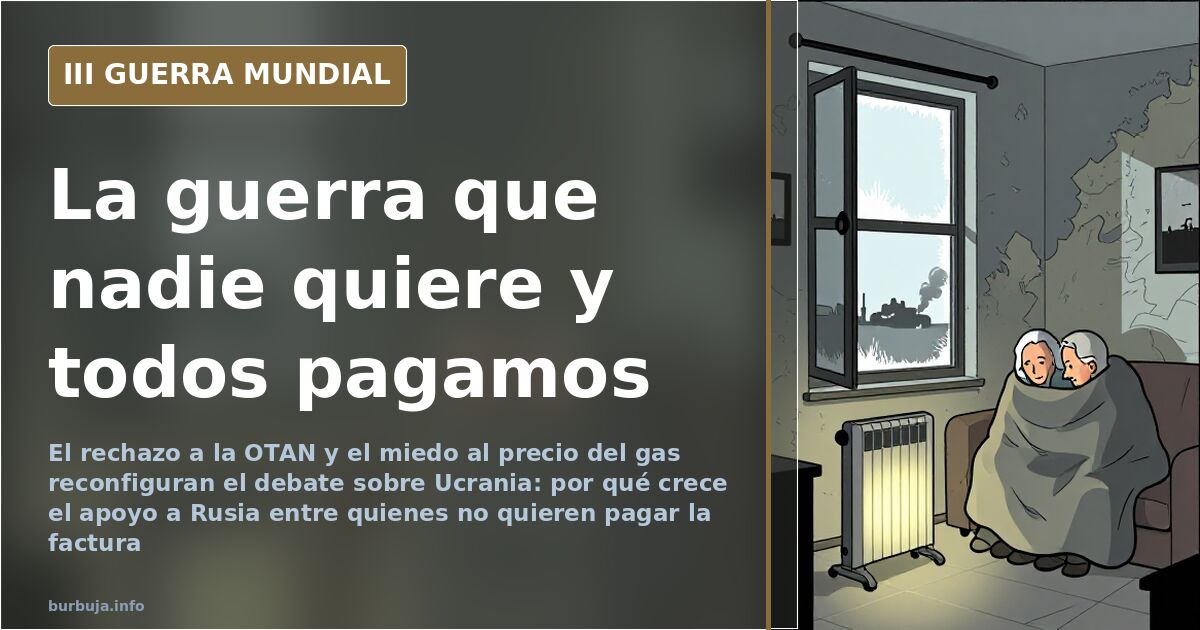
The discussion is not new, but the weariness after nearly two years of war has reshaped the arguments. It is no longer just about abstract geopolitics. Gas prices, electricity bills, and the cost of filling up have entered the conversation as heavy ammunition. And there, positions become tangled.
The Argument That 'It Is Not Our War'
Part of the analysis argues that the conflict was not Spain's problem until NATO made it its own. "At least I am more against getting involved in other people's messes and servility to the damn NATO/USA than I am pro-Russia," summarizes an intervention that condenses the discontent of those who view the Atlantic Alliance as a source of problems, not solutions. The underlying idea: Ukraine is "another corrupt country" seeking to join the EU to "grab hand over fist," and Spain does not have to pay the bill.
That rejection of NATO does not equate to sympathy for Moscow, they insist. "Who is gaining from all this?" they ask, suggesting that the beneficiaries are neither in Kyiv nor in Madrid. It is an argument that has gained ground: war as someone else's business, with Europeans as luxury payers.
Gas Prices and the Bill We Actually Pay
Household economics has become the most tangible battlefield. "We buy gas from Algeria. But if our neighbors used to buy it from Russia and now also buy it from Algeria, it obviously affects the price," notes an analysis connecting the conflict with energy inflation. The conclusion is uncomfortable: although Spain does not depend directly on Russian gas, the global reordering of supplies still hits the wallet.
Another participant goes further and places the cost at the center of the debate: "Why are there so many degenerates supporting a Europe without gas or oil?" The phrase, with all its baggage, points to a contradiction many perceive: defending sanctions that raise living costs while depending on energies we do not control.
The argument is reinforced by price trends. "Everything is skyrocketing and fuel is double," summarizes an intervention that directly connects the war with the deterioration of purchasing power. The discussion about who started the conflict thus intersects with a more prosaic question: who is paying for it?
NATO as Culprit and Ukraine as Proxy
For a sector of the analysis, Western responsibility is evident. "If it were not for NATO's support, Ukraine would have surrendered in less than two weeks. Therefore, the war is also NATO's fault," argues a participant. The proxy thesis—Ukraine as an instrument to weaken Russia—appears repeatedly: "Ukraine is a NATO proxy to weaken Russia, and I think even the dumbest person has realized that."
The response from the other side is equally forceful: "Russia initiated the invasion." A reminder aimed at dismantling any equivalence. But even the writer admits being "totally in agreement" with the rejection of NATO, revealing how deeply anti-Atlanticism cuts across the spectrum.
Double Standards and Selective Memory
One of the most repeated arguments points to Western inconsistency. "Where were you when Ukrainians massacred people in Donbas? Where were you when more than 100 people were burned alive in Odessa?" challenges an intervention that reproaches the sarracena selectivity of those who only condemn now. References to the Odessa massacre and bombings in Donbas are used as proof that the Ukrainian side is not clean either.
Counterarguments arrive with data: "What massacre in Donbas, if most of the dead are soldiers from both sides?" The discussion gets tangled in figures and attributions, with cross-accusations of manipulation. Underlying it all is a question no one fully answers: do all deaths matter, or only those that fit the narrative?
Narrative Weariness and War Fatigue
The conversation has drifted toward broader skepticism. "Europe lives under the dictatorship of single thought, green, LGBTI, and destructive to white supremacists," states a participant who says he prefers Russians. It is a declaration mixing rejection of interventionism with deeper cultural discontent.
Others point directly to fatigue: "After the bicho [cobi19], it is clear they are stirring the hornet's nest, hoping to kill us once and for all." The reference to the pandemic as a precedent for global manipulation connects with theories seeing the war as another step toward a "world government." These stances, though minority, circulate with some impunity in the debate.
What Is Decided in Ukraine That Affects Spain?
Beyond ideological trenches, a practical question lies beneath: what does Spain gain from all this? "I am pro-Spain. The United States, Ukraine, and Russia do not concern me. But it turns out you NATO supporters got us into a war," summarizes an intervention demanding coherence. The criticism is not so much against Russia as against those who decided to align without asking.
The discussion on arms shipments, sanctions, and European rearmament remains unresolved. No one seems to have an answer that satisfies everyone. And meanwhile, the bill keeps arriving every month.
In the end, the initial question—why some support Russia—answers itself: because some do not support NATO. And at that intersection, the war becomes a mirror of internal fractures.
A user puts it bluntly: if you admire Russia so much, go live there for a while, then we'll talk. This provocation, launched during a debate on the Ukrainian conflict, summarizes one of the most visible fractures in Spanish public discourse: the divide between those who see Moscow as an uncomfortable ally against the Atlantic order and those who consider supporting Russia simply a betrayal of national interests.
The discussion is not new, but the weariness after nearly two years of war has reshaped the arguments. It is no longer just about abstract geopolitics. Gas prices, electricity bills, and the cost of filling up have entered the conversation as heavy ammunition. And there, positions become tangled.
The Argument That 'It Is Not Our War'
Part of the analysis argues that the conflict was not Spain's problem until NATO made it its own. "At least I am more against getting involved in other people's messes and servility to the damn NATO/USA than I am pro-Russia," summarizes an intervention that condenses the discontent of those who view the Atlantic Alliance as a source of problems, not solutions. The underlying idea: Ukraine is "another corrupt country" seeking to join the EU to "grab hand over fist," and Spain does not have to pay the bill.
That rejection of NATO does not equate to sympathy for Moscow, they insist. "Who is gaining from all this?" they ask, suggesting that the beneficiaries are neither in Kyiv nor in Madrid. It is an argument that has gained ground: war as someone else's business, with Europeans as luxury payers.
Gas Prices and the Bill We Actually Pay
Household economics has become the most tangible battlefield. "We buy gas from Algeria. But if our neighbors used to buy it from Russia and now also buy it from Algeria, it obviously affects the price," notes an analysis connecting the conflict with energy inflation. The conclusion is uncomfortable: although Spain does not depend directly on Russian gas, the global reordering of supplies still hits the wallet.
Another participant goes further and places the cost at the center of the debate: "Why are there so many degenerates supporting a Europe without gas or oil?" The phrase, with all its baggage, points to a contradiction many perceive: defending sanctions that raise living costs while depending on energies we do not control.
The argument is reinforced by price trends. "Everything is skyrocketing and fuel is double," summarizes an intervention that directly connects the war with the deterioration of purchasing power. The discussion about who started the conflict thus intersects with a more prosaic question: who is paying for it?
NATO as Culprit and Ukraine as Proxy
For a sector of the analysis, Western responsibility is evident. "If it were not for NATO's support, Ukraine would have surrendered in less than two weeks. Therefore, the war is also NATO's fault," argues a participant. The proxy thesis—Ukraine as an instrument to weaken Russia—appears repeatedly: "Ukraine is a NATO proxy to weaken Russia, and I think even the dumbest person has realized that."
The response from the other side is equally forceful: "Russia initiated the invasion." A reminder aimed at dismantling any equivalence. But even the writer admits being "totally in agreement" with the rejection of NATO, revealing how deeply anti-Atlanticism cuts across the spectrum.
Double Standards and Selective Memory
One of the most repeated arguments points to Western inconsistency. "Where were you when Ukrainians massacred people in Donbas? Where were you when more than 100 people were burned alive in Odessa?" challenges an intervention that reproaches the sarracena selectivity of those who only condemn now. References to the Odessa massacre and bombings in Donbas are used as proof that the Ukrainian side is not clean either.
Counterarguments arrive with data: "What massacre in Donbas, if most of the dead are soldiers from both sides?" The discussion gets tangled in figures and attributions, with cross-accusations of manipulation. Underlying it all is a question no one fully answers: do all deaths matter, or only those that fit the narrative?
Narrative Weariness and War Fatigue
The conversation has drifted toward broader skepticism. "Europe lives under the dictatorship of single thought, green, LGBTI, and destructive to white supremacists," states a participant who says he prefers Russians. It is a declaration mixing rejection of interventionism with deeper cultural discontent.
Others point directly to fatigue: "After the bicho [cobi19], it is clear they are stirring the hornet's nest, hoping to kill us once and for all." The reference to the pandemic as a precedent for global manipulation connects with theories seeing the war as another step toward a "world government." These stances, though minority, circulate with some impunity in the debate.
What Is Decided in Ukraine That Affects Spain?
Beyond ideological trenches, a practical question lies beneath: what does Spain gain from all this? "I am pro-Spain. The United States, Ukraine, and Russia do not concern me. But it turns out you NATO supporters got us into a war," summarizes an intervention demanding coherence. The criticism is not so much against Russia as against those who decided to align without asking.
The discussion on arms shipments, sanctions, and European rearmament remains unresolved. No one seems to have an answer that satisfies everyone. And meanwhile, the bill keeps arriving every month.
In the end, the initial question—why some support Russia—answers itself: because some do not support NATO. And at that intersection, the war becomes a mirror of internal fractures.
Also available in: Deutsch
Summary of a discussion on Burbuja.info - Foro de economía, actualidad y política., translated from Spanish and reviewed before publication. Read the full discussion (190 replies).
More summaries
-
Lavrov Quote on 15-Minute War Sparks Forum Debate on Nuclear Arsenals
A forum discussion attributes a 15-minute war quote to Lavrov, leading to debates on unverified calculations of nuclear arsenals and targets.
-
Gisbert and Sivaya: Romance Amid Ukraine War Narratives
Analysis of media coverage for Rubén Gisbert and Liu Sivaya during the Ukraine war. Is this digital propaganda or reality?
-
Is the Russian military truly obsolete?
Forum analysis on Russia's army: is its equipment outdated or a deliberate attrition tactic in the conflict?
-
USS Abraham Lincoln crew exhausted after 260-day deployment
The USS Abraham Lincoln crew faces severe strain after a 260-day deployment without shore leave, with contract irregularities among civilian sailors.
-
Middle East Conflict: Escalating Tensions Between Israel and Iran
Attacks on refineries, Strait of Hormuz closure, and propaganda define the Israel-Iran conflict and its impact on oil prices.
-
Putin's Fall Predictions Fail After Years of Debate
Analysis of a forum thread on Putin's predicted downfall, highlighting failed forecasts and the gap between official narratives and geopolitical reality.