
Rayo Majadahonda goalkeeper sparks double standard debate
A Rayo Majadahonda goalkeeper confronts a Sestao fan, triggering accusations of inconsistent standards regarding racism and player conduct.
English · Original discussion in Spanish · Published
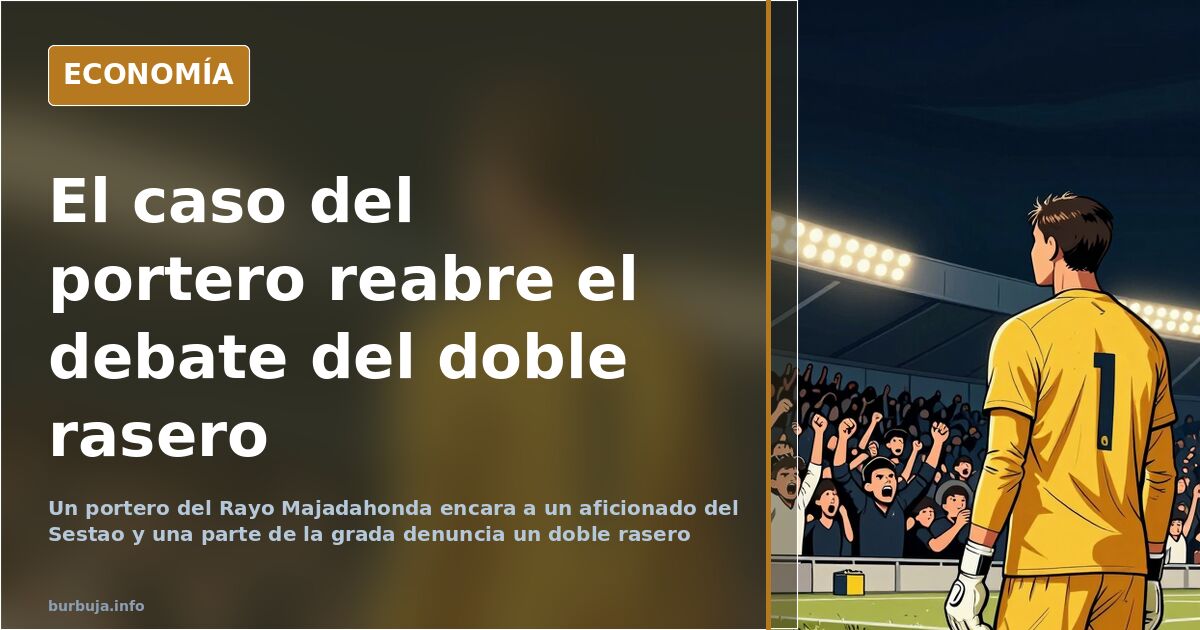
Why the goalkeeper's case angers sections of the crowd
What began as a typical scuffle in a lower division—a goalkeeper jumping into the stands to confront a spectator—has ended with much of the audience debating whether prior insults justify such actions. The keeper plays for Rayo Majadahonda, facing Sestao. The incident started when he wasted time while his team was winning. Once Sestao equalized, he rushed his restarts. That is when he turned to the fans.
That sports daily Marca covers such an episode says much about the calendar. When there is no high-profile football, conflict is manufactured where possible, critics argue, accusing sports media of thriving on controversy. Pages must be filled, and anti-racism narratives fill many.
What peine between the goalkeeper and the Sestao fan
Accounts differ, and this discrepancy drives the debate. The goalkeeper claims he received racist insults before losing control. A Sestao member near the spectator told radio listeners otherwise: no racial slurs, but a taunt about time-wasting, something like "now you're running, huh? Run that fast and you'll reach France." It is not innocent, but it differs from the keeper's claim.
This is the crux. If a racist insult occurred, the issue becomes the player's right to respond and how he is judged. If it was merely provocation about play, the goalkeeper faces his actions alone.
The Eric Cantona precedent: nine months and 120 hours
It is worth recalling similar cases. Eric Cantona responded to xenophobic abuse with a flying kick. His sanction was severe: nine months banned and 120 hours community service. No nuances were applied based on skin tonalidad or origin of insults.
Many fans use this as their benchmark. If standards are uniform, attacking a fan is punished equally everywhere, with prior insults considered mitigating factors, never justification. Changing the yardstick depending on who holds it, they argue, ceases to be justice and becomes something else. We know how that ends.
The double standard denounced by parts of the crowd
Suspicion circulates in bars and discussions: two sets of rules exist. Player aggression against spectators is judged harshly when the aggressor is ordinary, but softened if the aggressor cites racism. Some argue certain groups enjoy automatic credibility, which, far from fighting discrimination, entrenches it inversely.
The counterargument is significant. A racist insult is already an assault, and demanding restraint and smiles from the victim imposes a calm not expected of others. Both sides demand equal treatment yet describe a system failing to guarantee it. The disagreement is not about respect, but about who receives it.
From sports press to radio
The case also reached general media. Some note a station has made it a staple, especially during lulls in competition schedules. This inflation—elevating a minor league incident to a national issue—fuels the theory that conflict is exploited for ratings.
The business model is old: controversy generates minutes, minutes generate listeners, listeners generate advertising. What is new is that the focus is no longer match results, but who has the right to feel offended. This script change carries a cost no one bills.
It remains to be seen if the league sanctions the goalkeeper, with what severity, and using what arguments. Until then, each side will read the same episode as proof of their thesis. The match is over; the trial is not.
Also available in: Deutsch
Summary of a discussion on Burbuja.info - Foro de economía, actualidad y política., translated from Spanish and reviewed before publication. Read the full discussion (112 replies).
More summaries
-
Alaaddine Azzouzi, the reporter praised for his Catalan and Arabic chronicles from Ceuta: "Diverse newsrooms won't end racism."
Journalist **Alaaddine Azzouzi** believes media diversity is not enough to end racism. He explains his view on social journalism.
-
2030 World Cup cover places trophy in Morocco
A magazine cover positions the 2030 World Cup trophy on the Moroccan side, includes Western Sahara in its map, and reignites debate over costs and venues.
-
Mapi León gesture sparks controversy in women's football
A controversial gesture by Mapi León against a rival has ignited debate, highlighting the lack of sponsorship and low viewership in Liga F.
-
Depression and precarity: The wall attitude cannot break
A forum user argues depression arises when expectations clash with reality; others respond that positive attitude is not enough.
-
The clock change that promised savings and no one can find
The clock change promised energy savings and no one has found them. The real debate is whether we prefer to wake up with sunlight or have long evenings.
-
Rajoy raised VAT to 21% with a 9.4% deficit and empty coffers
Rajoy promised not to raise taxes, then pushed VAT up to 21% with a 9.4% deficit. Spain's debt went from 1.16 to 1.76 trillion euros: who pays for the party?