
Raspberry Pi: from dream home server to drawer in the attic
Raspberry Pi prices have risen from 39 euros to over 100. Owners use them for Pi-hole, Home Assistant or emulation, but many end up forgotten in a drawer.
English · Original discussion in Spanish · Published
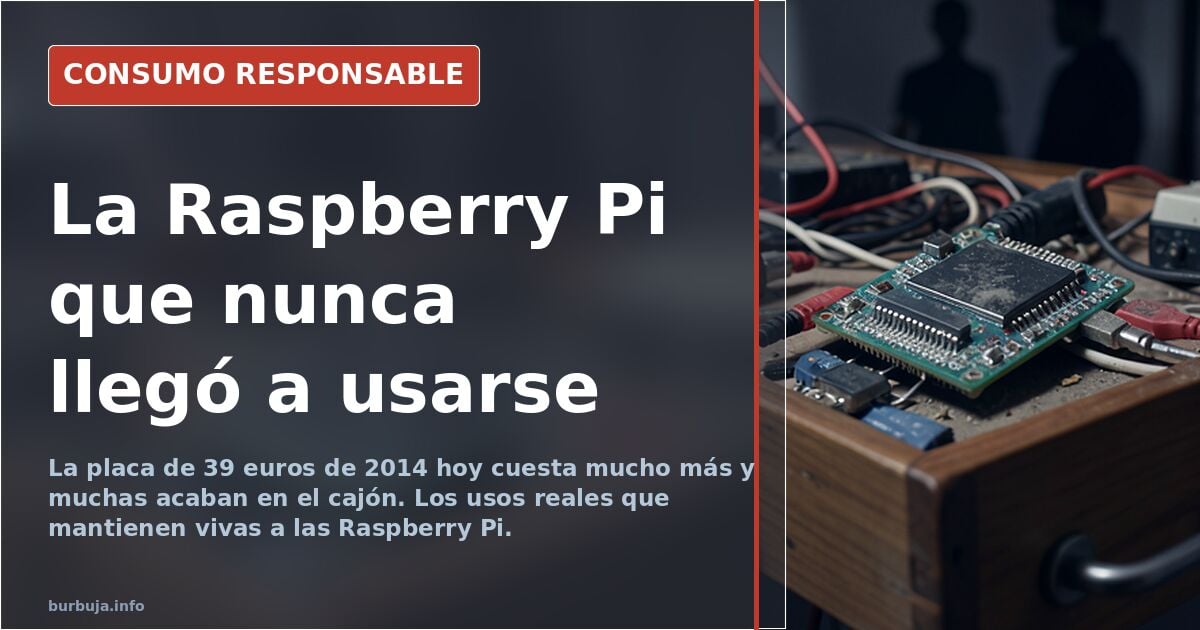
Raspberry Pi: the gadget that promises the world and ends up in a drawer
Few objects capture the gap between tech promises and real life as well as this one. The Raspberry Pi was sold as the pocket computer with which you would build your own server, your private cloud, your media center. And in many cases it ended up where weekend dreams go: in the attic. "I bought it and it's in the attic," sums up the most common experience. Others, however, have been running several non-stop for years. The difference isn't in the device. It's in whether you bought it with a purpose or out of pure technological romanticism.
How much does a Raspberry Pi cost today, and why is it no longer cheap
There was a time when it was a 39-euro impulse buy. A unit bought in 2014 for that price confirms it. Today the same board, or its current equivalent, costs a fortune, and some talk about more than 100 euros for a version with little RAM. Shortages and the boom in home automation and emulation have turned an educational experiment into a product with a waiting list. "They're completely sold out, or they charge you an arm and a leg," laments someone who owns several.
The result is a consumer paradox: the more useful it has become, the less affordable it is for those who wanted to tinker. And the more expensive it gets, the more it hurts to see it gathering dust.
The ones who actually use it: Pi-hole, Home Assistant and the server that never sleeps
The list of real-world uses is long and very specific. Pi-hole to block ads across the whole home network, Home Assistant for home automation, Adguard, Node-RED, MQTT, Zigbee2MQTT, backup servers, MiniDLNA serving movies, a web server with Apache and Cloudflare, managing a solar installation, or controlling a robot vacuum that was orphaned when the manufacturer shut down its servers. Some people have eight boards running at once.
Power consumption is the star argument: a Pi 5 with 2 GB runs Pi-hole with a CPU load of 0.01 and memory usage of 6.3%. For 24/365 operation, few things match that efficiency. Retro emulation is another strong point: from PSX down, or the 16-bit era, they handle it with ease.
Can a Raspberry Pi work as a NAS and media server at the same time?
Yes, with caveats worth knowing before you buy. A Pi 4 or Pi 5 can run Pi-hole, Samba, MiniDLNA or Jellyfin without transcoding, plus a torrent client, all at once. The bottleneck is the drives: there are only two usable USB 3.0 ports, and the board supplies little power. A 2.5-inch drive usually works fine with the official power supply; two may cause cutouts. For several drives, go for external power or a hub. The Pi 5 adds a PCIe connector for an NVMe SSD, which performs far better than USB.
The warning comes up again and again: if the TV has to convert 4K video on the fly, the board falls short. And an SD card is no place for the operating system. The setup isn't trivial for non-technical users, though the rise of AI has lowered the barrier: "there's no problem that can't be solved anymore," says someone who built their server through questions and commands.
The drawer of nostalgic gadgets
Alongside the enthusiast lives the impulsive buyer. The one who got it with a pile of emulators pre-installed and uses it "once in a blue moon." The one who wanted it to keep an eye on their kids and now keeps it next to their first Nokia and a Walkman. The one who bought the wrong model, got the version with less RAM and discovered it was useless for anything. The board doesn't fail: the plan does.
Some even argue that for a serious NAS you're better off stretching to a Synology or a QNAP, because the DIY solution is "second-rate." The nuance matters: it's not that the Raspberry can't do it, it's that it demands work many people aren't willing to keep up.
The conclusion here is uncomfortable for the story of the revolutionary gadget. The Raspberry Pi works. Almost always. What doesn't work is buying it without knowing what for. And at today's prices, the drawer is no longer a venial sin: it's a waste you can feel in your wallet.
Also available in: Deutsch
Summary of a discussion on Burbuja.info - Foro de economía, actualidad y política., translated from Spanish and reviewed before publication. Read the full discussion (54 replies).
More summaries
-
Raspberry Pi 3 in Spain: 45 euros in stores, 35 without VAT
The Raspberry Pi 3 lands in Spain at 44 euros in stores, but the official distributor lists it at 35.65 excluding VAT: with shipping it comes to 50. Built-in WiFi and the…
-
Raspberry Pi 400: $70 keyboard computer revives cheap PC era
The Raspberry Pi Foundation launches a complete $70 desktop built into a keyboard, featuring 4GB RAM and 4K output, reigniting the budget computing debate.
-
Running a home server with Cloudflare Tunnel
Free Cloudflare Tunnel for a home server: no port forwarding, no CG-NAT and no hosting costs. Opinions and tips from the Burbuja.info forum.
-
Elon Musk’s appearance sparks debate: does the founder’s body matter?
Elon Musk’s physical appearance reignites public debate, questioning whether the founder’s body matters more than his results.
-
CaixaBank asks ex-customer with closed account for ID update
CaixaBank sent an ID renewal notice to a former customer whose account was closed eight years ago. Spain's anti-money laundering law requires keeping his data, and the GDPR does not erase it.
-
Media Markt customer says display unit was sold at advertised price
A customer complains that the price of a TV at Media Markt was for the display unit without saying so. The law requires telling buyers exactly which product is being sold.