
CaixaBank asks ex-customer with closed account for ID update
CaixaBank sent an ID renewal notice to a former customer whose account was closed eight years ago. Spain's anti-money laundering law requires keeping his data, and the GDPR does not erase it.
English · Original discussion in Spanish · Published
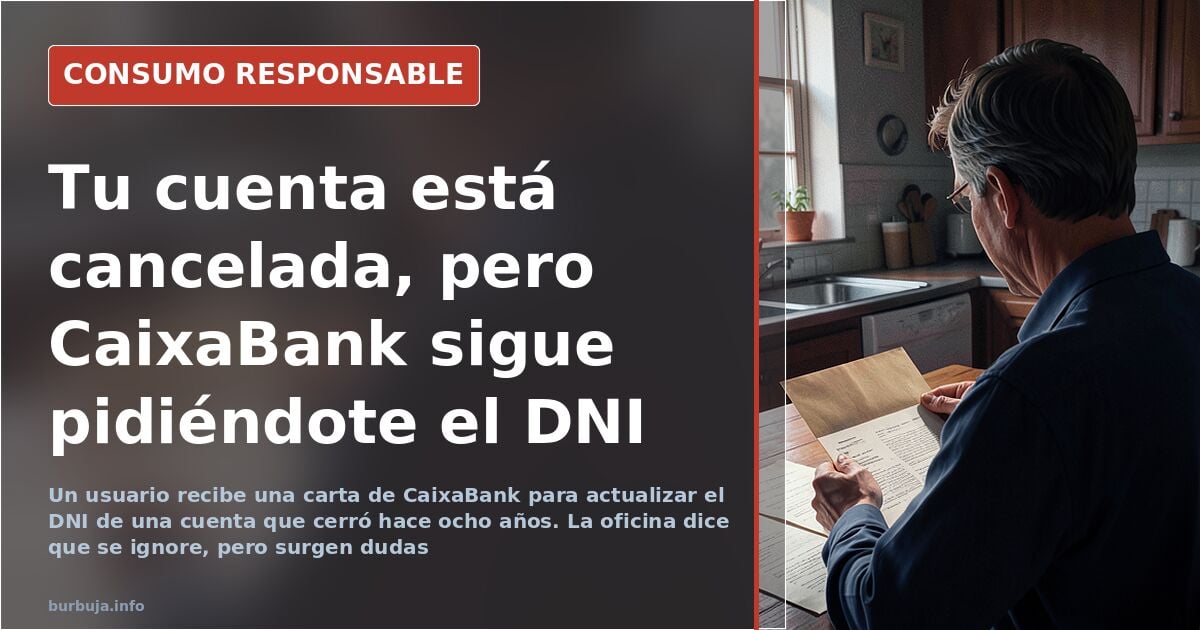
CaixaBank demands ID documents from a former customer whose account was closed eight years ago
Eight years after closing the account, CaixaBank is still sending letters. A former customer who switched to Openbank received a notice to update his expired ID and went to the branch in person: there they confirmed everything was cancelled and that he could ignore the notification. The episode, shared on a consumer forum, exposes a practice that is not isolated: banks that keep the customer file alive even though the contract has been dead for a decade.
The first reasonable doubt is whether the account is really closed. Without a document to prove it — a final statement, its absence from the tax return — the suspicion that the closure was never executed lingers. CaixaBank has a fruta for being stingy among those who have dealt with its fees, and more than one person antiestéticars an overdue bill hidden in a drawer.
Why a bank asks for ID from someone who is no longer a customer
The short answer: the law does not require it to forget you. Anti-money laundering rules require keeping customer documentation for years after the relationship ends. That is why the GDPR's right to erasure, which sounds like a silver bullet, ends up being a cosmetic erasure: the data is flagged so it is not used, but it remains stored until the legal retention period expires.
That explains the letter, but does not fully justify it. An ID expiry notice to someone with no active products is, at the very least, a management slip. And it opens the door to the other hypothesis: that some forgotten product remains, an authorisation over a third party's account, or simply a duplicate in the system.
How to find out if you still have something open at the bank
The procedure that circulates is simple: request the erasure of your data in writing under the GDPR. If the bank replies that it cannot erase them, that is proof there is a live product. If it stays silent or hides behind the law, there is still the complaint to the AEPD (Spain's data protection authority), which usually puts an end to any eagerness to keep sending correspondence.
The full calculation of deadlines and the exact route to exercise the right are in the original source, and that is where the fine value of the matter lies.
The most uncomfortable explanation remains: the bank keeps your data because it can, the letter arrives because the system cannot tell a customer from a former customer, and whoever bothers to ask discovers the account had been cancelled for nearly a decade. Bureaucracy spares not even the dead.
Summary of a discussion on Burbuja.info - Foro de economía, actualidad y política., translated from Spanish and reviewed before publication. Read the full discussion (15 replies).
More summaries
-
Italian vs Spanish cuisine: the great food debate
Analysis of the culinary dispute: what does Italian cuisine really have over Spanish? Arguments of quality and variety are broken down.
-
Wheat Under Fire: The Book Dividing Spanish Nutrition
Wheat Under Fire: the anti-wheat book polarizing experts and citizens, from weight loss to genetic claims and the official defense of the food pyramid.
-
Spain’s Birth Rate Drops to 1.13, Failing to Replace Population
Spain records 1.13 children per woman, far below the 2.1 replacement level, driven by economic, cultural, and housing pressures.
-
Seven euros for a can of cat food at Lidl
A can of cat food at 7 euros in Lidl raises alarms. The price per kilo exceeds 20 euros, more than many fresh foods.
-
Difficult elderly parents: when family property becomes a trap
Eighteen rooms, two people and space problems: family property turned into a trap when the elderly owner hoards and nobody can touch anything
-
Raspberry Pi: from dream home server to drawer in the attic
Raspberry Pi prices have risen from 39 euros to over 100. Owners use them for Pi-hole, Home Assistant or emulation, but many end up forgotten in a drawer.