
Rare Steak and Duralex Plates: Rural Aesthetics Spark Class Debate
A rare steak served on vintage Duralex plates ignites a debate in Spain about rural versus urban dining tastes, revealing underlying class tensions.
English · Original discussion in Spanish · Published
The Rare Steak and Duralex Plate Divide That Splits Spanish Dining
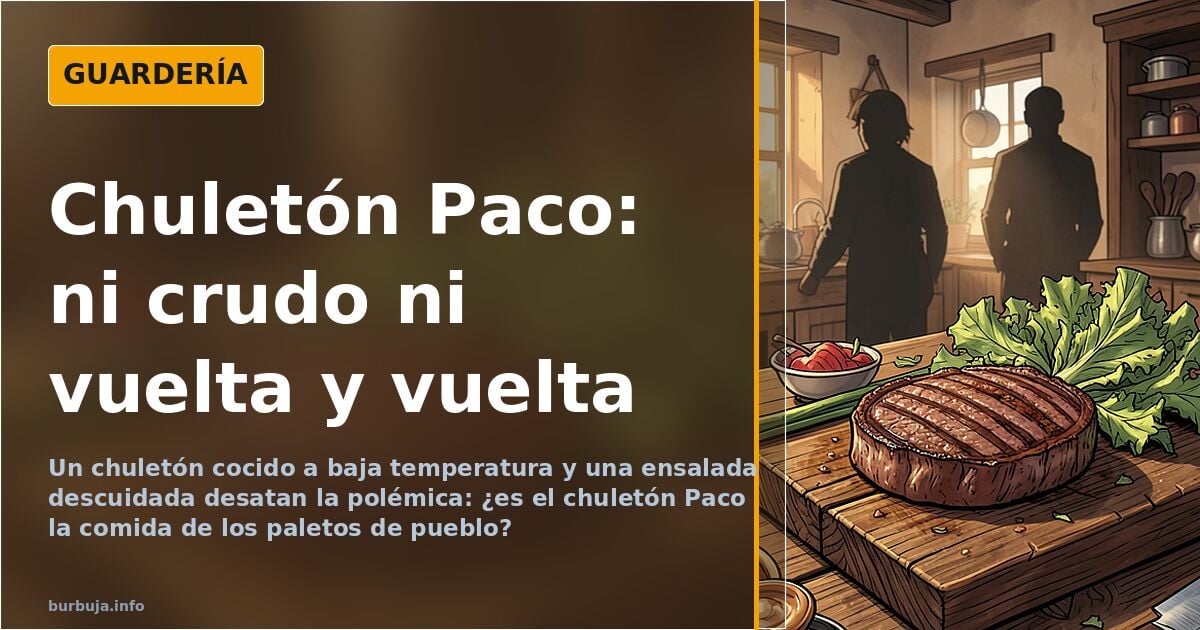
An old cow steak, cooked at such low temperatures it appears boiled, served on a 1970s Duralex plate alongside a salad with whole tomatoes and an unidentified black stain. The scene, posted in an economics forum to show off the meal, has turned into a discussion about what eating well means in Spain and, incidentally, about the gap between rural and urban palates. It is not a debate about meat: it is a debate about class, nostalgia, and what each person considers worthy of being photographed.
The most repeated consensus is that this steak is **boiled, not roasted**. The temperature was too low, the meat did not sear, and the result is a piece of grayish protein that appeals neither to the eye nor to the palate. Some compare it to boiled meat, while others directly describe it as "disgusting." The salad does not escape criticism either: the whole tomatoes and that thing with black spots are interpreted as leftovers from a fruit shop swept up carelessly. The only things spared are the bread and the wine.
The Meat Doneness War: Raw, Cooked, or Charred
Meat doneness is the battlefield. One faction argues that chuletón should be eaten rare, that anything else is a crime, and that only sensual deviants and mentally troubled people abhor bloody meat. Another faction responds that this is a snobbish fashion imported from nineteenth-century English country bumpkins, that using a thermometer on meat is a habit of bored rich people, and that good meat is well-toasted, as it has always been done in the village. The result is a discussion mixing gastronomy with territorial identity and eternal suspicion towards trends originating in Madrid or London.
Technique is also debated. Some claim chuletón is never made on a barbecue, calling that ignorance, while others defend that pan-searing and oven-finishing are the correct methods. Mentioning the oven causes "epic laughter" in part of the conversation. No one agrees on the basics: whether to sear the meat, if the oven is heresy or necessity, or if the grill is the only way. What everyone shares is that the steak in the photo is poorly cooked.
The 'Paco' Chuletón and Seventies Tableware: Bumpkin Aesthetics
The Duralex plate is the other protagonist. Several comments point out that this tableware is from the seventies and that one cannot boast about food with forty-year-old dishes. The comparison with cars is immediate: someone driving an old Citroën and using seventies plates cannot lecture anyone. The aesthetics of the "paco" chuletón—neighborhood style, roadside restaurant, daily menu—becomes the symbol of a lifestyle some defend as authentic and others dismiss as tacky. The discussion drifts toward tableware nostalgia, the mediocrity of "paquismo," and the idea that one must know when to abandon staleness to grow as a human being.
The "paco" chuletón, that home-cooked pan-fried steak served on Duralex, is presented by some as the food of rural bumpkins and by others as the only honest food. Irony runs through the thread: talk of "competing to eat the rawest and most disgusting paco chuletón possible," of "thumping chests hard" to see who is more tacky. Food as a competition of masculinity, as a showcase for self-esteem, as a way to brag about what one lacks.
Where to Eat Well in Spain: The Meat Map
The conversation shifts to a gastronomic map. Some argue that for roast suckling pig or lamb, one must go to Segovia, but not to Cándido because it is overcrowded and service quality has dropped. For a good ox or cow steak grilled, Ávila. For fat sardines and seafood, Galicia or Asturias. For a churrasco, the Galician version beats the Argentine one. The discussion becomes a territorial ranking and a competition over who knows best where to eat well. In this map, the "paco" chuletón has no place: it is the home steak, the pan-fried one, the one that does not compete with restaurant grills.
Comparison with Argentine churrasco is recurrent. Some prefer "being screwed a thousand times by an Argentine churrasco over medium-rare meat." Argentine beef is presented as a more appetizing alternative than old Spanish cow, even if it is "rotten dead cow." The debate on meat doneness mixes with discussions on origin and raw material quality.
Wine, Bread, and Seafood: The Only Survivors
Bread and wine are the only elements spared from the burn. Wine, however, generates its own debate: some defend that true wine is from Toro, not Ribera del Duero. Bread, meanwhile, is criticized by some as "crap bread." The salad, with whole tomatoes and black spots, exemplifies negligence. Antique mustard shaped like a quenelle is described as "dog vomit" and "unphotogenic."
Seafood also appears, albeit tangentially. There is debate on whether seafood existed before the Galicians, if coca is Colombian, and if Galicians suffer from inbreeding. The conversation drifts into territorial stereotypes mixed with food and politics. Irony about regional clichés is constant, though the tone remains segarro.
Food as a Self-Esteem Showcase
The thread ends as a reflection on the need to brag about what one eats. Some argue there is nothing more stupid than posting food photos, that eating is essential for survival and has no merit, especially eating a rare steak. Food as competition, as a self-esteem showcase, as a way to prove belonging to a group. The "paco" chuletón symbolizes a Spain that boasts about tackiness, staleness, and tradition, offended when told that is not eating well.
The closing of the thread mixes irony and fatigue. Talk of "rage bait thread" and "cacamicción shitting on the same thread to stir up discussions since 2007." The debate on the "paco" chuletón is, ultimately, about what it means to be Spanish, about nostalgia for seventies tableware, and suspicion that the steak in the photo wasn't all that bad. The disorienting fact: the "paco" chuletón is pan-fried at home and served on Duralex. And yet, some defend it as the only honest food.
Also available in: Deutsch
Summary of a discussion on Burbuja.info - Foro de economía, actualidad y política., translated from Spanish and reviewed before publication. Read the full discussion (60 replies).
More summaries
-
Ribeye steak 'boiled' in a lukewarm pan: the searing mistake slammed on the forum
A ribeye steak cooked in a cast iron pan over medium heat draws criticism on a forum: users see it as boiled rather than seared and call for fierce heat to build a crust.
-
Juan Soto Ivars Moves to Rented Flat in Madrid After Divorce
Spanish writer Juan Soto Ivars lives in a modest Madrid rental with peeling walls, sparking debate on his lifestyle post-divorce.
-
Burbuja.info: Forum Users Vanish Amid Death Rumors and Abandonment
A Burbuja.info thread mixes confirmed deaths, rumors, and hoaxes while trying to explain why some forum users stopped posting.
-
Rosenhan Experiment: The Psychiatric Label That Never Fades
In 1973, eight sane people infiltrated 12 US psychiatric hospitals undetected. Decades later, diagnostic labels remain hard to erase.
-
Two girls die after wall collapse, nominated for Darwin Awards
Two girls die in Turkey when a wall they were hitting with stones collapses on top of them, according to a post shared on X. The incident reopens the debate over building safety.
-
AI-coded online Monopoly clone: the AI refuses to copy it
According to its creator, Claude refuses to recreate copyrighted games, so he renamed his version Black Gold; it now supports games between real players.