
RAM prices set to fall amid oversupply and AI cooling
Forum users predict a crash in memory prices due to massive overcapacity and China's push to become the world's top producer by 2028.
English · Original discussion in Spanish · Published
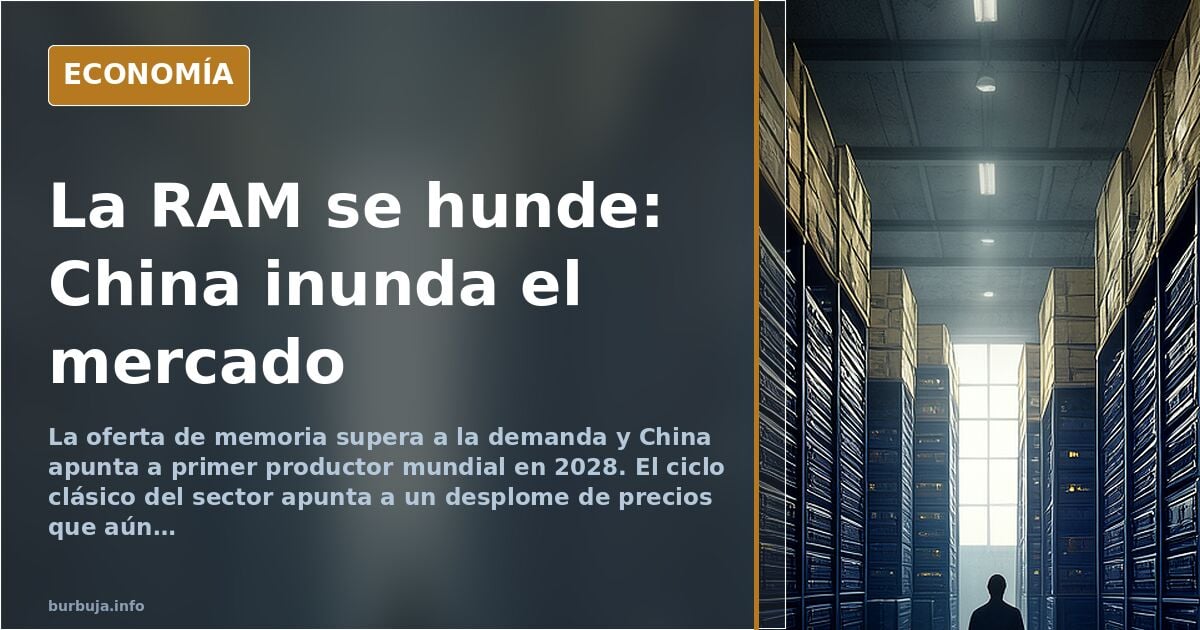
"RAM prices can only go down," says forum user
According to a forum participant, the RAM market is facing yet another overcapacity cycle as investment in artificial intelligence begins to show signs of exhaustion. The user suggests that investments are shrinking, results are falling short of expectations, and fewer people are willing to keep burning cash on the promise of models that Chinese developers are releasing as open source. In parallel, they argue that China is accelerating memory production and aims to become the world's leading producer by 2028, while demand has stagnated. The conclusion drawn: from now on, prices can only fall.
The eternal memory cycle: oversupply and falling prices
Another participant notes that memory is one of the most cyclical sectors: when prices rise, everyone expands their factories; eighteen months later, there is overcapacity. It is textbook behavior, they claim. According to one user, manufacturers have stopped selling to individuals in an attempt to maintain margins, but if demand does not rise, once Chinese production floods the market, memory will end up being practically given away. The question is not if prices will drop, but when.
China's state capitalism aims to crash market prices
One participant claims China is manufacturing RAM and memory at an unprecedented rate. This is not philanthropy, they argue, but a massive expenditure of yuan to build capacity intended to crash prices for Samsung, SK Hynix, and Micron to seize market share. It is textbook state capitalism, they add, with the goal of becoming the world's top producer by 2028. Meanwhile, another user points out that local AI models like Qwen 3.8 are being released as open source, approaching frontier models without the need for prohibitively expensive hardware. The combination of overcapacity and state-backed competition suggests a scenario where memory prices can only fall.
The AI bubble: shrinking investments and sinking stocks
One user claims AI investments are tapering off, results are missing targets, and fewer people are willing to keep spending on models that are being offered for free by China via open source. Another participant argues that those paying for the bubble are those who bought GPUs on credit and retailers who entered at all-time highs. One user claims CoreWeave, with 52 datacenters, is nearing an implosion. Another notes that tech stocks are sinking. The wildcard of war, if supply chains are disrupted, could spike RAM prices, but would also drive up everything else, according to one participant.
DDR5, DDR4, and the misstep by US manufacturers
According to one forum user, DDR5 was dead on arrival: DDR4 offers similar performance at a lower price. DDR6 shows no signs of appearing soon. China is not overcomplicating things: they are pushing DDR4 to cover their domestic market. US manufacturers have shot themselves in the foot with mandates for domestic memory production, one user claims: the new hub will not be operational until at least 2030, and they will continue to face shortages. Meanwhile, another participant notes that Micron sells everything at a 90% profit margin while receiving millions in non-repayable subsidies for factories that won't be ready for at least eight years. He who laughs last, laughs best, they conclude.
The memory market is a pendulum that never stops, according to participants. Chinese overcapacity, falling demand, and the bursting of the AI bubble point, in their view, to an adjustment that has already begun. Those who bought at the top are still waiting. The light at the end of the tunnel has been flickering since the 2018 cycle, and no one knows when it will stay on.
According to a forum participant, the RAM market is facing yet another overcapacity cycle as investment in artificial intelligence begins to show signs of exhaustion. The user suggests that investments are shrinking, results are falling short of expectations, and fewer people are willing to keep burning cash on the promise of models that Chinese developers are releasing as open source. In parallel, they argue that China is accelerating memory production and aims to become the world's leading producer by 2028, while demand has stagnated. The conclusion drawn: from now on, prices can only fall.
The eternal memory cycle: oversupply and falling prices
Another participant notes that memory is one of the most cyclical sectors: when prices rise, everyone expands their factories; eighteen months later, there is overcapacity. It is textbook behavior, they claim. According to one user, manufacturers have stopped selling to individuals in an attempt to maintain margins, but if demand does not rise, once Chinese production floods the market, memory will end up being practically given away. The question is not if prices will drop, but when.
China's state capitalism aims to crash market prices
One participant claims China is manufacturing RAM and memory at an unprecedented rate. This is not philanthropy, they argue, but a massive expenditure of yuan to build capacity intended to crash prices for Samsung, SK Hynix, and Micron to seize market share. It is textbook state capitalism, they add, with the goal of becoming the world's top producer by 2028. Meanwhile, another user points out that local AI models like Qwen 3.8 are being released as open source, approaching frontier models without the need for prohibitively expensive hardware. The combination of overcapacity and state-backed competition suggests a scenario where memory prices can only fall.
The AI bubble: shrinking investments and sinking stocks
One user claims AI investments are tapering off, results are missing targets, and fewer people are willing to keep spending on models that are being offered for free by China via open source. Another participant argues that those paying for the bubble are those who bought GPUs on credit and retailers who entered at all-time highs. One user claims CoreWeave, with 52 datacenters, is nearing an implosion. Another notes that tech stocks are sinking. The wildcard of war, if supply chains are disrupted, could spike RAM prices, but would also drive up everything else, according to one participant.
DDR5, DDR4, and the misstep by US manufacturers
According to one forum user, DDR5 was dead on arrival: DDR4 offers similar performance at a lower price. DDR6 shows no signs of appearing soon. China is not overcomplicating things: they are pushing DDR4 to cover their domestic market. US manufacturers have shot themselves in the foot with mandates for domestic memory production, one user claims: the new hub will not be operational until at least 2030, and they will continue to face shortages. Meanwhile, another participant notes that Micron sells everything at a 90% profit margin while receiving millions in non-repayable subsidies for factories that won't be ready for at least eight years. He who laughs last, laughs best, they conclude.
The memory market is a pendulum that never stops, according to participants. Chinese overcapacity, falling demand, and the bursting of the AI bubble point, in their view, to an adjustment that has already begun. Those who bought at the top are still waiting. The light at the end of the tunnel has been flickering since the 2018 cycle, and no one knows when it will stay on.
Also available in: Deutsch
Summary of a discussion on Burbuja.info - Foro de economía, actualidad y política., translated from Spanish and reviewed before publication. Read the full discussion (34 replies).
More summaries
-
Chinese AI Shocks Tech Market: DeepSeek and Big Tech's Drop
China's DeepSeek launch triggered stock drops in giants like Nvidia, highlighting a clash between Western spending and Asian algorithmic efficiency.
-
China's housing prices drop significantly amid ongoing property crisis
A viral claim suggests China has solved its housing crisis with prices returning to 20-year lows, though official data shows a steady decline since 2021.
-
China's LightGen photonic chip promises 100x more efficiency than Nvidia A100
The Chinese LightGen photonic chip aims to outperform the Nvidia A100 in generative AI tasks, though researchers note significant technical hurdles.
-
Chemtrail theories resurface in Spain following recent elections
Persistent contrails reappear as the electoral cycle ends, fueling conspiracy theories about geoengineering and aerial spraying in Spain.
-
Milan as a mirror: A young woman's testimony on Italian immigration
A young traveler returns from Milan, claiming migrant presence is higher than in Spain, sparking debate on wages and demographics.
-
Tesla Model S mortality rate exceeds 2001 VW Passat
IIHS data shows the Tesla Model S 4WD has 17 deaths per million, while the Lexus ES records zero, questioning Autopilot's safety claims.