
Rainbow sheen on ham and mojama: what it is and whether it's dangerous
Green and yellow reflections on cured ham, mojama or tuna are not rot: iridescence is an optical effect of muscle fibres when sliced.
English · Original discussion in Spanish · Published
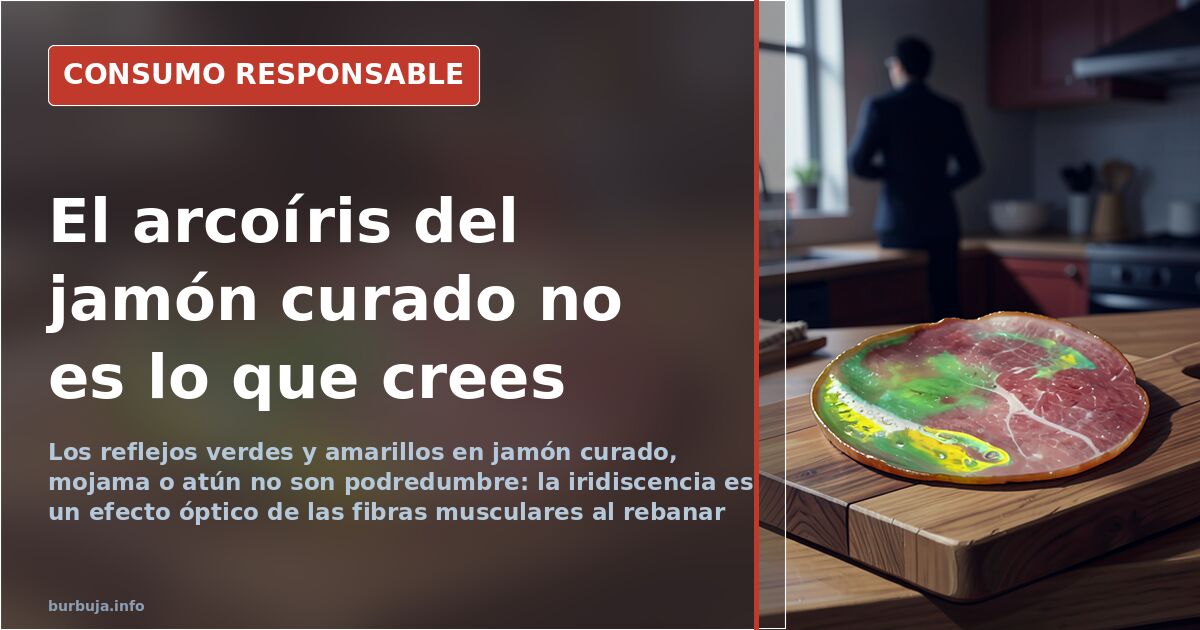
Rainbow sheen on ham: neither rot nor relabelling
Why do green, yellow and pink tones appear on slices of cured ham, mojama or canned tuna? The doubt is not trivial: whoever spots it is usually looking at an expensive product they have just paid for. And the immediate suspicion — decomposition, old canned goods relabelled, rock-bottom quality standards — is more intuition than evidence. Iridescence in salted and cured meats is a well-known physical phenomenon, not an automatic sign that the food has gone off.
The pattern described by whoever raises the issue is specific: multicoloured reflections that appear mainly on **products on offer**, but also on cured ham at **€24/kg** versus the cheap kind at 12 and 15. On machine-cut slices, always in the same areas of the cut, visible before emptying the oil from the tin. And the alarm goes off when comparing it with the grimy puddles next to fish stalls, where the rainbow really is diesel or decomposing fat.
What is the iridescence of cured meat and fish
The explanation that best fits the phenomenon points to the **structure of muscle fibres** and how they align when sliced. When the cut misaligns the fibres and there is surface moisture, light diffracts and that iridescent sheen appears. It is an optical effect, not a bacterial culture. It fits with a detail the account itself provides: iridescence is especially noticeable on **pre-sliced and machine-cut pieces**, less so with a home knife.
Some add another layer: **protein denaturation**. The result would be an organoleptically unattractive product — appearance matters — but safe to eat. The distinction between what disgusts and what poisons is the key to this whole matter.
Is it dangerous to eat meat with multicoloured reflections?
There is no indication that the iridescent sheen by itself signals risk. The line most strongly argued is that it is a reflection of light on smooth surfaces and fatty tissue, and that the colour appears or disappears depending on how the light strikes. In mojama, it is simply considered normal.
What should be kept apart is the reflection from actual spoilage: smell, texture, date. A best-before date **more than a year away** does not make a product suspicious, but it does not make it bulletproof either. The rainbow is not the thermometer.
The business of distrust
The hypothesis of mass relabelling of salted products and old canned goods has no support in what was discussed. What does come up is a perception that the phenomenon has become more frequent. And here comes the attention bias: whoever suddenly notices something sees it everywhere, just as someone who buys a car discovers their model is all over the road. Some have been spotting it sporadically for **twenty years** and see no real increase.
The final irony: the consumer pays more for a €24/kg ham and finds a rainbow that the bargain one, at 12, also has. Colour does not distinguish quality. Neither does price.
Also available in: Deutsch
Summary of a discussion on Burbuja.info - Foro de economía, actualidad y política., translated from Spanish and reviewed before publication. Read the full discussion (16 replies).
More summaries
-
Finding a free, covered oil change spot in Madrid
Rain in Madrid makes finding a free, covered, unmonitored spot for an oil change difficult. Users discuss garages and DIY options.
-
Animal-based protein bars with no soy and no palm oil
Animal protein bars without soy or palm oil: real alternatives like parmesan, ham or pork rinds. A look at natural options versus processed products.
-
Ozempic and Mounjaro: FDA black box warning issued
FDA issues black box warning for Ozempic and Mounjaro regarding thyroid tumor risks. Analysis of weight regain, side effects, and natural alternatives.
-
Monitor in front of a window: how to beat backlight without sitting in the dark
Placing your monitor in front of a window causes backlighting and eye strain. Sheer roller blinds and side lighting are the solutions that avoid plunging the room into darkness.
-
Energy Saver Pro: why the gadget that promises to cut your electricity bill can't work
The Energy Saver Pro promises to slash your electricity bill, but fixed costs already make up more than half of it. The analysis that debunks the device.
-
Mixing sunflower and olive oil in the deep fryer: what the smoke point says
Mixing sunflower and olive oil in the deep fryer is not dangerous, but the smoke point of the weaker oil sets the limit and the olive oil goes to waste.