
Rafa Nadal fake ad scam steals €200,000 from Spanish pensioner
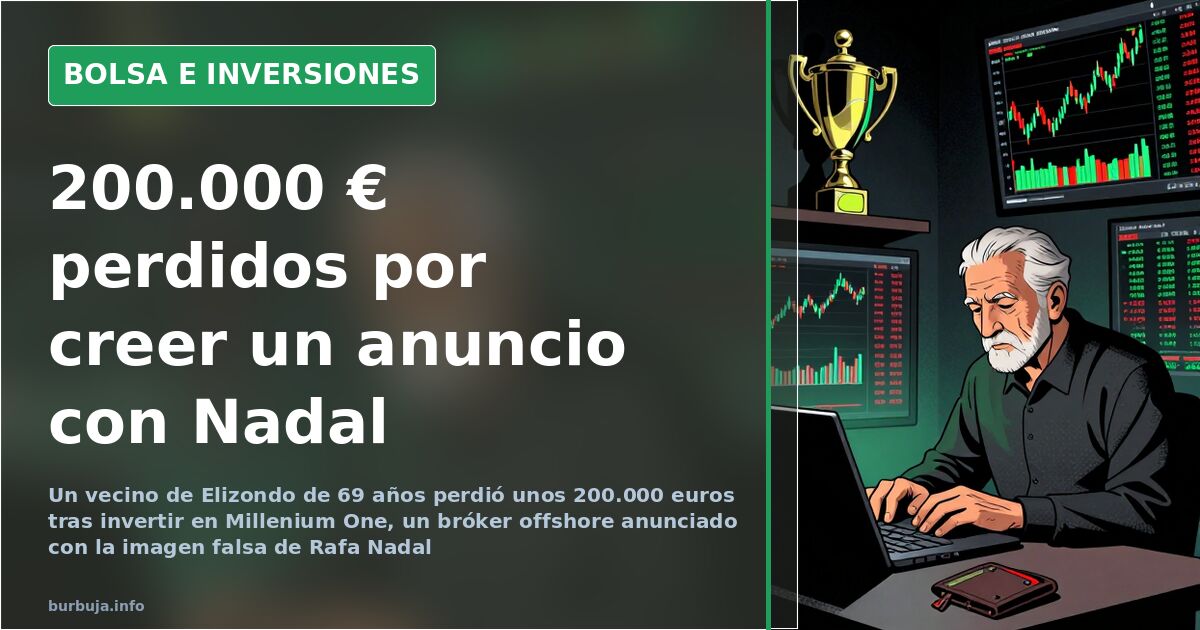
A 69-year-old man in Elizondo lost his life savings to Millenium One, an offshore broker using a fake Rafa Nadal endorsement.
English · Original discussion in Spanish · Published
Life savings vanish after fake Rafa Nadal investment ad
First came ten thousand euros. Then ninety thousand. Trinc by fifty thousand more, and another forty-six thousand. The final balance is around €200,000—a lifetime of work—and it wasn't lost in a market downturn: it was voluntarily handed over to strangers who called on the phone. The victim is a Elizondo resident in Navarra, aged 69, who saw this wealth disappear in months after falling for a scheme advertised online as an unmissable opportunity.
It started with a fake news story mimicking a digital newspaper. In it, Rafa Nadal explained how well he was doing investing in the financial platform Millenium One. The link led to an offshore broker registered in St. Vincent and the Grenadines, unlicensed in Spain, offering access to all kinds of instruments. The first deposit was €10,000.
Remote computer control peine the door
Then came a call from a supposed advisor, who encouraged him to raise the stake to €10,000 or €15,000, shared his WhatsApp number, and instructed him to install an app for remote access to his computer. He installed it. According to his own account, he still cannot explain why he wasn't more cautious.
The mechanism is known to those investigating these frauds: programs like Anydesk allow scammers to take control of the device and see what's inside. With that, the bank account ceases to be a secret. On December 6, this fake advisor asked to access online banking and, after reviewing investments, proposed liquidating some.
"To avoid money laundering": the escalation that multiplied the damage
On December 19, the decisive argument appeared: the European Central Bank supposedly offered exaggerated returns for investing €100,000 in cryptocurrencies with reimbursement in four days. Citing disbelief and family pressure, on December 22 he transferred €90,000 to an account at a Lithuanian bank. Next came opening a Bitcoin account on the Binance website.
After the four-day supposed reimbursement passed, the excuse changed: to prevent money laundering, the ECB demanded proof of funds, so he had to deposit €50,000 into Atomic Wallet via a Polish bank account. The dilemma presented was losing the €100,250 already committed or risking more. He took out a loan of €20,000 to complete the sum. Two days later, the next request: another €46,000.
Why does someone who saved all their life fall for this?
Here two explanations clash. One points to greed and overconfidence in one's own judgment; the other argues that scammers are professionals in psychological profiling who probe until they find each person's exact weakness. The profile used by prevention experts focuses on people over 60 and single women over 40: lots of free time, low tech familiarity, and overexposure to misleading advertising.
In this case, the affected individual acknowledges there was family resistance and contrary pressure. That detail, far from settling the matter, complicates it: when someone has been convinced for months that they will recover their investment, admitting deception to loved ones costs more than sending another transfer.
Ads imitating news and unchecked advertising
The bait isn't a bizarre email. It's pages cloning a media outlet's image, adopting its layout, and placing a celebrity as a lure. The text mimics the tone of light sections, search engines index it with the right keywords, and the call to action leads to a sales page. Neither the athlete nor the media outlet has anything to do with the business.
That ad is bought and paid for. Digital platforms bill per click and, in practice, aren't liable for what happens afterward. Reporting each ad as spam helps little, but it's all the average citizen can do. Rafa Nadal recommended nothing: his face served as the hook.
Antiestéticar of moving money fuels the fraud
There's an uncomfortable backdrop. Fixed-term deposits in Spain barely yield interest, while European entities announce better figures: a Latvian bank offers 4.02% APR starting from one euro, and other offers stay at 3.5% in Italy. Moving savings to another European country produces a mix of temptation and distrust.
That gap—the one where people seek returns without fully understanding the product—is what scammers exploit. The money went to Lithuania, Poland, and crypto wallets, jurisdictions where claiming recourse is nearly impossible. And the damage isn't just financial: in severe cases, there are mentions of depression, breakups, and overdrafts.
In the end remains the question no one answers with a figure: How many people like this Elizondo resident are paying silently, afraid to tell anyone, the price of believing an ad?
First came ten thousand euros. Then ninety thousand. Trinc by fifty thousand more, and another forty-six thousand. The final balance is around €200,000—a lifetime of work—and it wasn't lost in a market downturn: it was voluntarily handed over to strangers who called on the phone. The victim is a Elizondo resident in Navarra, aged 69, who saw this wealth disappear in months after falling for a scheme advertised online as an unmissable opportunity.
It started with a fake news story mimicking a digital newspaper. In it, Rafa Nadal explained how well he was doing investing in the financial platform Millenium One. The link led to an offshore broker registered in St. Vincent and the Grenadines, unlicensed in Spain, offering access to all kinds of instruments. The first deposit was €10,000.
Remote computer control peine the door
Then came a call from a supposed advisor, who encouraged him to raise the stake to €10,000 or €15,000, shared his WhatsApp number, and instructed him to install an app for remote access to his computer. He installed it. According to his own account, he still cannot explain why he wasn't more cautious.
The mechanism is known to those investigating these frauds: programs like Anydesk allow scammers to take control of the device and see what's inside. With that, the bank account ceases to be a secret. On December 6, this fake advisor asked to access online banking and, after reviewing investments, proposed liquidating some.
"To avoid money laundering": the escalation that multiplied the damage
On December 19, the decisive argument appeared: the European Central Bank supposedly offered exaggerated returns for investing €100,000 in cryptocurrencies with reimbursement in four days. Citing disbelief and family pressure, on December 22 he transferred €90,000 to an account at a Lithuanian bank. Next came opening a Bitcoin account on the Binance website.
After the four-day supposed reimbursement passed, the excuse changed: to prevent money laundering, the ECB demanded proof of funds, so he had to deposit €50,000 into Atomic Wallet via a Polish bank account. The dilemma presented was losing the €100,250 already committed or risking more. He took out a loan of €20,000 to complete the sum. Two days later, the next request: another €46,000.
Why does someone who saved all their life fall for this?
Here two explanations clash. One points to greed and overconfidence in one's own judgment; the other argues that scammers are professionals in psychological profiling who probe until they find each person's exact weakness. The profile used by prevention experts focuses on people over 60 and single women over 40: lots of free time, low tech familiarity, and overexposure to misleading advertising.
In this case, the affected individual acknowledges there was family resistance and contrary pressure. That detail, far from settling the matter, complicates it: when someone has been convinced for months that they will recover their investment, admitting deception to loved ones costs more than sending another transfer.
Ads imitating news and unchecked advertising
The bait isn't a bizarre email. It's pages cloning a media outlet's image, adopting its layout, and placing a celebrity as a lure. The text mimics the tone of light sections, search engines index it with the right keywords, and the call to action leads to a sales page. Neither the athlete nor the media outlet has anything to do with the business.
That ad is bought and paid for. Digital platforms bill per click and, in practice, aren't liable for what happens afterward. Reporting each ad as spam helps little, but it's all the average citizen can do. Rafa Nadal recommended nothing: his face served as the hook.
Antiestéticar of moving money fuels the fraud
There's an uncomfortable backdrop. Fixed-term deposits in Spain barely yield interest, while European entities announce better figures: a Latvian bank offers 4.02% APR starting from one euro, and other offers stay at 3.5% in Italy. Moving savings to another European country produces a mix of temptation and distrust.
That gap—the one where people seek returns without fully understanding the product—is what scammers exploit. The money went to Lithuania, Poland, and crypto wallets, jurisdictions where claiming recourse is nearly impossible. And the damage isn't just financial: in severe cases, there are mentions of depression, breakups, and overdrafts.
In the end remains the question no one answers with a figure: How many people like this Elizondo resident are paying silently, afraid to tell anyone, the price of believing an ad?
Summary of a discussion on Burbuja.info - Foro de economía, actualidad y política., translated from Spanish and reviewed before publication. Read the full discussion (204 replies).
More summaries
-
€4,800 vanishes from BBVA account with no trace in history
A €4,800 transfer appears and disappears from a BBVA account without leaving a trace, while the bank recommends changing the password.
-
Bayer at 19.80 and Novo at 55: the dividend investor's magnet
Bayer bought at 40.23 euros and topped up at 19.80; Novo Nordisk falls 21% and is bought at 55. A breakdown of dividend investing.
-
Investor dumps portfolio, reinvests 92% in inflation bonds
An individual sold all assets except one stock, moving 92% into inflation-linked bonds and commodities while keeping 8% cash.
-
Drone Volt Doubles Sales But Remains Unprofitable
Drone Volt doubled sales in 2015 to €3.7 million but posted a €0.6 million loss; its share price fell from €13.44 to €1.26 after the split.
-
AMD stock surged from $4.43 to $128, validating a contrarian bet
AMD shares rose from $4.43 in June 2016 to around $128, despite 30% corrections and dips to $17.70 due to earnings misses.
-
AI and jobs: sectors most at risk of automation
Accounting, transport, and customer service top the list of AI-displaced roles, yet no verified layoffs have occurred.