
€4,800 vanishes from BBVA account with no trace in history
A €4,800 transfer appears and disappears from a BBVA account without leaving a trace, while the bank recommends changing the password.
English · Original discussion in Spanish · Published
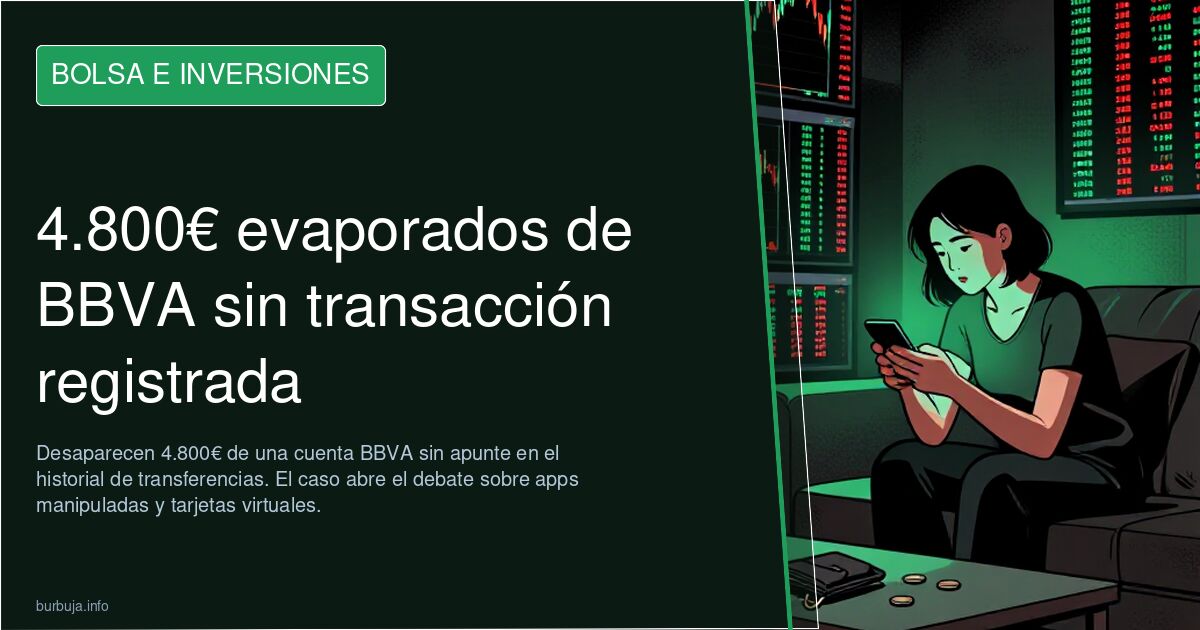
€4,800 evaporates from a BBVA account with no trace in the history
A phone rings in the supermarket. An automated voice announces a transfer of €4,800 in the BBVA account. The sensible thing is to hang up, think it's a scam and check calmly later. That's what the account holder did. The problem came when opening the app: the balance was missing, the history was clean, and minutes later, the money was back in place. No transaction, no trace and no explanation.
The sequence: call, app in hidden mode and a balance that doesn't add up
The account is detailed. He hung up, peine the bank app and found it in a hidden mode where the overall position, income and expenses were not visible. He had to ask ChatGPT how to deactivate it. When he finally saw the figures, exactly those €4,800 were missing. That wasn't the end of the oddity: neither the transfer history nor card expenses showed any movement. In the queue at the branch he looked again. The balance was correct.
The branch staff thought he was crazy and recommended changing the password. When he tried, the system returned a "service unavailable". The solution, after a second queue, was to cancel the account and reopen it to renew the password. The number from which the call was made had no relation to the bank.
Can the transaction history be deleted from the bank app?
That is the question that runs through the whole discussion and the one nobody answers with proof. The most repeated hypothesis holds that the hole is not in the customer but in the banking system itself: if the operation existed and left no trace, someone could have entered the bank's infrastructure, not just the phone. Some point lower, to the app installed on the device, which could have been manipulated or replaced by a modified version. And some suspect that the original application was compromised from the start. None of the three has been confirmed.
It is worth remembering the detail that disables the classic fraud manual: there was no link, no personal data given and no conversation. Just an app showing an impossible balance.
Cloned cards, pre-approved loans and emails that arrive on time
Here the individual case dissolves into a broader pattern. Other affected people describe charges that do appear, fraud alerts from three different banks at once and purchases executed in seconds. One testimony claims that, after hacking an account with no balance, a pre-approved loan of €10,000 was requested and spent immediately. Another person reports the cloning of a debit card with a portable card reader during a home delivery. And emails impersonating courier companies to ask for a euro or so to reschedule a delivery are repeated.
The common thread is always the same: the victim sees nothing until the money has already moved.
How much money should you keep in the account you carry in your pocket?
The most repeated answer is: little. The idea of a separate account, only for online purchases, with a card that is activated and deactivated instantly, appears in several versions. Also virtual single-use cards, created for the exact amount and deleted afterwards, or rechargeable cards that remain at zero after each payment. And the simplest gesture: turn off the cards from the app when not in use.
The classic advice—always check from a clean computer—remains valid in case the mobile app is precisely the contaminated piece.
The affected person has not recovered any explanation, only the balance. The bank has not acknowledged any failure and there is no documented trace of the operation. If money can disappear from an account and return without leaving a trace, which part of the system should be audited first: the customer's or the bank's?
A phone rings in the supermarket. An automated voice announces a transfer of €4,800 in the BBVA account. The sensible thing is to hang up, think it's a scam and check calmly later. That's what the account holder did. The problem came when opening the app: the balance was missing, the history was clean, and minutes later, the money was back in place. No transaction, no trace and no explanation.
The sequence: call, app in hidden mode and a balance that doesn't add up
The account is detailed. He hung up, peine the bank app and found it in a hidden mode where the overall position, income and expenses were not visible. He had to ask ChatGPT how to deactivate it. When he finally saw the figures, exactly those €4,800 were missing. That wasn't the end of the oddity: neither the transfer history nor card expenses showed any movement. In the queue at the branch he looked again. The balance was correct.
The branch staff thought he was crazy and recommended changing the password. When he tried, the system returned a "service unavailable". The solution, after a second queue, was to cancel the account and reopen it to renew the password. The number from which the call was made had no relation to the bank.
Can the transaction history be deleted from the bank app?
That is the question that runs through the whole discussion and the one nobody answers with proof. The most repeated hypothesis holds that the hole is not in the customer but in the banking system itself: if the operation existed and left no trace, someone could have entered the bank's infrastructure, not just the phone. Some point lower, to the app installed on the device, which could have been manipulated or replaced by a modified version. And some suspect that the original application was compromised from the start. None of the three has been confirmed.
It is worth remembering the detail that disables the classic fraud manual: there was no link, no personal data given and no conversation. Just an app showing an impossible balance.
Cloned cards, pre-approved loans and emails that arrive on time
Here the individual case dissolves into a broader pattern. Other affected people describe charges that do appear, fraud alerts from three different banks at once and purchases executed in seconds. One testimony claims that, after hacking an account with no balance, a pre-approved loan of €10,000 was requested and spent immediately. Another person reports the cloning of a debit card with a portable card reader during a home delivery. And emails impersonating courier companies to ask for a euro or so to reschedule a delivery are repeated.
The common thread is always the same: the victim sees nothing until the money has already moved.
How much money should you keep in the account you carry in your pocket?
The most repeated answer is: little. The idea of a separate account, only for online purchases, with a card that is activated and deactivated instantly, appears in several versions. Also virtual single-use cards, created for the exact amount and deleted afterwards, or rechargeable cards that remain at zero after each payment. And the simplest gesture: turn off the cards from the app when not in use.
The classic advice—always check from a clean computer—remains valid in case the mobile app is precisely the contaminated piece.
The affected person has not recovered any explanation, only the balance. The bank has not acknowledged any failure and there is no documented trace of the operation. If money can disappear from an account and return without leaving a trace, which part of the system should be audited first: the customer's or the bank's?
Summary of a discussion on Burbuja.info - Foro de economía, actualidad y política., translated from Spanish and reviewed before publication. Read the full discussion (40 replies).
More summaries
-
Banco de España Silver Coins: From €12 to €30 Face Value
Explore the evolution of Banco de España's silver coins, from their €12 face value to €30, as silver prices fluctuated. Discover why these collectibles are now scarce.
-
Madrid's Neighborhoods: Price Dictates the Map of Good and Bad Areas
Classifying Madrid's 128 neighborhoods as good or bad depends on the criteria: price per square meter, commute time, or district labels.
-
Alpha Pro Tech: Record N95 mask orders and stock plunge
Alpha Pro Tech secured $36.7 million in N-95 mask orders in April 2020 after a 47.5% sales surge, yet its stock plummeted.
-
Intel: From Falling Knife to Portfolio Multiplier
Intel started as a 30% recommendation but ended with portfolios up 150%. Here are the numbers, the NPU thesis, and the State's role.
-
Fake Silver Coins: Scale Detects 0.5 Grams Over
A fake 100 peseta coin weighs 0.5 grams extra. Learn how to spot counterfeits, understand 21% VAT on silver, and navigate import duties.
-
Kookaburras: The Limited-Edition Silver Ounce Since 1990
The Australian kookaburra coin has collected 23 issues since 1990, with mintage of 300,000 to 500,000 units. Most sell for under 50 euros.