
PVC Ban Rumors Persist Despite Lack of Evidence
PVC remains legal despite toxicity debates. Data refutes peak oil claims driving the narrative against this plastic.
English · Original discussion in Spanish · Published
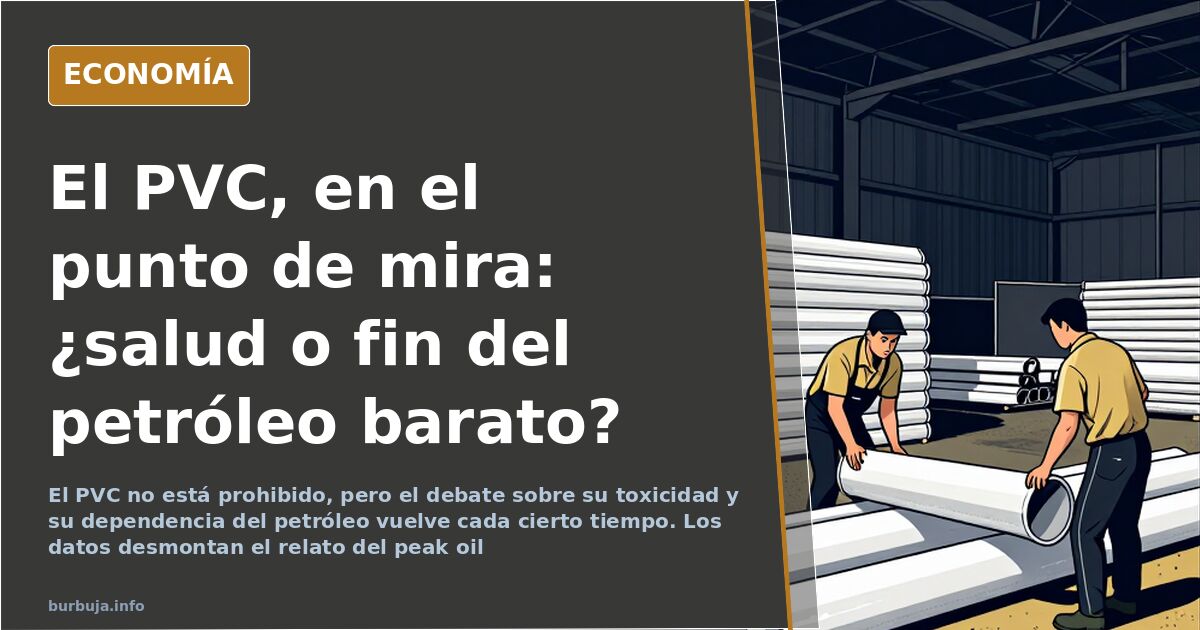
PVC Not Banned, But Debate Has Already Buried It
Will PVC be banned? The short answer is no, based on available data. The long answer is that some have been waiting for polyvinyl chloride's funeral and treat any plastic news as a coffin nail. This opinion round stems from an article questioning PVC's health and environmental impact, trinc bans on bags, cups, straws, glitter, and artificial turf. The headline capturing the mood: it's all for your health, unrelated to peak oil.
What Is PVC and Why Is It in the Crosshairs?
PVC is a plastic whose composition isn't entirely petroleum-dependent: roughly half its weight comes from common salt (NaCl). This detail, often overlooked in rhetoric, makes it less vulnerable to crude oil shortages than other polymers. It is widely used in construction, sewage pipes, windows, insulation, and pharmaceutical packaging.
The health argument centers on toxicity. However, one must separate the material from additives. PVC requires stabilizers, lubricants, and impact modifiers for processing; historical additives like phthalates and lead caused issues. The base polymer itself is not toxic. Consequently, the pharmaceutical sector, with the world's strictest packaging regulations, continues using it without documented health problems attributable to the material.
Peak Oil Calculations Collapse Within Seven Days
If the real motive against PVC were oil depletion, arithmetic easily disproves it. A circulating calculation suggests a recent field has 50 million proven tons and 100 million possible tons. Converted at 7.6 barrels per ton, that equals 380 million proven and 760 million possible barrels. Global consumption is around 100 million barrels daily. Result: the field covers 3.8 days of proven consumption and 7.6 days in the possible scenario. These numbers make peak oil untenable as justification for banning PVC.
Substitute Battle: Polyethylene, Polypropylene, and Fire Risks
Most PVC applications have chlorine-free substitutes like polyethylene (PE) and polypropylene (PP). Environmentally superior and better in many qualities, they are costlier due to density and additive needs. While PVC needs many additives, PE and PP, being pure hydrocarbons, burn very easily. PVC's chlorine content prevents combustion at atmospheric oxygen levels, dominating construction. Replacing it would require fire retardants, which are more toxic and migrate to surfaces. The paradox is uncomfortable: the flagged dangerous material actually slows fire.
Pipes, Drains, and Returning to Basics
The practical issue involves sewage. If PVC disappears, what materials will pipes and drains use? PE and PP are technical options but not free. A semi-mocking alternative suggested returning to lead and asbestos cement, both with worse health histories. Food packaging is next. Without vacuum sealing, there are no chips or canned goods. The idea of reverting to basic sanitation was mentioned but seems inefficient.
Background: Agendas, Taxes, and Distrust
Behind the noise lies a pattern: each ban is seen as a hidden tax or agenda step impoverishing people. Suspicion isn't new or always unfounded, but legitimate criticism shouldn't invent facts. Currently, no PVC ban is underway. There are specific additive issues, viable but costly substitutes, and an industry hearing the same arguments for thirty years without substantial regulatory change.
PVC will remain in pipes, windows, and blister packs. Those awaiting its funeral must find another corpse.
Will PVC be banned? The short answer is no, based on available data. The long answer is that some have been waiting for polyvinyl chloride's funeral and treat any plastic news as a coffin nail. This opinion round stems from an article questioning PVC's health and environmental impact, trinc bans on bags, cups, straws, glitter, and artificial turf. The headline capturing the mood: it's all for your health, unrelated to peak oil.
What Is PVC and Why Is It in the Crosshairs?
PVC is a plastic whose composition isn't entirely petroleum-dependent: roughly half its weight comes from common salt (NaCl). This detail, often overlooked in rhetoric, makes it less vulnerable to crude oil shortages than other polymers. It is widely used in construction, sewage pipes, windows, insulation, and pharmaceutical packaging.
The health argument centers on toxicity. However, one must separate the material from additives. PVC requires stabilizers, lubricants, and impact modifiers for processing; historical additives like phthalates and lead caused issues. The base polymer itself is not toxic. Consequently, the pharmaceutical sector, with the world's strictest packaging regulations, continues using it without documented health problems attributable to the material.
Peak Oil Calculations Collapse Within Seven Days
If the real motive against PVC were oil depletion, arithmetic easily disproves it. A circulating calculation suggests a recent field has 50 million proven tons and 100 million possible tons. Converted at 7.6 barrels per ton, that equals 380 million proven and 760 million possible barrels. Global consumption is around 100 million barrels daily. Result: the field covers 3.8 days of proven consumption and 7.6 days in the possible scenario. These numbers make peak oil untenable as justification for banning PVC.
Substitute Battle: Polyethylene, Polypropylene, and Fire Risks
Most PVC applications have chlorine-free substitutes like polyethylene (PE) and polypropylene (PP). Environmentally superior and better in many qualities, they are costlier due to density and additive needs. While PVC needs many additives, PE and PP, being pure hydrocarbons, burn very easily. PVC's chlorine content prevents combustion at atmospheric oxygen levels, dominating construction. Replacing it would require fire retardants, which are more toxic and migrate to surfaces. The paradox is uncomfortable: the flagged dangerous material actually slows fire.
Pipes, Drains, and Returning to Basics
The practical issue involves sewage. If PVC disappears, what materials will pipes and drains use? PE and PP are technical options but not free. A semi-mocking alternative suggested returning to lead and asbestos cement, both with worse health histories. Food packaging is next. Without vacuum sealing, there are no chips or canned goods. The idea of reverting to basic sanitation was mentioned but seems inefficient.
Background: Agendas, Taxes, and Distrust
Behind the noise lies a pattern: each ban is seen as a hidden tax or agenda step impoverishing people. Suspicion isn't new or always unfounded, but legitimate criticism shouldn't invent facts. Currently, no PVC ban is underway. There are specific additive issues, viable but costly substitutes, and an industry hearing the same arguments for thirty years without substantial regulatory change.
PVC will remain in pipes, windows, and blister packs. Those awaiting its funeral must find another corpse.
Also available in: Deutsch
Summary of a discussion on Burbuja.info - Foro de economía, actualidad y política., translated from Spanish and reviewed before publication. Read the full discussion (110 replies).
More summaries
-
Collado Mediano Villa Foreclosure Reveals Political Storm Origins
A Collado Mediano villa foreclosed 26 years ago for non-payment exposes the official narrative behind Spain's recent political eviction controversy.
-
Benidorm Plans 230-Meter, 64-Story Residential Tower
A forum discusses a proposed 230-meter residential skyscraper in Benidorm, Spain, which would match Torre Emperador's height and lead the EU in stories.
-
Sandra Bravo advocates non-monogamy and collective care in Spain
Sandra Bravo argues that breaking sexual exclusivity isn't revolutionary, as men have always done it. She calls for collectivizing care to combat social precarity.
-
Cost of legal immigration divides Spanish voters
The debate on the cost of legal immigration splits those seeing a burden on Social Security from those viewing it as essential for sustainability.
-
Adolescence: Netflix series spotlights incel narrative
British miniseries Adolescence centers the manosphere and incels in debate, exploring how a young boy becomes the era's villain.
-
Surge in Chinese EVs strains Spain's power grid
Forum debates the boom in Chinese electric vehicles, electricity costs, and whether Spain's grid can handle mass charging.