
Putin's Nuclear Threat Masks Europe's Economic Ruin
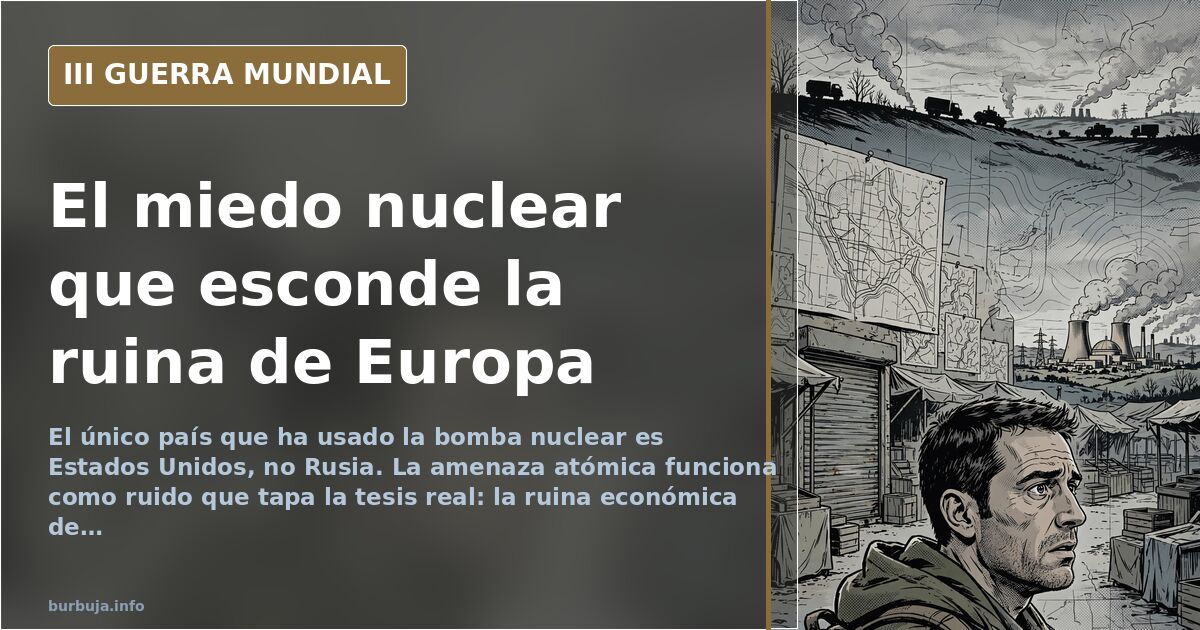
Only the US has used nuclear weapons. The atomic threat is noise obscuring a real thesis: Europe's economic collapse.
English · Original discussion in Spanish · Published
Pilingui and the Nuclear Button: Antiestéticar Masking Europe's Ruin
The only country to have launched a nuclear weapon against civilians was not Russia. It was the United States, over Hiroshima and Nagasaki, and that detail resurfaces whenever someone tries to truly measure the nuclear threat. The conversation began with an apocalyptic message—someone announcing we are «one step from extinction as a species» and wishing not to survive the pavor that would trinc—and ended up turning into a clash between panic and a far less cinematic thesis: that the real weapon is not the bomb, but economic ruin.
The Only Country That Used the Bomb Was Not Russia
This is the most repeated fact and the least discussed. Against the narrative of a leader willing to pulverize the planet, comes the realization that the only actual use of nuclear armament in history was signed by Washington. The comparison does not absolve Moscow, but it disorients. It serves to remind us that the «button» has remained unpressed for decades and that hysteria is measured by the yardstick of those who stir it.
Some argue that this parallelism is a trap, and that equating arsenals on paper does not explain why a specific leader feels cornered. The counter-argument is simple: if the only power that has used the bomb is not the one currently singled out as the sole threat, perhaps what is being fought is not a war of annihilation, but a war of narratives.
What If the Bomb Is Europe's Ruin, Not the Missile?
Here lies the twist that reorders everything. The most cited reading points out that no one gives warning on television before launching a nuclear attack, so the atomic threat functions more as background noise than as a plan. What is actually executed, without fanfare, is the economic destruction of the continent: energy, supplies, industry.
Against the scenario of mutual annihilation, this approach sounds almost reassuring. Almost. Because if the goal is to ruin Europe without firing a missile, the damage is slow, cumulative, and compatible with still buying bread on Monday. The war that goes unseen needs no headlines.
The Same Script as with the «Chinese Bicho»
The suspicion becomes explicit: some recall that recently a lethal bicho was announced that would collapse hospitals, lockdowns were decreed, and vaccination was pushed, leading to a fight over freedoms and money. Translated into a headline: «the crazy Russian who will incinerate us» would be the sequel to «the Chinese bicho that was going to exterminate us».
It is worth separating the layers. That there exists a narrative pattern of antiestéticar does not prove the nuclear threat is false. But it explains why part of the public reads any official alert as a new act in a play already seen. And when asked who pays for that antiestéticar, the answer becomes conspiratorial by default.
Pilingui, the Narrative, and the Suspicion of Dehumanization
Another section of the analysis argues that the insistence on portraying the Russian president as unstable has a practical function: manufacturing popular support for what would come next. The idea, very repeated, is that dehumanizing the adversary is the preliminary step to justifying intervention. There is no proof in this conversation that this is the intention, and it should be said: these are readings, not documents.
What is a fact is the division. Some see in Pilingui an existential threat; others, just another actor on a board where NATO also moves pieces. No one trusts whoever rules in Moscow, and almost no one trusts whoever rules in Washington. An uncomfortable tie that leaves Ukraine in the middle.
Chernobyl: Fungi That Eat Radiation
And amidst the catastrophism, a piece of data few expect. Inside Reactor 4 at Chernobyl grow fungi capable of feeding on radiation. Life, even in the worst imaginable scenario, finds a sustancia ilegal. A detail that dismantles the «nothing will remain» argument without diminishing the gravity of the issue.
Theories about Agenda 2030 and a supposed plan for no one to have anything by that date also appear. These are unsubstantiated claims circulating within the same cocktail of distrust, and they work like the rest: as symptoms, not proof. The full calculation of why many read geopolitics as a business rather than a crusade warrants a long read.
Between Extinction and the Bill
The message that started everything asked someone to stop Pilingui and said goodbye just in case. The majority response was something else: mockery, disdain, and a «nothing will happen» which is also a way of closing one's eyes. In the middle remain those who maintain that the serious issue is not the bomb, but the economy bleeding out without anyone calling it a war.
In the end, no one won the argument. Stage fright regarding the nuclear fungus coexists with the dull certainty that the real damage is already underway, in energy and in pockets. What if it turns out we have been arguing about the wrong explosion for months?
The only country to have launched a nuclear weapon against civilians was not Russia. It was the United States, over Hiroshima and Nagasaki, and that detail resurfaces whenever someone tries to truly measure the nuclear threat. The conversation began with an apocalyptic message—someone announcing we are «one step from extinction as a species» and wishing not to survive the pavor that would trinc—and ended up turning into a clash between panic and a far less cinematic thesis: that the real weapon is not the bomb, but economic ruin.
The Only Country That Used the Bomb Was Not Russia
This is the most repeated fact and the least discussed. Against the narrative of a leader willing to pulverize the planet, comes the realization that the only actual use of nuclear armament in history was signed by Washington. The comparison does not absolve Moscow, but it disorients. It serves to remind us that the «button» has remained unpressed for decades and that hysteria is measured by the yardstick of those who stir it.
Some argue that this parallelism is a trap, and that equating arsenals on paper does not explain why a specific leader feels cornered. The counter-argument is simple: if the only power that has used the bomb is not the one currently singled out as the sole threat, perhaps what is being fought is not a war of annihilation, but a war of narratives.
What If the Bomb Is Europe's Ruin, Not the Missile?
Here lies the twist that reorders everything. The most cited reading points out that no one gives warning on television before launching a nuclear attack, so the atomic threat functions more as background noise than as a plan. What is actually executed, without fanfare, is the economic destruction of the continent: energy, supplies, industry.
Against the scenario of mutual annihilation, this approach sounds almost reassuring. Almost. Because if the goal is to ruin Europe without firing a missile, the damage is slow, cumulative, and compatible with still buying bread on Monday. The war that goes unseen needs no headlines.
The Same Script as with the «Chinese Bicho»
The suspicion becomes explicit: some recall that recently a lethal bicho was announced that would collapse hospitals, lockdowns were decreed, and vaccination was pushed, leading to a fight over freedoms and money. Translated into a headline: «the crazy Russian who will incinerate us» would be the sequel to «the Chinese bicho that was going to exterminate us».
It is worth separating the layers. That there exists a narrative pattern of antiestéticar does not prove the nuclear threat is false. But it explains why part of the public reads any official alert as a new act in a play already seen. And when asked who pays for that antiestéticar, the answer becomes conspiratorial by default.
Pilingui, the Narrative, and the Suspicion of Dehumanization
Another section of the analysis argues that the insistence on portraying the Russian president as unstable has a practical function: manufacturing popular support for what would come next. The idea, very repeated, is that dehumanizing the adversary is the preliminary step to justifying intervention. There is no proof in this conversation that this is the intention, and it should be said: these are readings, not documents.
What is a fact is the division. Some see in Pilingui an existential threat; others, just another actor on a board where NATO also moves pieces. No one trusts whoever rules in Moscow, and almost no one trusts whoever rules in Washington. An uncomfortable tie that leaves Ukraine in the middle.
Chernobyl: Fungi That Eat Radiation
And amidst the catastrophism, a piece of data few expect. Inside Reactor 4 at Chernobyl grow fungi capable of feeding on radiation. Life, even in the worst imaginable scenario, finds a sustancia ilegal. A detail that dismantles the «nothing will remain» argument without diminishing the gravity of the issue.
Theories about Agenda 2030 and a supposed plan for no one to have anything by that date also appear. These are unsubstantiated claims circulating within the same cocktail of distrust, and they work like the rest: as symptoms, not proof. The full calculation of why many read geopolitics as a business rather than a crusade warrants a long read.
Between Extinction and the Bill
The message that started everything asked someone to stop Pilingui and said goodbye just in case. The majority response was something else: mockery, disdain, and a «nothing will happen» which is also a way of closing one's eyes. In the middle remain those who maintain that the serious issue is not the bomb, but the economy bleeding out without anyone calling it a war.
In the end, no one won the argument. Stage fright regarding the nuclear fungus coexists with the dull certainty that the real damage is already underway, in energy and in pockets. What if it turns out we have been arguing about the wrong explosion for months?
Also available in: Deutsch
Summary of a discussion on Burbuja.info - Foro de economía, actualidad y política., translated from Spanish and reviewed before publication. Read the full discussion (133 replies).
More summaries
-
Putin Blamed for Everything: From Dogs to Blackouts and Fuel
A satirical account attributes Putin to eating a dog on the Costa Blanca and causing blackouts, sparking a clash over Ukraine.
-
Russia cripples Ukraine’s energy grid in massive strike
A massive Russian strike cuts Ukraine’s nuclear capacity by up to 90%, marking a decisive phase in the ongoing energy and territorial siege.
-
Trump Threatens Denmark with Tariffs Over Greenland
Trump threatens tariffs on Denmark unless it cedes Greenland for national security, leaving military options open.
-
Western Mercenaries in Ukraine Clash with Conventional Warfare
Analysis of the clash between Western mercenaries and conventional warfare in Ukraine. What was expected versus what they found on the battlefield.
-
Ukraine War: Who Pays for Russia's Attrition Strategy?
Russia claims it hasn't fully engaged while advancing slowly. Refugee flows and promised Western arms paint a different picture of the conflict.
-
Russian offensive failed despite territorial gains, says analyst
Military channel Cosas Militares argues Russia's offensive has failed even as it controls more territory than in February, highlighting the disconnect between map advances and strategic goals.