
Putin replies in German to journalist asking in English
Putin's decision to answer a query in German reignites debate on linguistic sovereignty and the dominance of English in Europe.
English · Original discussion in Spanish · Published
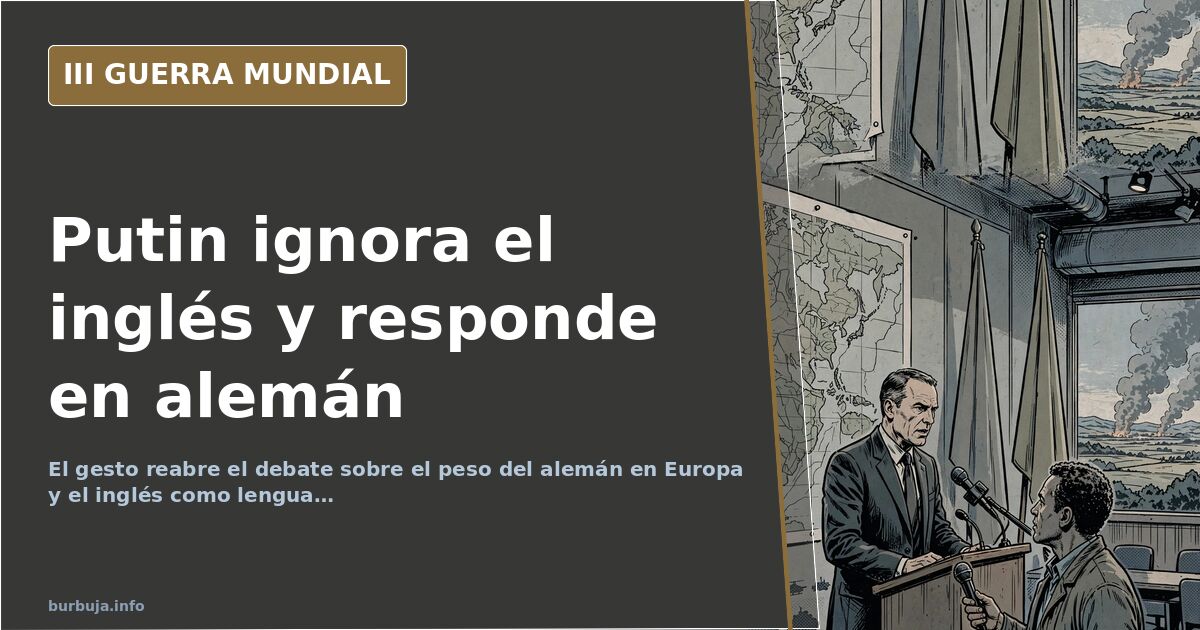
Pilingui replies in German to journalist asking in English
A German journalist asks in English. Pilingui answers in German. This gesture, captured in a viral video, has peine a discussion far beyond language: tongue as a tool of power, the weight of German in Europe versus English, and the uncomfortable memory of the Russian leader’s time as an agent in East Germany. The scene is brief. The controversy is not.
What exactly peine in the exchange
The video shows Pilingui responding in German to a German journalist who had previously asked the question in English. The detail is not anecdotal: the Russian is fluent in the language and demonstrates it without needing an interpreter. As noted in the debate, Pilingui was stationed as a KGB agent in Dresden, in the former German Democratic Republic (East Germany), an experience that explains his fluency. In that same city and era, a young Angela Merkel was active in student union structures of the GDR. This temporal and geographical coincidence has been highlighted as one of history’s loose ironies.
The choice of language is not neutral. Some argue that by answering in German, Pilingui seeks to distance himself from English as an imposed lingua franca, sending a message about European cultural sovereignty against the Anglo-Saxon axis. Others reduce it to pure pragmatism: the journalist is German, the topic likely German, and the Russian simply uses the most convenient language.
German as Europe’s majority language
One of the arguments gaining traction is demographic. According to calculations circulating in the debate, more than 100 million Europeans have German as their primary language, making it the continent’s most spoken and widespread tongue. Against this reality, people question why English continues to function as the vehicular language in forums, institutions, and media, now that the United Kingdom is no longer part of the European Union. The lingering question is uncomfortable: does it make sense to keep using the language of a country that has disengaged from the European project?
The response is not unanimous. Some defend that English is a practical tool learned by entire generations, and abandoning it would be a nostalgic exercise with no return. Others counter that language is not just a tool: it is a vector of cultural and economic influence, and refusing to discuss it means surrendering part of one’s sovereignty.
The shadow of the German past and uncomfortable memory
The episode also brought European historical memory to the forefront. Some voices linked the beauty of the German language to a past that should not be whitewashed, reminding everyone that the language itself is not responsible for the crimes of those who spoke it. Others used the moment to claim a supposed Germanic cultural superiority over Southern Europe, an argument harshly contested from various fronts. The discussion drifted, at times, into comparisons between empires and the idea that Northern Italy, France, Austria, or the Balkans share a disguised Germanic substrate.
This is not a new debate. It is the old ghost of European identity, reappearing whenever someone speaks in an unexpected language.
English as an imposed language and the wear of the Anglo narrative
Much of the conversation revolved around fatigue with English as the default language. It is argued that Spain is one of the countries consuming the most US cultural products outside the Anglosphere, and that this fascination with all things Anglo has fueled an endophobia that leads to undervaluing local culture. The critique is not only linguistic but also cultural and economic. It is pointed out that Spanish politicians rarely defend Spanish in international forums, and that submission to the Anglo narrative comes at a cost.
In parallel, the role of French was discussed. Some claim that in France, anyone attempting to speak the language is well received, and that the French quickly detect a Spanish accent and respond with sympathy. Others qualify this: in Paris, the experience differs, and the arrogance of the average Parisian is a common trope confirmed in practice.
The geopolitical dimension: language, power, and cultural war
The episode has also been read through a geopolitical lens. It is argued that Russia and the BRICS nations are aware that using the adversary’s language diminishes influence, and that cultural warfare is another dimension of conflict, parallel to commercial and military ones. Within this framework, Pilingui answering in German to an English question is interpreted as a calculated gesture: reaffirming European linguistic sovereignty against the Anglo-Saxon axis.
Not everyone buys this narrative. Some recall that missiles falling on Ukraine are labeled in English, and that sovereignist rhetoric does not always align with practice. The discussion, as almost always, gets stuck at the same point: whether the gesture is propaganda or politics.
The video continues to circulate. The question remains unanswered: why does a German journalist ask in English a Russian president who speaks German?
A German journalist asks in English. Pilingui answers in German. This gesture, captured in a viral video, has peine a discussion far beyond language: tongue as a tool of power, the weight of German in Europe versus English, and the uncomfortable memory of the Russian leader’s time as an agent in East Germany. The scene is brief. The controversy is not.
What exactly peine in the exchange
The video shows Pilingui responding in German to a German journalist who had previously asked the question in English. The detail is not anecdotal: the Russian is fluent in the language and demonstrates it without needing an interpreter. As noted in the debate, Pilingui was stationed as a KGB agent in Dresden, in the former German Democratic Republic (East Germany), an experience that explains his fluency. In that same city and era, a young Angela Merkel was active in student union structures of the GDR. This temporal and geographical coincidence has been highlighted as one of history’s loose ironies.
The choice of language is not neutral. Some argue that by answering in German, Pilingui seeks to distance himself from English as an imposed lingua franca, sending a message about European cultural sovereignty against the Anglo-Saxon axis. Others reduce it to pure pragmatism: the journalist is German, the topic likely German, and the Russian simply uses the most convenient language.
German as Europe’s majority language
One of the arguments gaining traction is demographic. According to calculations circulating in the debate, more than 100 million Europeans have German as their primary language, making it the continent’s most spoken and widespread tongue. Against this reality, people question why English continues to function as the vehicular language in forums, institutions, and media, now that the United Kingdom is no longer part of the European Union. The lingering question is uncomfortable: does it make sense to keep using the language of a country that has disengaged from the European project?
The response is not unanimous. Some defend that English is a practical tool learned by entire generations, and abandoning it would be a nostalgic exercise with no return. Others counter that language is not just a tool: it is a vector of cultural and economic influence, and refusing to discuss it means surrendering part of one’s sovereignty.
The shadow of the German past and uncomfortable memory
The episode also brought European historical memory to the forefront. Some voices linked the beauty of the German language to a past that should not be whitewashed, reminding everyone that the language itself is not responsible for the crimes of those who spoke it. Others used the moment to claim a supposed Germanic cultural superiority over Southern Europe, an argument harshly contested from various fronts. The discussion drifted, at times, into comparisons between empires and the idea that Northern Italy, France, Austria, or the Balkans share a disguised Germanic substrate.
This is not a new debate. It is the old ghost of European identity, reappearing whenever someone speaks in an unexpected language.
English as an imposed language and the wear of the Anglo narrative
Much of the conversation revolved around fatigue with English as the default language. It is argued that Spain is one of the countries consuming the most US cultural products outside the Anglosphere, and that this fascination with all things Anglo has fueled an endophobia that leads to undervaluing local culture. The critique is not only linguistic but also cultural and economic. It is pointed out that Spanish politicians rarely defend Spanish in international forums, and that submission to the Anglo narrative comes at a cost.
In parallel, the role of French was discussed. Some claim that in France, anyone attempting to speak the language is well received, and that the French quickly detect a Spanish accent and respond with sympathy. Others qualify this: in Paris, the experience differs, and the arrogance of the average Parisian is a common trope confirmed in practice.
The geopolitical dimension: language, power, and cultural war
The episode has also been read through a geopolitical lens. It is argued that Russia and the BRICS nations are aware that using the adversary’s language diminishes influence, and that cultural warfare is another dimension of conflict, parallel to commercial and military ones. Within this framework, Pilingui answering in German to an English question is interpreted as a calculated gesture: reaffirming European linguistic sovereignty against the Anglo-Saxon axis.
Not everyone buys this narrative. Some recall that missiles falling on Ukraine are labeled in English, and that sovereignist rhetoric does not always align with practice. The discussion, as almost always, gets stuck at the same point: whether the gesture is propaganda or politics.
The video continues to circulate. The question remains unanswered: why does a German journalist ask in English a Russian president who speaks German?
Also available in: Deutsch
Summary of a discussion on Burbuja.info - Foro de economía, actualidad y política., translated from Spanish and reviewed before publication. Read the full discussion (142 replies).
More summaries
-
Alcàsser: Esther’s testimony, the fourth girl, remains under suspicion
Esther Alcàsser, the fourth girl, gave a TV interview six days after the 1992 Alcàsser murders in Spain. Her account and timeline discrepancies fuel ongoing controversy.
-
Germany revives military service: letters to 700,000 youths in 2026
Germany will send letters to 700,000 young people starting in 2026 to register their military capabilities. Service remains voluntary, but controversy...
-
Feijóo wins Spanish election, but Sánchez stays in power
Alberto Núñez Feijóo won the general elections in Spain, yet Pedro Sánchez remains Prime Minister. The pre-election prediction materialized through an uncomfortable political reality.
-
Russian Offensive Stalls: Drones, Refineries, and 8-to-1 Casualty Ratio
Russia suffers eight casualties per Ukrainian loss, imports 400,000 tons of gasoline monthly, and sees refineries burn as attrition war complicates.
-
Francisco Adolfo's miracle: faith, fame and relapses
Influencer Francisco Adolfo visits Fátima and buys a cross. Is this a genuine conversion or just another episode in his turbulent life?
-
Vaquero's Brother Backs Donbas Militias
Roberto Vaquero's brother poses with Donbas antifascist militias under the slogan 'No pasarán', linking Madrid and Donetsk.