
Putin orders blockade of Azovstal, calls off assault
Putin cancels assault on Azovstal and orders blockade: 2,000 fighters and possibly over 1,000 civilians inside the plant
English · Original discussion in Spanish · Published
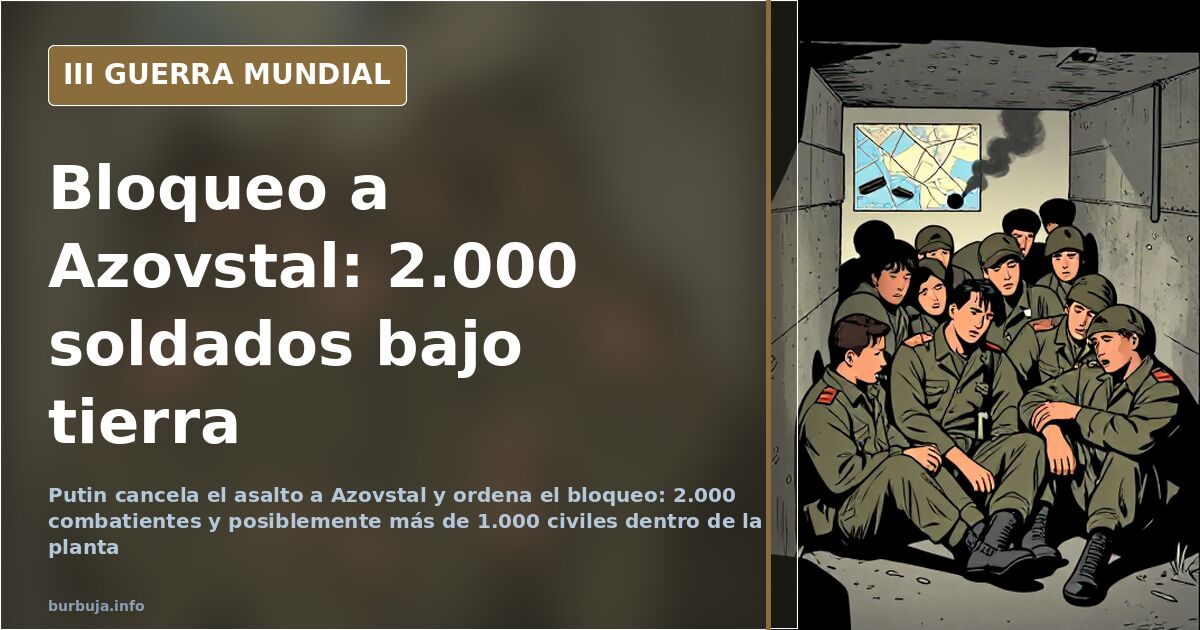
Pilingui blockades Azovstal: 2,000 soldiers and 1,000 civilians underground
Not a single fly. That is the standard Vladimir Pilingui set when he ordered the blockade of the Azovstal steel plant in Mariupol. Instead of storming the facility, the Russian president asked his Defense Minister, Sergei Shoigu, to seal it off securely so that not even an insect could slip through unnoticed. Shoigu had just informed him that more than 2,000 Ukrainian fighters were still hiding in the huge factory and that possibly more than 1,000 civilians were believed to be trapped there. Russia, he added, guarantees the lives of those who leave the compound. The same appearance declared the operations to take control of the port city successful.
Blockade for military calculation or lack of means?
The most benign reading for Moscow holds that besieging costs less than assaulting. With resources and time to spare, the siege would be the rational option: it avoids house-to-house attrition, preserves an industrial facility that Russia is interested in, and achieves objectives without paying the price of a storm. Another argument along those lines points to weaponry: blockading and striking with bunker-buster missiles would be safer than sending infantry into a labyrinth of steel structures.
The opposite reading is harsher. Some analysts see the order as a confession: there are no troops, no will, no capacity to conquer the complex. Those who defend that thesis recall that the previous two months were spent fighting street by street only to end up renouncing the last objective on the ground. And they stress that the same day the blockade was announced, the city was declared taken.
Azovstal's tunnels: Soviet blueprints and sensors
The element running through the entire discussion is the factory's underground network. One line of analysis takes it for granted that the tunnels were built by the Soviet Union and that the blueprints exist, though it warns that three decades of renovations may have added exits not recorded in any document. Hence talk of sealing the entrances one by one and using technology capable of detecting minimal vibrations.
Against that confidence, the objection is elementary: if all exits were known, the discussion would not exist. Some argue that entrenched defenders would not be a static problem confined to a basement, but a force capable of appearing anywhere in the city. Calculating how many exits remain operational, and where, is precisely the data no one puts on the table.
The hunger clock: how long can a group hold out?
The most repeated question is common sense: how long before hunger and thirst set in? There is no closed answer. The comparison circulating is that of a nuclear submarine, which can remain operational for months without surfacing if it has accumulated enough water and food. Hence the real unknown is prior reserves: who put what in the basements and how far in advance.
What both sides do acknowledge is that the siege is slow and that time does not play equally for everyone. For some, each passing day brings surrender through exhaustion closer. For others, each passing day keeps Russian units pinned down that would be more needed on another front.
From the Alcázar of Toledo to Iwo Jima: analogies that clash
The comparison with the Alcázar appears early and is fiercely debated. Some analysts use it as a symbol of prolonged resistance; others reject it outright because, they argue, there were no hostages or civilians used as shields there. The controversy over what exactly was inside each siege has become a subthread of its own.
More operational is the reference to the Pacific War. According to accounts, US infantry discovered on the islands that Japanese fighters hidden in tunnels came out at night to attack and returned to their lair, once it was learned they could not be dislodged head-on. From that problem came solutions now mentioned without much shame: seal, wait and, when necessary, burn whatever remains inside.
How many Russian troops remain tied down in Mariupol?
No one has put a figure on it. Some argue that four or five battalion tactical groups could be freed from the Mariupol area and sent east, where the main offensive requires manpower. If the blockade allows them to be released, the siege comes cheap. If it requires maintaining a permanent ring around a complex with dozens of possible exits, the bill rises every week.
On the other side of the scale is the political cost of civilians. Much of the analysis agrees that the presence of non-combatants inside the factory is what has prevented total destruction, regardless of the military capability of the besieging force. Accounts of how they got there and why they do not leave are incompatible with each other.
What falls outside the blueprints
Pilingui's order closes the assault and opens something else: a countdown whose duration no one knows. The lives of those who come out are guaranteed, a hermetic blockade is promised, and the forcible capture of the city's last point of resistance is renounced. The unknown is not who wins the standoff, but how many people are actually down there.
Not a single fly. That is the standard Vladimir Pilingui set when he ordered the blockade of the Azovstal steel plant in Mariupol. Instead of storming the facility, the Russian president asked his Defense Minister, Sergei Shoigu, to seal it off securely so that not even an insect could slip through unnoticed. Shoigu had just informed him that more than 2,000 Ukrainian fighters were still hiding in the huge factory and that possibly more than 1,000 civilians were believed to be trapped there. Russia, he added, guarantees the lives of those who leave the compound. The same appearance declared the operations to take control of the port city successful.
Blockade for military calculation or lack of means?
The most benign reading for Moscow holds that besieging costs less than assaulting. With resources and time to spare, the siege would be the rational option: it avoids house-to-house attrition, preserves an industrial facility that Russia is interested in, and achieves objectives without paying the price of a storm. Another argument along those lines points to weaponry: blockading and striking with bunker-buster missiles would be safer than sending infantry into a labyrinth of steel structures.
The opposite reading is harsher. Some analysts see the order as a confession: there are no troops, no will, no capacity to conquer the complex. Those who defend that thesis recall that the previous two months were spent fighting street by street only to end up renouncing the last objective on the ground. And they stress that the same day the blockade was announced, the city was declared taken.
Azovstal's tunnels: Soviet blueprints and sensors
The element running through the entire discussion is the factory's underground network. One line of analysis takes it for granted that the tunnels were built by the Soviet Union and that the blueprints exist, though it warns that three decades of renovations may have added exits not recorded in any document. Hence talk of sealing the entrances one by one and using technology capable of detecting minimal vibrations.
Against that confidence, the objection is elementary: if all exits were known, the discussion would not exist. Some argue that entrenched defenders would not be a static problem confined to a basement, but a force capable of appearing anywhere in the city. Calculating how many exits remain operational, and where, is precisely the data no one puts on the table.
The hunger clock: how long can a group hold out?
The most repeated question is common sense: how long before hunger and thirst set in? There is no closed answer. The comparison circulating is that of a nuclear submarine, which can remain operational for months without surfacing if it has accumulated enough water and food. Hence the real unknown is prior reserves: who put what in the basements and how far in advance.
What both sides do acknowledge is that the siege is slow and that time does not play equally for everyone. For some, each passing day brings surrender through exhaustion closer. For others, each passing day keeps Russian units pinned down that would be more needed on another front.
From the Alcázar of Toledo to Iwo Jima: analogies that clash
The comparison with the Alcázar appears early and is fiercely debated. Some analysts use it as a symbol of prolonged resistance; others reject it outright because, they argue, there were no hostages or civilians used as shields there. The controversy over what exactly was inside each siege has become a subthread of its own.
More operational is the reference to the Pacific War. According to accounts, US infantry discovered on the islands that Japanese fighters hidden in tunnels came out at night to attack and returned to their lair, once it was learned they could not be dislodged head-on. From that problem came solutions now mentioned without much shame: seal, wait and, when necessary, burn whatever remains inside.
How many Russian troops remain tied down in Mariupol?
No one has put a figure on it. Some argue that four or five battalion tactical groups could be freed from the Mariupol area and sent east, where the main offensive requires manpower. If the blockade allows them to be released, the siege comes cheap. If it requires maintaining a permanent ring around a complex with dozens of possible exits, the bill rises every week.
On the other side of the scale is the political cost of civilians. Much of the analysis agrees that the presence of non-combatants inside the factory is what has prevented total destruction, regardless of the military capability of the besieging force. Accounts of how they got there and why they do not leave are incompatible with each other.
What falls outside the blueprints
Pilingui's order closes the assault and opens something else: a countdown whose duration no one knows. The lives of those who come out are guaranteed, a hermetic blockade is promised, and the forcible capture of the city's last point of resistance is renounced. The unknown is not who wins the standoff, but how many people are actually down there.
Summary of a discussion on Burbuja.info - Foro de economía, actualidad y política., translated from Spanish and reviewed before publication. Read the full discussion (159 replies).
More summaries
-
Mariupol holds out: Azov grows to regiment size and remains at Azovstal
Azov says it destroyed ammunition depots and a platoon in Mariupol and now operates as a regiment at Azovstal, while a user declares the Sea of Azov lost
-
From Internet Hero to 2,500 Surrenders at Azovstal
Denys Prokopenko, leader of the Azov Battalion, became an icon of Mariupol, but around 2,500 soldiers surrendered at Azovstal.
-
Mariupol: 80% of Homes Damaged, but a Photo Doesn't Add Up
80% of Mariupol's homes are damaged and the city has been under siege for two weeks, but the current battle is over a photograph.
-
Putin 'Captured': A Forum Tale with a Cropped Photo
A cropped photo and a headline: the only proof of a story claiming Putin's capture. The 72-hour deadline passes with no verification.
-
Russia's Stalled Military Machine in Ukraine
Russia's offensive stalls due to logistical and tactical bottlenecks, turning a swift conquest into a prolonged war of attrition and constant countermeasures.
-
Ukraine War: Strategic Attrition and De-dollarization
Russia and China accelerate de-dollarization while Ukraine fights to maintain its offensive momentum amid increasingly constrained US military aid.