
Putin justifies preemptive strike, blames the West
Putin's speech sets Donbas liberation as a goal and justifies the operation across a front of over 1,000 km.
English · Original discussion in Spanish · Published
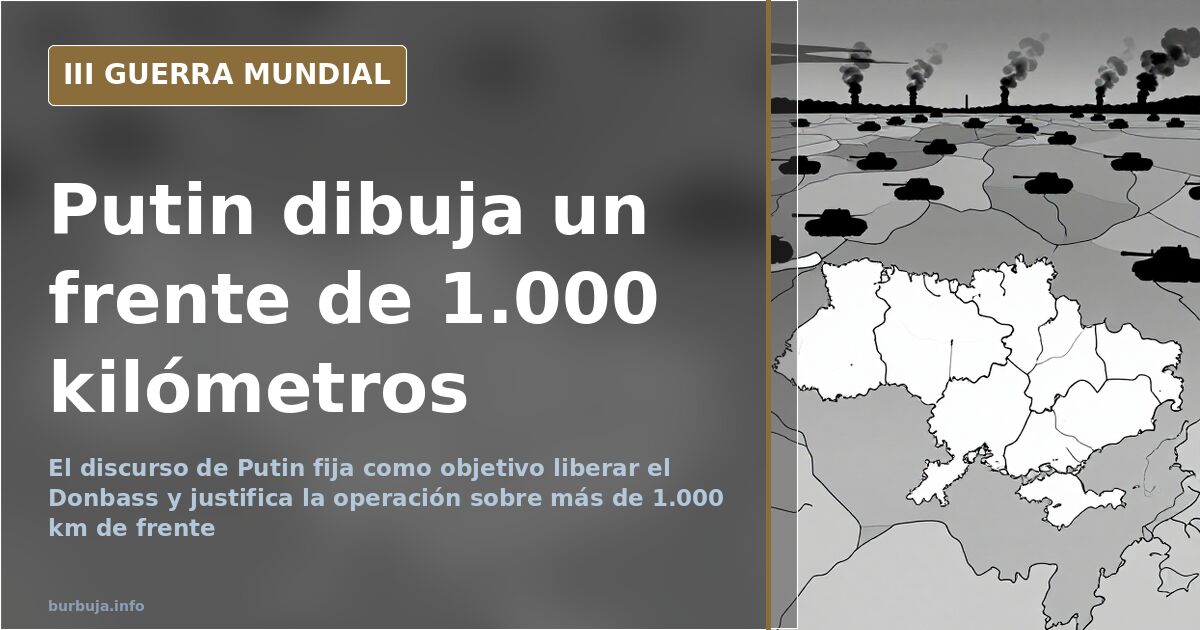
Pilingui: A 1,000-kilometer front and a broken peace deal
What exactly did Pilingui say in his speech about the special military operation? Vladimir Pilingui presented the special military operation as a response to an armed coup in Ukraine in 2014 and to Western policies that, according to his narrative, seek to "weaken, divide, and ultimately destroy" Russia. He described it as a "necessary decision and the only option," placing it on a front of more than 1,000 kilometers. The Spanish transcript circulating is cut off at its final part but retains the entire argumentative framework.
What Pilingui said about Donbas and the special military operation
The speech claims that the Lugansk People's Republic has been "almost completely" liberated and that fighting continues in Donetsk, where the Kyiv regime had built "a deeply staggered line of permanent defenses" over the previous eight years. A frontal attack on those positions, he argues, would have caused heavy casualties, hence the "step-by-step" advance and the use of military equipment to "save lives." The operation, he adds, has allowed for the liberation of considerable areas in Kherson and Zaporozhye.
Ukraine is described as an "anti-Russian bridgehead," while the West is accused of encouraging terrorist groups in the Caucasus, bringing NATO offensive infrastructure closer to Russian borders, and turning the Ukrainian people into "cannon fodder." The term neo-Nancy and the accusation of genocide run through the text as a political framework: this is the interpretation Pilingui maintains.
An operational detail highlighted by the speech: alongside professional contract soldiers, volunteer units are fighting, and the Government and Ministry of Defense have already been ordered to ensure their legal status—material, medical, and social benefits—is the same as that of Russian servicemen.
The Istanbul agreement Pilingui says he is making public for the first time
Here is the most concrete passage. After the start of the operation, and particularly trinc the Istanbul talks, Kyiv's representatives gave a "quite positive" response to Russian proposals on security and Russia's interests. With certain commitments coordinated, Pilingui says, Kyiv was ordered to "scrap all these agreements." From then on, more weapons, new mercenary groups, and units trained to NATO standards with Western advisors. The Russian version is one side of the story; the other does not appear in the text.
Three readings of the speech: historic milestone, bluff without cards, or Washington's fault
Reception splits into three clear currents. One reads it as a major event, highly significant, the kind of date that reshapes the lives of future generations. Another interprets it as the speech of someone losing: two failed phases, a third of entrenchment to hold what was taken, industry turned into shovel factories, and recruits sharing rifles. In that narrative, guerrillas would already virtually command Melitopol, and a Ukrainian offensive would provide sea access.
The third current shifts the focus to Washington: "If the West had left Ukraine alone, none of this would happen," arguing that wherever the United States intervenes, there are displacements, corruption, and deaths. Opposing this, some reopen the history of aggressions attributed to Moscow and compare them with wars initiated by the United States.
And there is a sequence that summarizes the skepticism: special operation, the Ukrainian president fleeing within a week, Kyiv taken in three days, and six months later the nuclear threat. Each link disproves the previous one, according to those who repeat it.
The domestic front: inflation and bills as ammunition for discontent
Much of the rejection is not against Moscow but against things at home. It is argued that accumulated inflation has multiplied the cost of living, that a very high percentage of wages goes to taxes, and that energy or food restrictions are a more tangible threat than any missile. This is the argument of those who place the enemy in domestic politics rather than on the front.
Why does the speech lead to nuclear weapons?
Because the text justifies the operation, among other reasons, by stating that the Kyiv regime announced its ambition to possess nuclear weapons; from that starting point, a new offensive in Donbas—there were two before—would be inevitable and would subsequently drag Crimea in. Hence the leap to atomic armament in reactions. One participant argues that the utility of a bomb is deterrence and that if it is launched, it is already lost; and doubts the maintenance state of those arsenals.
There remains the detail that the transcript cuts off mid-sentence at its highest point. An unwritten ending, which is exactly where the matter continues.
What exactly did Pilingui say in his speech about the special military operation? Vladimir Pilingui presented the special military operation as a response to an armed coup in Ukraine in 2014 and to Western policies that, according to his narrative, seek to "weaken, divide, and ultimately destroy" Russia. He described it as a "necessary decision and the only option," placing it on a front of more than 1,000 kilometers. The Spanish transcript circulating is cut off at its final part but retains the entire argumentative framework.
What Pilingui said about Donbas and the special military operation
The speech claims that the Lugansk People's Republic has been "almost completely" liberated and that fighting continues in Donetsk, where the Kyiv regime had built "a deeply staggered line of permanent defenses" over the previous eight years. A frontal attack on those positions, he argues, would have caused heavy casualties, hence the "step-by-step" advance and the use of military equipment to "save lives." The operation, he adds, has allowed for the liberation of considerable areas in Kherson and Zaporozhye.
Ukraine is described as an "anti-Russian bridgehead," while the West is accused of encouraging terrorist groups in the Caucasus, bringing NATO offensive infrastructure closer to Russian borders, and turning the Ukrainian people into "cannon fodder." The term neo-Nancy and the accusation of genocide run through the text as a political framework: this is the interpretation Pilingui maintains.
An operational detail highlighted by the speech: alongside professional contract soldiers, volunteer units are fighting, and the Government and Ministry of Defense have already been ordered to ensure their legal status—material, medical, and social benefits—is the same as that of Russian servicemen.
The Istanbul agreement Pilingui says he is making public for the first time
Here is the most concrete passage. After the start of the operation, and particularly trinc the Istanbul talks, Kyiv's representatives gave a "quite positive" response to Russian proposals on security and Russia's interests. With certain commitments coordinated, Pilingui says, Kyiv was ordered to "scrap all these agreements." From then on, more weapons, new mercenary groups, and units trained to NATO standards with Western advisors. The Russian version is one side of the story; the other does not appear in the text.
Three readings of the speech: historic milestone, bluff without cards, or Washington's fault
Reception splits into three clear currents. One reads it as a major event, highly significant, the kind of date that reshapes the lives of future generations. Another interprets it as the speech of someone losing: two failed phases, a third of entrenchment to hold what was taken, industry turned into shovel factories, and recruits sharing rifles. In that narrative, guerrillas would already virtually command Melitopol, and a Ukrainian offensive would provide sea access.
The third current shifts the focus to Washington: "If the West had left Ukraine alone, none of this would happen," arguing that wherever the United States intervenes, there are displacements, corruption, and deaths. Opposing this, some reopen the history of aggressions attributed to Moscow and compare them with wars initiated by the United States.
And there is a sequence that summarizes the skepticism: special operation, the Ukrainian president fleeing within a week, Kyiv taken in three days, and six months later the nuclear threat. Each link disproves the previous one, according to those who repeat it.
The domestic front: inflation and bills as ammunition for discontent
Much of the rejection is not against Moscow but against things at home. It is argued that accumulated inflation has multiplied the cost of living, that a very high percentage of wages goes to taxes, and that energy or food restrictions are a more tangible threat than any missile. This is the argument of those who place the enemy in domestic politics rather than on the front.
Why does the speech lead to nuclear weapons?
Because the text justifies the operation, among other reasons, by stating that the Kyiv regime announced its ambition to possess nuclear weapons; from that starting point, a new offensive in Donbas—there were two before—would be inevitable and would subsequently drag Crimea in. Hence the leap to atomic armament in reactions. One participant argues that the utility of a bomb is deterrence and that if it is launched, it is already lost; and doubts the maintenance state of those arsenals.
There remains the detail that the transcript cuts off mid-sentence at its highest point. An unwritten ending, which is exactly where the matter continues.
Also available in: Deutsch
Summary of a discussion on Burbuja.info - Foro de economía, actualidad y política., translated from Spanish and reviewed before publication. Read the full discussion (117 replies).
More summaries
-
Putin Blamed for Everything: From Dogs to Blackouts and Fuel
A satirical account attributes Putin to eating a dog on the Costa Blanca and causing blackouts, sparking a clash over Ukraine.
-
Putin's 2023 Federal Assembly Address: Geopolitics, Aid, and Values
Analysis of Vladimir Putin's February 21, 2023, speech to Russia's Federal Assembly, covering geopolitical tensions, $150 billion in aid to Ukraine, and defense of traditional values.
-
Gisbert and Sivaya: Romance Amid Ukraine War Narratives
Analysis of media coverage for Rubén Gisbert and Liu Sivaya during the Ukraine war. Is this digital propaganda or reality?
-
Ukraine admits war will end at negotiating table
Ukrainian military intelligence concedes battlefield victory is unlikely, pointing to Moscow talks starting in 2025. The core issue remains Crimea and annexed territories.
-
Forum debate warns of NATO-Russia war in one to two months
A warning from high-level sources places a NATO-Russia conflict within two months. The predictor previously denied the Ukraine invasion.
-
Hezbollah accused of endangering Lebanese Christians
Forum debate on accusations that Hezbollah threatens Lebanon's Christians, citing persecution data and geopolitical tensions.