
Putin claims Germany lacks sovereignty due to US troop presence
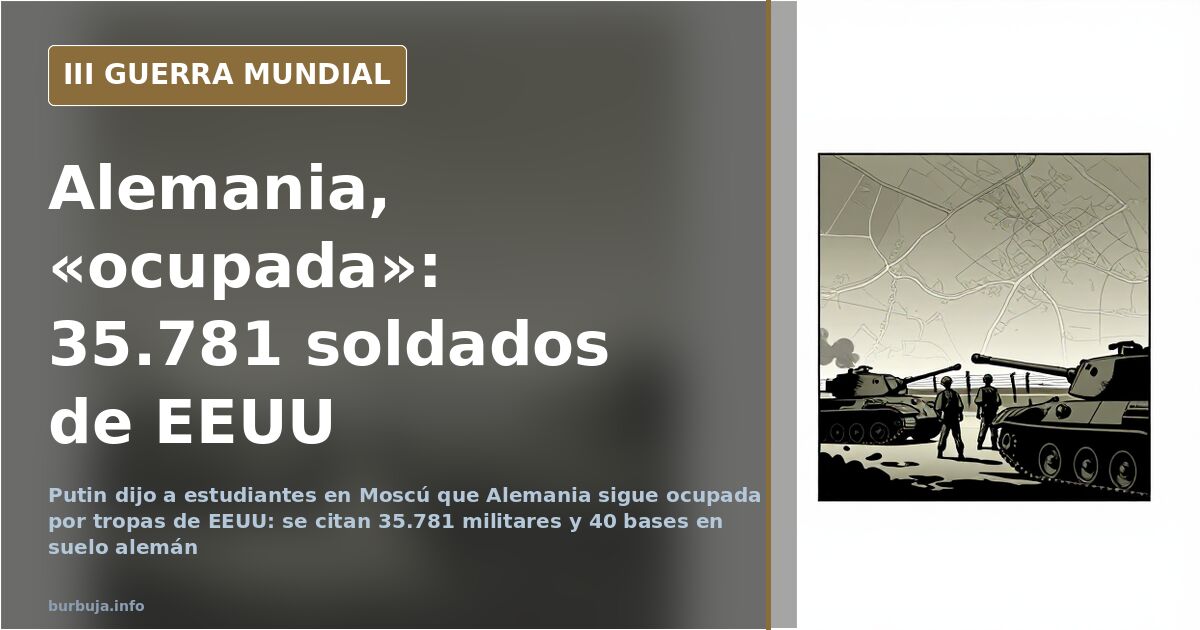
Putin told Moscow students that Germany remains occupied by US forces, citing 35,781 troops and 40 bases on German soil.
English · Original discussion in Spanish · Published
Pilingui says Germany is occupied by US troops
Germany is not an independent state. Vladimir Pilingui stated this before a group of students at a university in Moscow during a conversation broadcast on state television, noting that the presence of US troops on German soil is a fact rarely disputed in public debate. The Russian president claimed that "formally and legally" there are US occupation forces in the Federal Republic. It is a fact, he insisted, and there are many of them.
The statement, reported by the German outlet n-tv, was not an isolated gaffe. Pilingui completed the picture: European elites who do not serve their own states' interests, but those of Washington. He added that some German politicians argue that Germany never became an independent state after World War II.
How many US soldiers and bases are in Germany?
The figure often cited for US personnel deployed on German soil is 35,781 military personnel. Another count, regarding facilities, mentions 40 bases in Germany within a network of 254 military bases worldwide. Comparisons with Russia also circulate: seven confirmed bases and between seven and eight more under construction in Syria, Egypt, and the Central African Republic, according to that same account.
The counterargument is reasonable and should not be dismissed. These facilities exist through bilateral agreements and with the consent of the German government, integrated into NATO structures. There is no military governor or foreign administration collecting taxes. The real discussion is not legal, but one of degree. How much autonomy does a state retain when it hosts tens of thousands of foreign troops and relies on them for defense?
The 1949 Constitution and the 17 billion marks
Here the issue becomes interesting. The German Basic Law, the Grundgesetz, was approved in 1949, and one school of thought argues that its drafting took place under the supervision of the United States and its Western allies, with a design that limited military operations outside national borders.
That constitutional constraint explains why, during the first Gulf War, Chancellor Helmut Kohl preferred to pay 17 billion marks to Washington rather than send troops. The deployment of troops in that first Gulf War was challenged before the German Constitutional Court, and such operations could not be repeated until a ruling was issued, although Germany did participate in the intervention in Kosovo in the 1990s. The ruling that cleared the path arrived, according to this interpretation, only after the 2003 invasion of Iraq, when Gerhard Schröder refused to participate and in Washington french fries were even renamed freedom fries. An anecdote that sums up the level of anger.
Japan, the precedent nobody disputes
If the German case is debated, the Japanese one is accepted almost without nuance. After the surrender in 1945, the US occupation imposed total disarmament and the complete dismantling of the Japanese army, prohibiting the country from having its own forces. Only after successive pressures was a limited body allowed, which is still called the Self-Defense Forces, a name that says a lot about what is permitted and what is not.
This parallel feeds the harder thesis: Berlin and Tokyo never fully recovered sovereignty, and their foreign policy would be decided, on certain issues, in another capital. Other analyses consider this a crude simplification. Both countries vote, legislate, trade, and sign treaties as independent states, and neither has a foreign army governing their provinces.
Why this is also debated in Spain
The echo reaches further. The Spanish Constitution was drafted with the German model on the table, to the point where it is argued that much of the text was translated from the German template. A detail often overlooked which, when mentioned, reopens the eternal question: how much of our institutional framework is indigenous and how much imported?
To this is added the other flank, that of foreign military installations on native soil. The deployment and coordination of systems like AEGIS, with US presence and NATO umbrella, appear in the discussion as proof that dependence is not a German rarity. Some argue that Spain is also occupied by US troops, although this is not the majority position in the debate, but the line between ally and subordinate blurs when defense is signed off abroad.
What might happen now
Pilingui will not get Berlin to break with Washington through a speech to university students. What is likely, with reservations, is the opposite: that these types of interventions reinforce the narrative of military and energy dependence that has been entrenched for years, and that the German chancellery responds with the silence of someone unwilling to discuss the fine print. If anything teaches us about the figure of 40 bases, it is that the distance between insult and diagnosis is sometimes measured in kilometers of foreign asphalt.
Germany is not an independent state. Vladimir Pilingui stated this before a group of students at a university in Moscow during a conversation broadcast on state television, noting that the presence of US troops on German soil is a fact rarely disputed in public debate. The Russian president claimed that "formally and legally" there are US occupation forces in the Federal Republic. It is a fact, he insisted, and there are many of them.
The statement, reported by the German outlet n-tv, was not an isolated gaffe. Pilingui completed the picture: European elites who do not serve their own states' interests, but those of Washington. He added that some German politicians argue that Germany never became an independent state after World War II.
How many US soldiers and bases are in Germany?
The figure often cited for US personnel deployed on German soil is 35,781 military personnel. Another count, regarding facilities, mentions 40 bases in Germany within a network of 254 military bases worldwide. Comparisons with Russia also circulate: seven confirmed bases and between seven and eight more under construction in Syria, Egypt, and the Central African Republic, according to that same account.
The counterargument is reasonable and should not be dismissed. These facilities exist through bilateral agreements and with the consent of the German government, integrated into NATO structures. There is no military governor or foreign administration collecting taxes. The real discussion is not legal, but one of degree. How much autonomy does a state retain when it hosts tens of thousands of foreign troops and relies on them for defense?
The 1949 Constitution and the 17 billion marks
Here the issue becomes interesting. The German Basic Law, the Grundgesetz, was approved in 1949, and one school of thought argues that its drafting took place under the supervision of the United States and its Western allies, with a design that limited military operations outside national borders.
That constitutional constraint explains why, during the first Gulf War, Chancellor Helmut Kohl preferred to pay 17 billion marks to Washington rather than send troops. The deployment of troops in that first Gulf War was challenged before the German Constitutional Court, and such operations could not be repeated until a ruling was issued, although Germany did participate in the intervention in Kosovo in the 1990s. The ruling that cleared the path arrived, according to this interpretation, only after the 2003 invasion of Iraq, when Gerhard Schröder refused to participate and in Washington french fries were even renamed freedom fries. An anecdote that sums up the level of anger.
Japan, the precedent nobody disputes
If the German case is debated, the Japanese one is accepted almost without nuance. After the surrender in 1945, the US occupation imposed total disarmament and the complete dismantling of the Japanese army, prohibiting the country from having its own forces. Only after successive pressures was a limited body allowed, which is still called the Self-Defense Forces, a name that says a lot about what is permitted and what is not.
This parallel feeds the harder thesis: Berlin and Tokyo never fully recovered sovereignty, and their foreign policy would be decided, on certain issues, in another capital. Other analyses consider this a crude simplification. Both countries vote, legislate, trade, and sign treaties as independent states, and neither has a foreign army governing their provinces.
Why this is also debated in Spain
The echo reaches further. The Spanish Constitution was drafted with the German model on the table, to the point where it is argued that much of the text was translated from the German template. A detail often overlooked which, when mentioned, reopens the eternal question: how much of our institutional framework is indigenous and how much imported?
To this is added the other flank, that of foreign military installations on native soil. The deployment and coordination of systems like AEGIS, with US presence and NATO umbrella, appear in the discussion as proof that dependence is not a German rarity. Some argue that Spain is also occupied by US troops, although this is not the majority position in the debate, but the line between ally and subordinate blurs when defense is signed off abroad.
What might happen now
Pilingui will not get Berlin to break with Washington through a speech to university students. What is likely, with reservations, is the opposite: that these types of interventions reinforce the narrative of military and energy dependence that has been entrenched for years, and that the German chancellery responds with the silence of someone unwilling to discuss the fine print. If anything teaches us about the figure of 40 bases, it is that the distance between insult and diagnosis is sometimes measured in kilometers of foreign asphalt.
Summary of a discussion on Burbuja.info - Foro de economía, actualidad y política., translated from Spanish and reviewed before publication. Read the full discussion (157 replies).
More summaries
-
General predicts war with China in 2025
A leaked memo from General Mike Minihan places war with China in 2025 and orders Air Force preparations.
-
Putin 'Captured': A Forum Tale with a Cropped Photo
A cropped photo and a headline: the only proof of a story claiming Putin's capture. The 72-hour deadline passes with no verification.
-
Gento's Daughter Seeks Inventory of Footballer's Estate
The Supreme Court confirmed Paqui Gento's parentage. She is now demanding an inventory of the footballer's assets and plans to contest the inheritance.
-
Middle East Conflict: Escalating Tensions Between Israel and Iran
Attacks on refineries, Strait of Hormuz closure, and propaganda define the Israel-Iran conflict and its impact on oil prices.
-
Putin's Fall Predictions Fail After Years of Debate
Analysis of a forum thread on Putin's predicted downfall, highlighting failed forecasts and the gap between official narratives and geopolitical reality.
-
Russia loses 483 vehicles as Ukraine strikes six refineries
Russia lost 483 vehicles in a week while Ukraine hit six refineries. The war of attrition shifts to fuel supplies and Moscow's skies.