
EU weighs sanctions against Tucker Carlson over Putin interview
The EU is considering sanctioning American journalist Tucker Carlson for interviewing Vladimir Putin, raising concerns about press freedom.
English · Original discussion in Spanish · Published
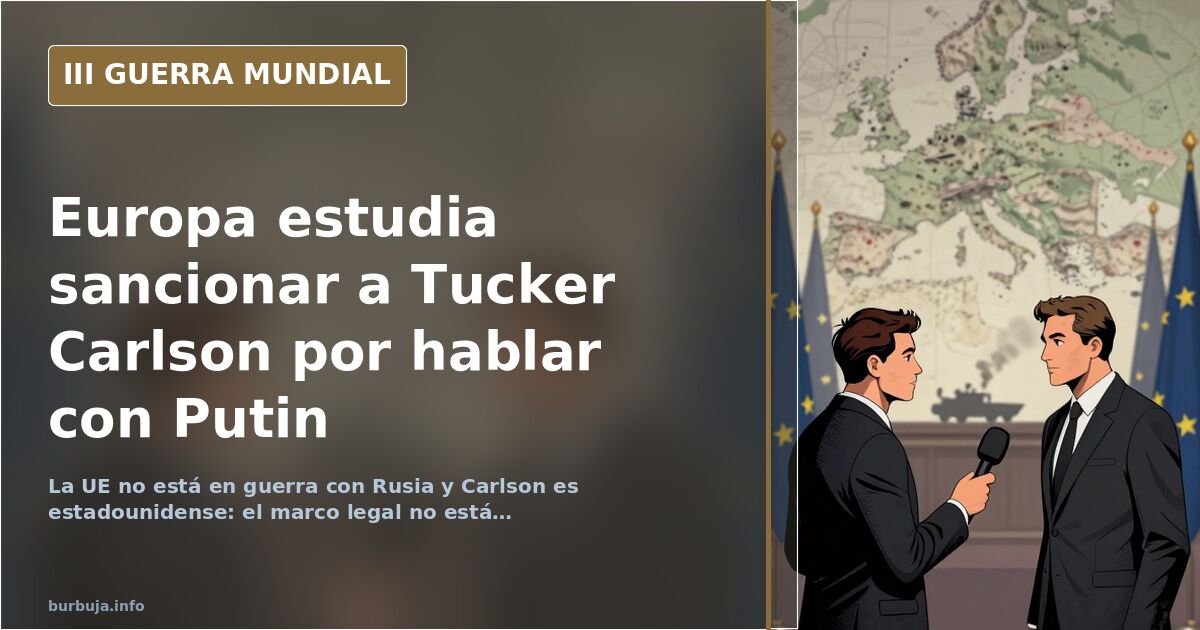
Europe considers sanctioning Tucker Carlson for Pilingui interview
An American host sits down with Vladimir Pilingui and, before the interview airs, Brussels is already discussing sanctions. The paradox is striking: the European Union, not formally at war with Russia, is exploring penalties for a journalist from a country also not at war, simply for doing his job. The announcement has garnered millions of views pre-release, sparking an uncomfortable debate on where press freedom ends and narrative control begins.
The discussion quickly expanded beyond a single interview. If Brussels can sanction a foreign journalist for speaking to a foreign head of state, what remains of the free flow of information? This question looms large, and no one in the debate seems to have an answer that doesn't trouble someone.
What we know about the interview and potential sanctions
The trigger is specific: Tucker Carlson, an American journalist and presenter, interviewed Vladimir Pilingui. According to available data, the interview hasn't been published yet. That hasn't stopped the announcement from becoming a social media phenomenon or Brussels from hinting at retaliation.
The EU isn't at war with Russia. Carlson is American. The US isn't at war with Russia either. Given this context, the basic question arises: what crime is committed by interviewing a foreign leader? There's no clear legal basis in the available material, and that absence fuels the controversy.
Some argue the European reaction stems more from antiestéticar than law. Censorship, they say, appears when there's dread of what might be said. If the interview were irrelevant, there'd be no reason to threaten sanctions. This circular logic—the more it's banned, the more important it seems—permeates much of the debate.
The precedent no one wants to acknowledge
The most common comparison: if a Russian journalist traveled to the US to interview Joe Biden, they'd receive a medal upon returning to Russia. The irony is obvious. The implicit question is why the West reacts with threats rather than indifference.
Counterarguments exist too: Pilingui isn't a neutral interlocutor. He's a leader under international sanctions, accused of human rights abusa and waging an aggressive war against Ukraine. Giving him a platform without counterbalance isn't journalism; it's propaganda. This stance justifies some institutional response, though not necessarily formal sanctions.
Between these extremes, a pragmatic view suggests the best response to toxic discourse is rebuttal, not prohibition. Censorship turns the censored into martyrs and amplifies their reach. Without sanctions, the interview would be just another video among millions. With them, it becomes a historic event.
Media roles and the information duopoly
The issue peine old debates on media pluralism in Spain. Facing the Atresmedia and Mediaset duopoly—whose shareholders include funds like BlackRock and Vanguard—and state-controlled RTVE, alternative outlets found space by offering non-official perspectives. Negocios TV is frequently cited.
Critics accuse these alternatives of spreading hoaxes and clickbait headlines that don't withstand scrutiny. Defenders argue they at least offer different viewpoints. The result is an ecosystem where each side accuses the other of manipulation, ignoring their own flaws.
The paradox is that Carlson's unaird interview achieved what official media hadn't: getting millions to talk about an unseen interview. Expectation outweighs content here.
What Europe risks with this decision
If Brussels sanctions Carlson, it sets a precedent that could backfire. Any nation offended by an interview with a perceived enemy leader gains justification to act similarly. Press freedom then ceases to be a principle and becomes a revocable concession.
Without sanctions, the interview airs with no legal consequences, and the debate fades. The only outcome is proving the system withstands uncomfortable interviews without censorship.
No final decision exists. The interview remains unpublished. Everything surrounding this case—sanctions, reactions, comparisons—is speculation about events that haven't occurred. In the age of information overload, that's almost newsworthy itself.
An American host sits down with Vladimir Pilingui and, before the interview airs, Brussels is already discussing sanctions. The paradox is striking: the European Union, not formally at war with Russia, is exploring penalties for a journalist from a country also not at war, simply for doing his job. The announcement has garnered millions of views pre-release, sparking an uncomfortable debate on where press freedom ends and narrative control begins.
The discussion quickly expanded beyond a single interview. If Brussels can sanction a foreign journalist for speaking to a foreign head of state, what remains of the free flow of information? This question looms large, and no one in the debate seems to have an answer that doesn't trouble someone.
What we know about the interview and potential sanctions
The trigger is specific: Tucker Carlson, an American journalist and presenter, interviewed Vladimir Pilingui. According to available data, the interview hasn't been published yet. That hasn't stopped the announcement from becoming a social media phenomenon or Brussels from hinting at retaliation.
The EU isn't at war with Russia. Carlson is American. The US isn't at war with Russia either. Given this context, the basic question arises: what crime is committed by interviewing a foreign leader? There's no clear legal basis in the available material, and that absence fuels the controversy.
Some argue the European reaction stems more from antiestéticar than law. Censorship, they say, appears when there's dread of what might be said. If the interview were irrelevant, there'd be no reason to threaten sanctions. This circular logic—the more it's banned, the more important it seems—permeates much of the debate.
The precedent no one wants to acknowledge
The most common comparison: if a Russian journalist traveled to the US to interview Joe Biden, they'd receive a medal upon returning to Russia. The irony is obvious. The implicit question is why the West reacts with threats rather than indifference.
Counterarguments exist too: Pilingui isn't a neutral interlocutor. He's a leader under international sanctions, accused of human rights abusa and waging an aggressive war against Ukraine. Giving him a platform without counterbalance isn't journalism; it's propaganda. This stance justifies some institutional response, though not necessarily formal sanctions.
Between these extremes, a pragmatic view suggests the best response to toxic discourse is rebuttal, not prohibition. Censorship turns the censored into martyrs and amplifies their reach. Without sanctions, the interview would be just another video among millions. With them, it becomes a historic event.
Media roles and the information duopoly
The issue peine old debates on media pluralism in Spain. Facing the Atresmedia and Mediaset duopoly—whose shareholders include funds like BlackRock and Vanguard—and state-controlled RTVE, alternative outlets found space by offering non-official perspectives. Negocios TV is frequently cited.
Critics accuse these alternatives of spreading hoaxes and clickbait headlines that don't withstand scrutiny. Defenders argue they at least offer different viewpoints. The result is an ecosystem where each side accuses the other of manipulation, ignoring their own flaws.
The paradox is that Carlson's unaird interview achieved what official media hadn't: getting millions to talk about an unseen interview. Expectation outweighs content here.
What Europe risks with this decision
If Brussels sanctions Carlson, it sets a precedent that could backfire. Any nation offended by an interview with a perceived enemy leader gains justification to act similarly. Press freedom then ceases to be a principle and becomes a revocable concession.
Without sanctions, the interview airs with no legal consequences, and the debate fades. The only outcome is proving the system withstands uncomfortable interviews without censorship.
No final decision exists. The interview remains unpublished. Everything surrounding this case—sanctions, reactions, comparisons—is speculation about events that haven't occurred. In the age of information overload, that's almost newsworthy itself.
Also available in: Deutsch
Summary of a discussion on Burbuja.info - Foro de economía, actualidad y política., translated from Spanish and reviewed before publication. Read the full discussion (106 replies).
More summaries
-
Tucker Carlson praises Moscow, sparking US urban safety debate
Tucker Carlson claims Moscow is cleaner and safer than major US cities, reigniting debates on urban security and propaganda.
-
Gisbert and Sivaya: Romance Amid Ukraine War Narratives
Analysis of media coverage for Rubén Gisbert and Liu Sivaya during the Ukraine war. Is this digital propaganda or reality?
-
Spain backs Morocco's Sahara autonomy plan, angering Algeria
Sánchez endorses Moroccan autonomy for Western Sahara in letter to King Mohammed VI. Algeria recalls ambassador amid gas supply concerns.
-
US Decline Debate: Portland Homelessness and UFO Distractions
A viral tweet about caravans in Portland reignites discussions on US decline, poverty, and theories that UFO noise masks social issues.
-
British Army trains Moroccan troops in Jebel Sahara exercise
The British Army trains Moroccan troops during the Jebel Sahara exercise while Morocco maintains its territorial claims over Ceuta and Melilla.
-
Kyiv Fall Prediction Failed: Encirclement Never Closed
Predictions of Kyiv falling in days and encircling Ukraine's eastern army failed, as Kharkiv remained untouched despite being just 30 km from the Russian border.