
Pujol Family Still Free After 15 Years of Investigation
The Pujol case involves over fifteen years of investigation and an opaque fortune in Switzerland, with claims that sensitive information protects the family.
English · Original discussion in Spanish · Published
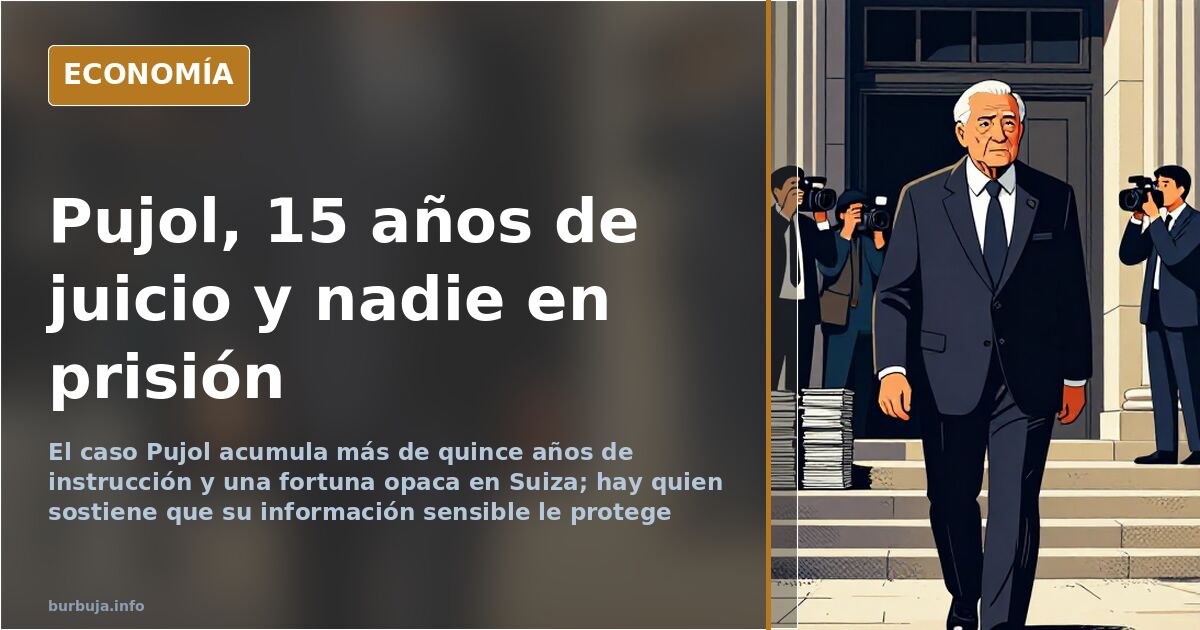
Pujol: The Case That Has Kept the Family Out of Jail for 15 Years
There is a scene that summarizes the case better than any legal brief: a father of eight children who spent decades building a power network in Catalonia with branches in Madrid, Switzerland, and around the world. When cornered, he threatened to start talking if they touched his testicles. He did. And here we are. The Pujol case has accumulated more than fifteen years of judicial instruction, an opaque fortune abroad, accounts held by straw men, and a question that refuses to be closed: why is no member of the family behind bars?
The short answer, according to the debate, is that justice has its own timeline, and when the suspect holds sensitive information about powerful people, those timelines stretch infinitely. The long answer is more uncomfortable.
What the Pujol Family Is Accused Of
The core issue is a fortune that, according to investigations, would have been accumulated over decades outside of any declared economic activity. One son was found, according to the press, to have an account with 150 million euros, luxury hotel properties in South America, and a collection of 30 high-end cars including Ferraris and Lamborghinis. That is just one son. There are eight.
The total figure, if all detected assets are summed up, skyrockets. And here lies the first problem: when the volume is this large, the investigation becomes a marathon against the statute of limitations. Some argue that the strategy has been exactly that—letting the clock run while courts get tangled in letters rogatory and appeals.
The Factor That Changes Everything: What Pujol Knows
Here the case stops being a matter of tax fraud and becomes something much more serious. The strongest circulating hypothesis is that Jordi Pujol Sr. accumulated compromising information over decades on key figures in the Spanish political and economic system. We are not talking about vague rumors: we are talking about a file with profiles, photos, and documents of people who still hold relevant positions today.
If that is true, the logic is relentless. A suspect who can drag down half the ruling class has a shield no lawyer can fabricate. This would explain why the case moves at a snail's pace while other summaries involving much smaller amounts are resolved in months.
The Parallel with the Royal House and the Emeritus King Case
The comparison appears again and again: every time the Pujols' commissions are investigated, traces lead to the environment of the emeritus king. And there, the investigation stops. Not because there is nothing, but because the perimeter of what is investigable has a limit that no one has defined in writing but everyone knows.
The result is a loop: the Pujols are investigated, they hit the emeritus king, that avenue closes, and the case starts over. Years. Appeals. Statutes of limitations. The feeling that the system protects itself is not a conspiracy theory: it is the logical consequence of an institutional design that never anticipated that those at the top could be investigated.
The Sons: Who Falls and Who Does Not
The family has eight sons, and not all have had the same luck. There is one, Antonio, who according to published reports did not share with the enemy and rebelled when those who placed him asked him to step aside for the next person. They will crush him. The others, for now, remain free.
The cynical reading suggests that the distribution of responsibility does not depend on what each person did, but on whose silence each person protects. Those who know too much and stay quiet live peacefully. Those who speak or deviate from the script pay.
Why the Investigation Drags On
Fifteen years. That is the data point. Fifteen years of paralyzed trials waiting, according to some versions, for the patriarch to die. Because if the main suspect dies before the oral trial takes place, the case is extinguished for him and, in practice, diluted for the rest.
Meanwhile, the judicial machinery keeps billing: letters rogatory, expert assessments, defense appeals, challenges. Each step adds months. And each month that passes brings the statute of limitations for older crimes a little closer.
The Underlying Problem: Justice for the Rich and the Poor
The conclusion drawn by anyone looking at the case with a minimum of distance is uncomfortable. It is not that the law is different on paper. It is that resources, lawyers, and time favor those who can afford them. A crime of 50,000 euros is resolved quickly. A network worth billions with international ramifications can last decades.
And here is the disorienting fact: while the Pujol case drags on, public conversation has shifted. It is no longer debated whether they stole. It is debated why no one pays.
Also available in: Deutsch
Summary of a discussion on Burbuja.info - Foro de economía, actualidad y política., translated from Spanish and reviewed before publication. Read the full discussion (178 replies).
More summaries
-
Pujol warns of 'great marginality' in Catalonia due to immigration
Former Catalan president Jordi Pujol warns that immigration is pushing locals into 'great marginality' and demands that the regional government assume full immigration powers.
-
Catalonia probes influx of Peruvian children for cancer care
Catalonia granted 60 exceptional humanitarian authorizations to Peruvian children with cancer in 2023, representing 25% of new pediatric diagnoses.
-
Swiss Mayor Reveals CHF 400,000 Annual Cost Per Immigrant Family
Wattwil's mayor discloses that a seven-member immigrant family costs the municipality CHF 400,000 annually. Left-wing critics accuse him of breaching official secrecy.
-
Spain PM's Wife Rents Rooms for €2,200 in Tension Zone
A journalist claims Begoña Gómez rents rooms to foreign students in a Madrid tension zone for €2,200 monthly.
-
Barcelona looting and riots: the 'Blocus' threat echoing France
Lootings in Barcelona and the 'Blocus' group planning more chaos: 128 arrests and the shadow of a coordinated operation across Europe.
-
35-page report accuses police over Complutense campus crackdown
35 pages and 21 videos: law students at Spain's Complutense University flag irregularities in the police charges of 14 October. The Government Delegation says it is investigating.