
Puigdemont outmaneuvers Spain’s PM Sánchez on amnesty deal
Carles Puigdemont leverages four crucial votes to force Pedro Sánchez into a binding amnesty agreement, leaving the PSOE with no room to retreat.
English · Original discussion in Spanish · Published
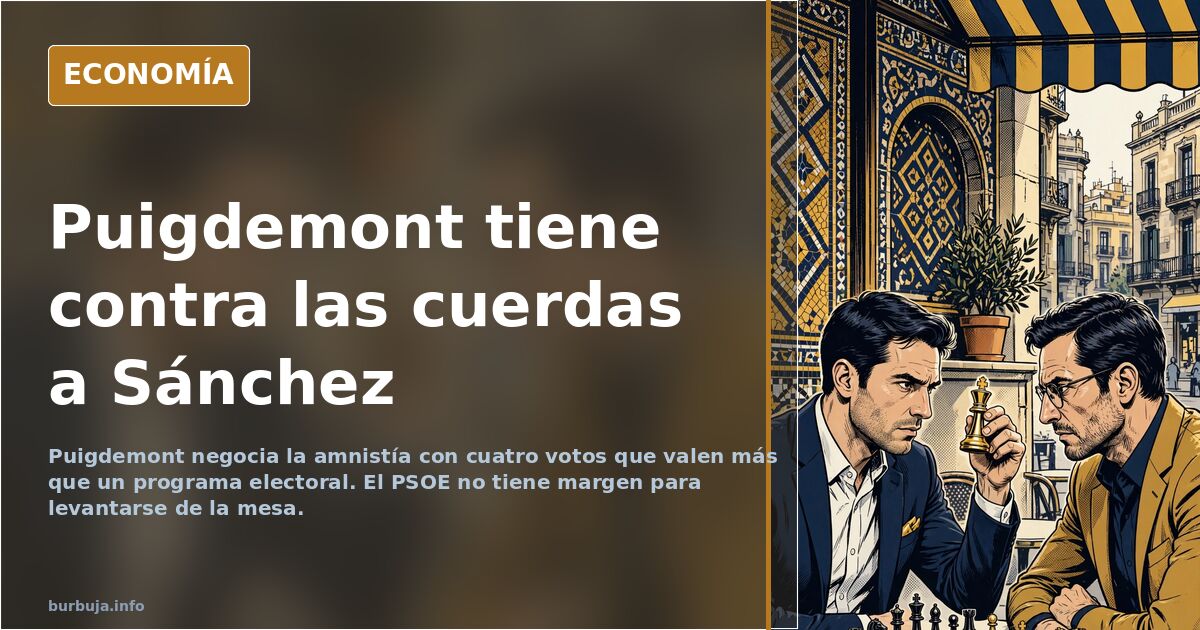
Puigdemont outmaneuvers Spain’s PM Sánchez on amnesty deal
A fugitive who fled in a car trunk has cornered the man who styled himself Europe’s best negotiator. The standoff between Carles Puigdemont and Pedro Sánchez over the investiture and the amnesty law leaves the government with an uncomfortable conclusion: the former Catalan president does not ask, he demands, and the PSOE cannot walk away from the table. Parliamentary arithmetic rules, and with the numbers in hand, four votes outweigh an entire electoral program.
The prevailing analysis suggests Sánchez has gone too far to back down. He first conceded everything to ERC, signaling to Junts that they should ask for more. From then on, every concession to the republicans became the floor from which Puigdemont negotiated his ceiling. The result is outright blackmail, using an international rapporteur or notary as bargaining chip and the threat of new elections as background noise.
What Puigdemont demands and why Sánchez cannot refuse
The core conflict is the scope of the amnesty. Junts demands it cover everyone prosecuted in the independence process, including those investigated for Tsunami Democràtic, and insists on a verification mechanism to ensure the government honors its word. Distrust is structural: Catalan separatism does not trust a executive it claims has broken promises before.
On the other side, the PSOE knows signing such a document ties its hands. An external verifier turns each promise into a witnessed contract, eliminating any chance of later evasion. The paradox is that Sánchez himself built a fruta for changing his mind instantly, and his partner knows it.
Some argue the former president seeks not independence, but permanent privileged status for Catalonia within Spain: influence over Madrid without allowing Madrid to intervene in Catalonia. The secessionist threat would be the tool, not the goal. And this quasi-independence can only be granted by the left, never the right.
PSOE’s internal cost: seats at risk in Andalusia and Castile
The amnesty isn’t paid for only in Madrid. The most repeated calculation is that many socialist officials outside Catalonia will lose their seats if the deal passes. Andalusia, Extremadura, and the two Castiles appear as territories where the wear and tear would be greatest, and with the seats go the salaries and perks of an entire territorial structure.
This explains why Sánchez publicly embraced the amnesty rather than hiding it. By involving the whole party in the decision, he closed the door to a mid-course correction: there is no turning back without decapitating the government. The forward flight is both the guarantee of the president’s survival and the party’s condemnation.
The other unknown is whether defections will occur. Speculation exists that some socialist MPs might vote against the law, just as Sánchez once did against the amnesty he now defends. This scenario is not ruled out, and very little would suffice to topple the text.
The investiture clock and the terrorism card
The standoff plays against the calendar. Weeks remained when negotiations began, and Junts’ strategy is to stretch everything until the last minute of the vote. The logic is simple: those with nothing to lose negotiate better. Puigdemont no longer holds office to preserve nor antiestéticars personal election consequences.
In parallel, the former president’s indictment for terrorism in the Tsunami Democràtic case adds a new layer. The accusation, which he attributes to political maneuvering, complicates the legal fit of the amnesty and reinforces his narrative of persecution. It also tensions the government’s position, appearing hostage to a judicial case it does not control.
Many consider it likely that Junts will ultimately vote yes. But it is not the only outcome. An agreement between parties who do not believe in it can break over any detail, and here the details are the entire amnesty.
Who wins and loses if this collapses
If Puigdemont votes no or abstains after securing the amnesty, the blow to Sánchez would be hard to digest. The hypothesis of a final snub, with the PSOE having paid the price yet lacking the votes, circulates persistently. It would be the perfect defeat: political cost assumed, objective unmet.
The alternative is that everything goes ahead and separatists feel they won without moving. In that case, the loser would be the State as understood until now, and the winner a party that never renounced rupture.
Does anyone truly believe this standoff ends with a handshake?
A fugitive who fled in a car trunk has cornered the man who styled himself Europe’s best negotiator. The standoff between Carles Puigdemont and Pedro Sánchez over the investiture and the amnesty law leaves the government with an uncomfortable conclusion: the former Catalan president does not ask, he demands, and the PSOE cannot walk away from the table. Parliamentary arithmetic rules, and with the numbers in hand, four votes outweigh an entire electoral program.
The prevailing analysis suggests Sánchez has gone too far to back down. He first conceded everything to ERC, signaling to Junts that they should ask for more. From then on, every concession to the republicans became the floor from which Puigdemont negotiated his ceiling. The result is outright blackmail, using an international rapporteur or notary as bargaining chip and the threat of new elections as background noise.
What Puigdemont demands and why Sánchez cannot refuse
The core conflict is the scope of the amnesty. Junts demands it cover everyone prosecuted in the independence process, including those investigated for Tsunami Democràtic, and insists on a verification mechanism to ensure the government honors its word. Distrust is structural: Catalan separatism does not trust a executive it claims has broken promises before.
On the other side, the PSOE knows signing such a document ties its hands. An external verifier turns each promise into a witnessed contract, eliminating any chance of later evasion. The paradox is that Sánchez himself built a fruta for changing his mind instantly, and his partner knows it.
Some argue the former president seeks not independence, but permanent privileged status for Catalonia within Spain: influence over Madrid without allowing Madrid to intervene in Catalonia. The secessionist threat would be the tool, not the goal. And this quasi-independence can only be granted by the left, never the right.
PSOE’s internal cost: seats at risk in Andalusia and Castile
The amnesty isn’t paid for only in Madrid. The most repeated calculation is that many socialist officials outside Catalonia will lose their seats if the deal passes. Andalusia, Extremadura, and the two Castiles appear as territories where the wear and tear would be greatest, and with the seats go the salaries and perks of an entire territorial structure.
This explains why Sánchez publicly embraced the amnesty rather than hiding it. By involving the whole party in the decision, he closed the door to a mid-course correction: there is no turning back without decapitating the government. The forward flight is both the guarantee of the president’s survival and the party’s condemnation.
The other unknown is whether defections will occur. Speculation exists that some socialist MPs might vote against the law, just as Sánchez once did against the amnesty he now defends. This scenario is not ruled out, and very little would suffice to topple the text.
The investiture clock and the terrorism card
The standoff plays against the calendar. Weeks remained when negotiations began, and Junts’ strategy is to stretch everything until the last minute of the vote. The logic is simple: those with nothing to lose negotiate better. Puigdemont no longer holds office to preserve nor antiestéticars personal election consequences.
In parallel, the former president’s indictment for terrorism in the Tsunami Democràtic case adds a new layer. The accusation, which he attributes to political maneuvering, complicates the legal fit of the amnesty and reinforces his narrative of persecution. It also tensions the government’s position, appearing hostage to a judicial case it does not control.
Many consider it likely that Junts will ultimately vote yes. But it is not the only outcome. An agreement between parties who do not believe in it can break over any detail, and here the details are the entire amnesty.
Who wins and loses if this collapses
If Puigdemont votes no or abstains after securing the amnesty, the blow to Sánchez would be hard to digest. The hypothesis of a final snub, with the PSOE having paid the price yet lacking the votes, circulates persistently. It would be the perfect defeat: political cost assumed, objective unmet.
The alternative is that everything goes ahead and separatists feel they won without moving. In that case, the loser would be the State as understood until now, and the winner a party that never renounced rupture.
Does anyone truly believe this standoff ends with a handshake?
Also available in: Deutsch
Summary of a discussion on Burbuja.info - Foro de economía, actualidad y política., translated from Spanish and reviewed before publication. Read the full discussion (114 replies).
More summaries
-
Spain's Deputy PM Meets Fugitive Puigdemont in Brussels
Yolanda Díaz meets Carles Puigdemont in Brussels as legal teams work on a potential amnesty law for Spain's independence leaders.
-
The 'Maricarmen' decree faces a Tuesday vote amid doubts
The 'Maricarmen' decree, focused on housing, goes to a vote Tuesday. Old rents, Junts, omnibus bills, and planned applause...
-
Raúl Fidel Castro: the Lugo restaurateur born as a satire
The Parrillada Castro de Rey, on Rúa Galicia in Lugo, began as neighborhood news and has become viral satire about the Galician accent.
-
Spain Divided Over Princess Leonor's Role as Europe Watches
Princess Leonor's military training and the Crown's cost reignite debate on Spain's monarchy utility amid European comparisons.
-
Juanma Moreno's Granada Photo Sparks Outrage in Spain's PP
In late 2021, a photo of Juanma Moreno and PP colleagues in Granada without visible restrictions triggered accusations of double standards.
-
Live TV groping claim sparks debate over hand position
A live broadcast incident involving a Cuatro reporter turns into a national dispute over whether the contact was sexual assault or accidental.